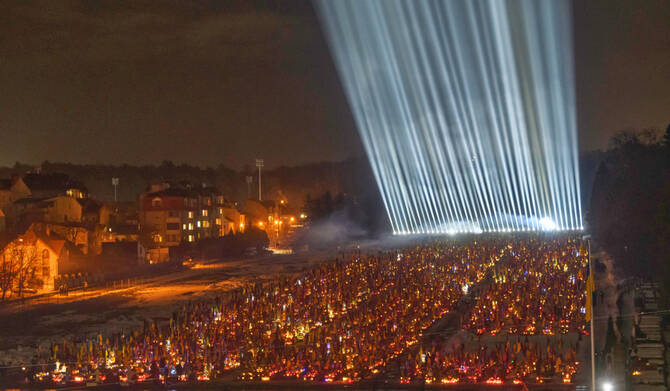

KYIV: President Volodymyr Zelensky declared Tuesday that Russia has not “broken Ukrainians” nor triumphed in its war, four years after an invasion that has severely tested the resolve of Kyiv and its allies and fueled European fears about the scale of Moscow’s ambitions.
In a show of support, more than a dozen senior European officials headed to the Ukrainian capital to mark the grim anniversary of the conflict, which has killed tens of thousands of people, upended life for millions of Ukrainians, and created instability far beyond its borders.
Zelensky said his country has withstood the onslaught by Russia’s bigger and better equipped army, which over the past year of fighting captured just 0.79 percent of Ukraine’s territory, according to the Institute for the Study of War, a Washington-based think tank. Russia now holds nearly 20 percent of Ukraine.
“Looking back at the beginning of the invasion and reflecting on today, we have every right to say: We have defended our independence, we have not lost our statehood,” Zelensky said on social media, adding that Russian President Vladimir Putin has “not achieved his goals.”
“He has not broken Ukrainians; he has not won this war,” Zelensky said.
Despite the show of defiance, Ukraine has struggled to hold off Russia’s onslaught, and the war has brought widespread hardship for Ukrainian civilians. Russia’s aerial attacks have devastated families and denied civilians power and running water.
As the war of attrition enters its fifth year, a US-led diplomatic push to end the largest conflict on the continent since World War II appears no closer to finding compromises that might make a peace deal possible.
Negotiations are stuck on what happens to the Donbas, eastern Ukraine’s industrial heartland that Russian forces mostly occupy but have failed to seize completely, and the terms of a postwar security arrangement that Kyiv is demanding to deter any future Russian invasion.
Zelensky urges Trump to visit
At a makeshift memorial in Kyiv’s central square, where thousands of small flags and portraits show photos of fallen soldiers, Zelensky said he would like US President Donald Trump to visit and witness for himself Ukrainian suffering.
“Only then can one truly understand what this war is really about,” Zelensky said.
Trump, who once vowed to end the war in a day, has repeatedly changed his tone toward Putin and Zelensky over the past year: sometimes criticizing the Ukrainian leader’s negotiating position while reaching out to the Russian leader and at others lashing out at Putin for heavy barrages and appearing more sympathetic to the Ukrainian predicament.
Kremlin spokesperson Dmitry Peskov said that the invasion would continue in pursuit of Moscow’s goals. They include a demand that Ukraine renounce its bid to join NATO, sharply cut its army, and cede vast swaths of territory.
Zelensky said he expected a fresh round of US-brokered talks with Russia within the next 10 days.
A ‘nightmare’ for Ukrainians
The number of soldiers killed, injured or missing on both sides could reach 2 million by spring, with Russia sustaining the largest number of troop deaths for any major power in any conflict since World War II, a report last month from the Center for Strategic and International Studies estimated.
European leaders see their countries’ own security at stake in Ukraine amid concerns that Putin may target them next.
German Chancellor Friedrich Merz wrote on X that “for four years, every day and every night has been a nightmare for the Ukrainians — and not just for them, but for us all. Because war is back in Europe.”
“We will only end it by being strong together, because the fate of Ukraine is our fate,” he added.
Putin’s dangerous gamble
Putin believes that time is on the side of his bigger army, Western officials and analysts say — and that Western support will trail off and that Ukraine’s military resistance will eventually crumble. Already Trump has ended new military aid to Ukraine — though other NATO countries now buy American weapons and give them to Kyiv.
But French President Emmanuel Macron described the war was “a triple failure for Russia: military, economic, and strategic.”
The war “has strengthened NATO — the very expansion Russia sought to prevent — galvanized Europeans it hoped to weaken, and laid bare the fragility of an imperialism from another age,” Macron said on X.
The European Union has also sent financial aid, but has sometimes met with reluctance from members Hungary and Slovakia.
While NATO countries have come to Ukraine’s aid, Russia has been helped by North Korea, which has sent thousands of troops and artillery shells; Iran, which has provided drone technology; and China, which the United States and analysts say has provided machine tools and chips.
A defining conflict
Among the European officials visiting Kyiv on Tuesday were the president of the European Council, Antonio Costa, President of the European Commission Ursula von der Leyen and Finnish President Alexander Stubb, as well as seven prime ministers and four foreign ministers.
The only American listed among the official guests in Kyiv ceremonies was Lt. Gen. Curtis Buzzard, a US officer who represents NATO in Ukraine.
British Armed Forces Minister Al Carns said Russia’s war on Ukraine was “the most defining conflict” in decades.
The war has brought a “revolution in military affairs,” especially through the rapid development of drone technology by both sides, according to Carns. Drones now cause the vast majority of battlefield casualties, he said.
Both sides face challenges in finding enough troops and are increasingly turning to uncrewed aerial drones that take the killing to areas far from the front lines, the London-based International Institute for Strategic Studies said in its annual report on the global military situation.
“Given both sides’ reliance on external support for materiel, decisions taken in foreign capitals will play an important role in shaping the war’s trajectory,” the think tank added.
The United Kingdom on Tuesday announced a new package of military and humanitarian support for Ukraine, including sending teams of British military medics to instruct their Ukrainian counterparts.
The cost of rebuilding war-battered Ukraine would amount to almost $588 billion over the next decade, according to World Bank, the European Commission, the United Nations and the Ukrainian government.
That is nearly three times the estimated nominal GDP of Ukraine for last year, they said in a report Monday.