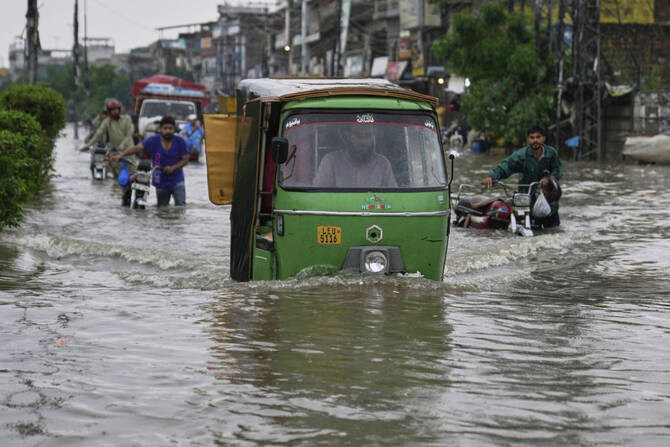
ISLAMABAD, Pakistan: Heavy rainfall that triggered floods in Pakistan in recent weeks, killing hundreds of people, was worsened by human-caused climate change, according to a new study.
The study by World Weather Attribution, a group of international scientists who study global warming’s role in extreme weather, found that rainfall from June 24 to July 23 in the South Asian nation was 10 percent to 15 percent heavier because of climate change, leading to many building collapses in urban and rural Pakistan.
Pakistan’s government has reported at least 300 deaths and 1,600 damaged houses due to the floods, heavy rain and other weather since June 26.
Saqib Hassan, a 50-year-old businessman in northern Pakistan, said flooding on July 22 destroyed his home and 18 of his relatives’ homes, along with their dairy farms. His farm animals were washed away, resulting in heavy losses — likely 100 million rupees ($360,000) — for him and his family.
Last-minute announcements from a nearby mosque were the only warning they got to evacuate their homes in the small town of Sarwarabad and get to higher ground.
“We are homeless now. Our houses have been destroyed. All the government has given us is food rations worth 50,000 rupees ($177) and seven tents, where we’ve been living for the past two weeks,” Hassan told The Associated Press over the phone.
Heavy rains cause series of disasters
High temperatures and intense precipitation worsened by global warming have accelerated the pace of recent extreme weather events faster than climate experts expected, said Islamabad-based climate scientist Jakob Steiner, who was not part of the WWA study.
“In the last few weeks, we have been scrambling to look at the number of events, not just in Pakistan, but in the South Asian region that have baffled us,” he said.
“Many events we projected to happen in 2050 have happened in 2025, as temperatures this summer, yet again, have been far above the average,” said Steiner, a geoscientist with the University of Graz, Austria, who studies water resources and associated risks in mountain regions.
Heavy monsoon rains have resulted in a series of disasters that have battered South Asia, especially the Himalayan mountains, which span across five countries, in the last few months.
Overflowing glacial lakes resulted in flooding that washed away a key bridge connecting Nepal and China, along with several hydropower dams in July. Earlier this week, a village in northern India was hit by floods and landslides, killing at least four people and leaving hundreds missing.
The authors of the WWA study, which was released early Thursday, said that the rainfall they analyzed in Pakistan shows that climate change is making floods more dangerous. Climate scientists have found that a warmer atmosphere holds more moisture, which can make rain more intense.
“Every tenth of a degree of warming will lead to heavier monsoon rainfall, highlighting why a rapid transition from fossil fuels to renewable energy is so urgent,” said Mariam Zachariah, a researcher at the Center for Environmental Policy, Imperial College London and lead author of the WWA study.
Extreme weather’s impact on Pakistan
Even though Pakistan is responsible for less than 1 percent of planet-heating gases in the atmosphere, research shows that it incurs an outsized amount of damage from extreme weather. Pakistan witnessed its most devastating monsoon season in 2022, with floods that killed more than 1,700 people and caused an estimated $40 billion in damage.
According to the United Nations, global funds set up to deal with loss and damages because of climate change or funds set up to adapt to climate change are falling well short of the amounts needed to help countries like Pakistan deal with climate impacts. The UN warns that its loss and damage fund only holds a fraction of what’s needed to address yearly economic damage related to human-caused climate change.
Similarly, UN reports state that developed countries such as the United States and European nations, which are responsible for the largest chunk of planet-heating gases in the atmosphere, are providing far less than what’s needed in adaptation financing.
These funds could help improve housing and infrastructure in areas vulnerable to flooding.
The WWA report says much of Pakistan’s fast-growing urban population lives in makeshift homes, often in flood-prone areas. The collapsing of homes was the leading cause of the 300 deaths cited in the report, responsible for more than half.
“Half of Pakistan’s urban population lives in fragile settlements where floods collapse homes and cost lives,” said Maja Vahlberg of the Red Cross Red Crescent Climate Center, who also helped author the WWA report, in a press statement. “Building flood-resilient houses and avoiding construction in flood zones will help reduce the impacts of heavy monsoon rain.”


Pakistan’s deadly monsoon floods were worsened by global warming, study finds


https://arab.news/cghqj
Pakistan’s deadly monsoon floods were worsened by global warming, study finds

- Pakistan’s government has reported at least 300 deaths and 1,600 damaged houses due to the floods, heavy rain and other weather since June 26
- Pakistan witnessed its most devastating monsoon season in 2022, with floods that killed more than 1,700 people



Russia says two crew members from US-seized tanker released
- “Two Russian sailors have been released and are on their way home to Russia,” Zakharova said
- Russia announced earlier this month that the US had decided to release the Russian duo
MOSCOW: Moscow said Wednesday two Russian crew members of a tanker seized this month by the United States in the Atlantic had been released and were on their way home.
US authorities took over the Russian-flagged vessel earlier this month, alleging it was part of a shadow fleet carrying oil from countries such as Venezuela, Russia and Iran in violation of US sanctions.
The United States said publicly that the Marinera’s crew could be prosecuted. Russia said that would be “categorically unacceptable” and accused Washington of stoking tensions and threatening international shipping.
“Two Russian sailors have been released and are on their way home to Russia,” foreign ministry spokeswoman Maria Zakharova told the state-run RIA Novosti news agency on Wednesday.
Russia announced earlier this month that the United States had decided to release the two Russian crew members, but last week its Foreign Minister Sergei Lavrov said the decision had not yet been implemented.
The captain and the first officer of the tanker have left UK waters, Solicitor General for Scotland, Ruth Charteris told a court hearing Tuesday, Press Association news agency reported.
“The captain and the first officer are now aboard the US Coast Guard vessel Munro and have departed the United Kingdom’s territorial sea,” Charteris said.
Twenty-six of the 28 crew have left the ship, officials told AFP. They were processed at a military site in Inverness, Scotland, the court was told, according to Press Association.
Five wanted to travel to the United States and 21 elsewhere. None have claimed asylum, the court heard.
“At the request of the US authorities, crew members have been allowed to disembark for onwards travel,” a UK government spokesperson told AFP Wednesday.
“They will be processed in line with all appropriate immigration and legal requirements.”
Britain was not involved in the movement of the other two crew members, the government said.
The United States seized the tanker, previously known as Bella 1, which was being escorted by the Russian navy, after chasing it from near the Venezuelan coast.
It was re-flagged and re-named to bring it under Russian jurisdiction in a bid to discourage the United States from trying to take it as part of its campaign against Venezuela.


