


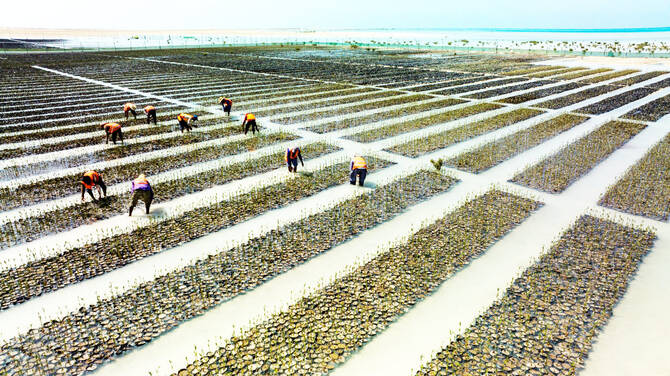

RIYADH: Saudi Arabia is scaling up efforts to protect and expand its mangrove forests — hailed as “nature’s super ecosystems” — as part of a push to restore coastal habitats, combat climate change, and diversify the Kingdom’s tourism economy.
As the world marks the UN-designated International Day for the Conservation of the Mangrove Ecosystem on July 26, new initiatives are building on earlier successes and harnessing cutting-edge technology, long-term planning, and private-sector collaboration.
“Mangrove forests are nature’s super ecosystems — capable of storing large amounts of carbon, preventing coastal erosion, supporting biodiversity, and mitigating floods,” said Raed Al-Basseet, group chief environment and sustainability officer at Red Sea Global.

Mangroves are salt-tolerant trees that grow in the intertidal zones of the Red Sea and Arabian Gulf. They stabilize coastlines, trap pollutants, act as carbon sinks, and provide vital breeding grounds for marine life.
Their dense roots protect against erosion and storm surges, while their branches shelter nesting birds, and marine species, such as shrimp, lay their eggs among their roots. Their leaves also serve as food for many other organisms.
Today, two species dominate Saudi Arabia’s mangrove zones: Rhizophora mucronata (Al-Qundil), found along the southern Red Sea coast, and Avicennia marina (Al-Qarm), which thrives on the Arabian Gulf and northern Red Sea shores.
DID YOU KNOW?
• International Day for the Conservation of the Mangrove Ecosystem is marked every year on July 26.
• Saudi Arabia aims to plant more than 100 million mangrove trees along its coastlines by the year 2030.
• Red Sea Global has cultivated more than 3 million seedlings as part of its environmental restoration strategy.
According to Saudipedia, Saudi Arabia is home to approximately 400 million mangrove trees, spread across 60 million square meters, with an average density of over 86,000 trees per hectare.
As part of the Saudi Green Initiative, launched in 2021 to support the Kingdom’s sustainability goals and its net-zero emissions target by 2060, authorities have committed to planting more than 100 million mangrove trees by 2030.

NCVC launched several initiatives to plant 13 million mangrove trees along the coasts of Jazan, Makkah, Tabuk, Madinah, Asir, and the Eastern Province. (NCVC photo)
That is a fraction of the SGI’s broader ambition to plant 10 billion trees across Saudi Arabia in the coming decades, but mangroves are a priority given their powerful role in carbon sequestration and biodiversity.
In 2023, a pilot mangrove restoration scheme began at Jeddah Islamic Port. Meanwhile, the National Center for Vegetation Cover Development and Combating Desertification is spearheading coastal planting projects in Jazan, Makkah, Tabuk, Madinah, Asir, and the Eastern Province, using nurseries and protective measures to ensure long-term survival.

NCVC announced this week the successful completion of three major projects for cultivating mangrove trees along the coasts of Tabuk, the Eastern Province, and Jazan. (SPA)
As of the 2021 mangrove conservation day, officials had already planted more than 14.6 million mangrove trees, in partnership with private and public sector entities.
“The cultivation and transplantation of mangrove trees is a highly technical process that demands detailed planning and precision,” said Al-Basseet. “We carefully monitor tidal cycles to identify suitable low-tide periods and avoid windy conditions during planting.”
Saudi Arabia’s mangrove reforestation programs are increasingly powered by geographic information systems, drones, and satellite imagery, helping experts pinpoint ideal sites based on factors like sediment composition, salinity, and tidal movement.
Opinion
This section contains relevant reference points, placed in (Opinion field)
To protect young trees, conservation teams install fencing and even deploy camera traps to deter animals, such as camels, from grazing on the saplings.
“Mangrove regeneration is integral to our broader environmental sustainability strategy,” said Tariq Al-Abassi, senior director of environmental programs at RSG. “By following a science-led approach, we ensure the long-term viability and regeneration of these ecosystems as a renewable natural asset.”
Mangroves are among the most carbon-dense forests on Earth, locking away CO2 in both biomass and soil. They also reduce ocean acidification by moderating localized pH levels, helping buffer marine life against the effects of climate change.
But their value is not only environmental. Mangroves support eco-tourism — such as kayaking, birdwatching, and nature tours — and provide ingredients used in cosmetics and dyes.

Mangrove trees provide shelter for many species. Birds nest in their branches, and marine species, such as shrimp, lay their eggs among the roots of the trees. (SPA)
Increasingly, they are a cornerstone of Saudi Arabia’s vision to develop eco-friendly marine parks and coastal attractions that align with its economic diversification goals under Vision 2030.
With rising global awareness around the importance of coastal ecosystems, Saudi Arabia’s mangrove strategy positions the Kingdom not only as a regional conservation leader but as a global one.
As Al-Basseet put it: “They are among our most efficient natural tools for climate resilience.”


