Over 200 Afghan PoR card holders return home as Pakistan sets September deportation deadline

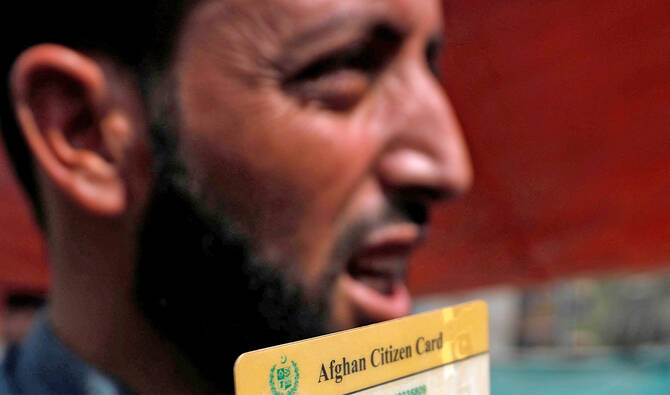
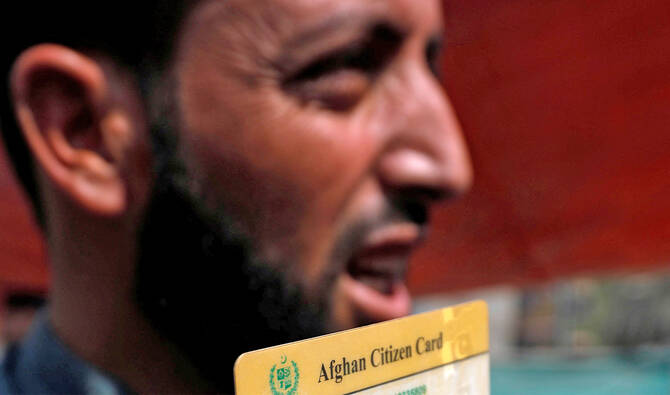
An Afghan national displays his Afghan Citizen Card, that was issued to him by the government of Pakistan, as he speaks to the members of the media while being detained and shift to a temporary holding centre, after Pakistan gave the last warning to undocumented migrants to leave, in Karachi, Pakistan, on November 2, 2023. (REUTERS)
Short Url
Updated 06 August 2025
Follow

Over 200 Afghan PoR card holders return home as Pakistan sets September deportation deadline

  • Proof of Registration cards granted legal refugee status to Afghans under UN-backed registration process
  • Pakistan began phased deportations in 2023 after deadly militant attacks, citing Afghan involvement

PESHAWAR: More than 200 Afghan refugees holding Proof of Registration (PoR) cards have returned to Afghanistan via Khyber Pakhtunkhwa province, authorities said on Tuesday, after Pakistan’s federal government renewed its call for Afghans to leave the country and set a September 1 deadline for deporting PoR cardholders.

The ongoing expulsion drive began in 2023, the same year Pakistan witnessed a surge in militant violence, including suicide attacks that officials linked, without offering direct evidence, to Afghan nationals.

Authorities initially targeted undocumented migrants, most of them Afghans, followed by those holding Afghan Citizen Cards (ACC). In June this year, Pakistan declined to renew PoR cards, rendering 1.4 million previously documented refugees illegal under national law.

PoR cards were issued by Pakistan to Afghans who were registered in collaboration with the Office of the United Nations High Commissioner for Refugees (UNHCR) and recognized the holder as a legal refugee in Pakistan. ACC cards, on the other hand, were issued to unregistered Afghans living in Pakistan, acknowledging them as Afghan nationals but without granting refugee status.

“213 PoR card holders have returned to Afghanistan through the Torkham border, along with 273 ACC holders and 1,070 undocumented Afghan nationals,” Khyber Pakhtunkhwa’s Home and Tribal Affairs Department said in a statement.

It added that one additional PoR card holder also crossed into Afghanistan via Angoor Ada, bringing the total to 214.

Pakistan said on Monday it would begin formal deportations of PoR card holders starting September 1, while voluntary returns would begin immediately.

“Afghan nationals holding Proof of Registration (PoR) cards shall be repatriated to Afghanistan as part of the ongoing implementation of the Illegal Foreigners Repatriation Plan (IFRP),” the interior ministry said in a notification.

“It has been decided that the voluntary return of PoR card holders shall commence forthwith, while the formal repatriation and deportation process will take effect from 1st September 2025,” it added.

Islamabad aims to deport around 3 million Afghans, including 1.4 million PoR card holders and some 800,000 ACC holders. More than a million Afghans have already left Pakistan since the crackdown began in 2023, according to the UN refugee agency.

Pakistan has long argued that some Afghan refugees are involved in militancy and crime, though the mass expulsions are widely viewed as an attempt to pressure Afghanistan’s Taliban authorities to curb cross-border insurgents, particularly those targeting Pakistani forces in Khyber Pakhtunkhwa and Balochistan.

UNHCR has urged Pakistan to halt forced deportations and ensure that any returns are voluntary, gradual and dignified.


Pakistan launches crypto testing framework to regulate digital assets

Updated 20 February 2026
Follow

Pakistan launches crypto testing framework to regulate digital assets

  • Regulatory ‘sandbox’ to let firms test crypto products under supervision
  • Move comes amid broader push to formalize Pakistan’s digital asset sector

ISLAMABAD: Pakistan’s Virtual Assets Regulatory Authority (PVARA) on Friday launched a crypto testing framework to regulate digital assets, allowing firms to trial new products and services under official supervision.

The initiative, formally structured as a regulatory “sandbox,” creates a controlled environment where companies can test crypto-related services under the oversight of the regulator before full-scale approval.

According to PVARA, the sandbox will support real-world use cases including tokenization, stablecoins, remittances and on- and off-ramp infrastructure.

Tokenization refers to converting real-world assets into digital tokens on a blockchain, while stablecoins are cryptocurrencies pegged to a fiat currency to maintain a stable value. On- and off-ramp infrastructure allows users to convert between fiat money and digital assets, enabling the practical use of virtual asset products.
“The Pakistan Virtual Assets Regulatory Authority has formally approved and launched its Regulatory Sandbox for virtual assets,” PVARA said in a post on X. “Sandbox Guidelines and the application process will be published shortly on our website.”


The move comes as the government seeks to build a formal regulatory framework for digital assets while attracting investment and strengthening oversight of the sector.

Pakistan has stepped up efforts recently to regulate its digital asset sector and is exploring digital currency initiatives as part of broader measures to reduce cash usage.

In January, Pakistan signed a memorandum of understanding with a company affiliated with World Liberty Financial, a crypto-based finance platform launched in September 2024 and linked to US President Donald Trump’s family to explore the use of a dollar-linked stablecoin for cross-border payments.