

Where We Are Going Today: Llama Cafe in Alkhobar

1 / 5
AN photo
2 / 5
AN photo
3 / 5
AN photo
4 / 5
AN photo
5 / 5
AN photo
Short Url
Updated 06 August 2025
Follow

Where We Are Going Today: Llama Cafe in Alkhobar

  • Food-wise, the SR25 Sahara chicken mirage salad was a standout: Fresh, full of textures and colors with pieces of chicken, sun-dried tomatoes, greens, yellow corn and even little bits of toasted nuts

Llama Cafe, with its whimsical name and minimalistic branding, could have easily leaned into gimmicky novelty, but it instead delivers an experience that feels polished and playful.

The homegrown brand launched in Dammam some years ago and has since expanded across the Eastern Province. We visited the Alkhobar location, the second branch, which opened last year.

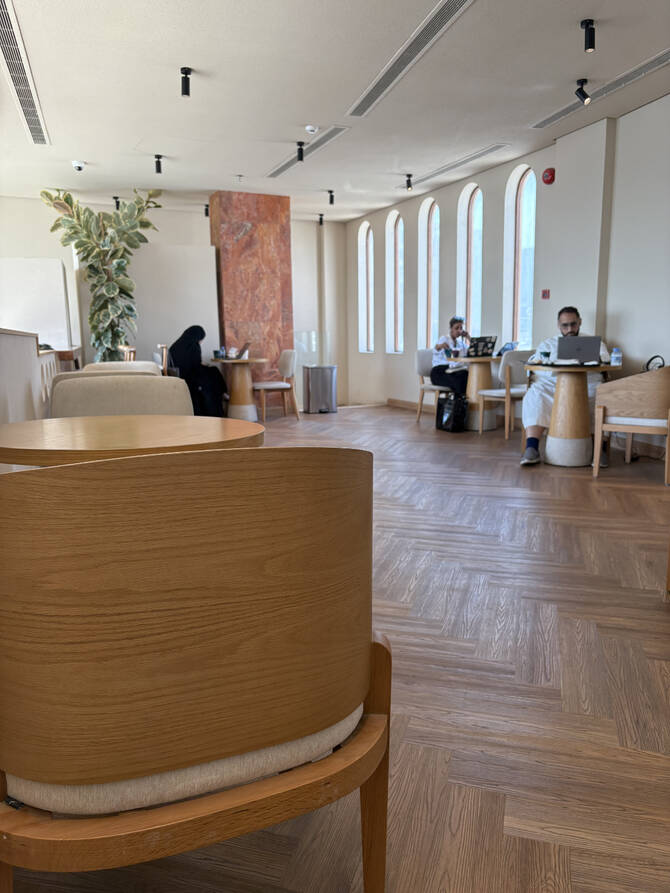
Sunlight poured in through massive windows, illuminating the space. The to-go fridge at the entrance was ideal for grabbing sandwiches or salads quickly.

I ordered the Llama iced tea, which features a refreshing hibiscus blend and thankfully contains no trace of actual llama.

Though SR21 ($5) felt steep for the small size, the drink came in a charming, durable cup that was so well made I gladly took it home to wash and reuse. 

Food-wise, the SR25 Sahara chicken mirage salad was a standout: Fresh, full of textures and colors with pieces of chicken, sun-dried tomatoes, greens, yellow corn and even little bits of toasted nuts.

It was all coated in a light dressing that you drizzle yourself. My favorite part — aside from the deliciousness — was that it was served in a compostable container. 

For dessert, I chose the Madrid cheesecake (SR19), which the staff eagerly recommended. It had a golden, slightly caramelized top and a buttery, well-balanced crust that added just the right amount of texture.

Speckled with real vanilla bean, it was creamy and rich in the middle without feeling heavy. It struck that ideal middle ground between airy and indulgent. Definitely worth trying!

I had been trying to cut back my caffeine intake but could not resist trying the seemingly popular V60 drip. I ordered mine iced with Guatemalan beans (SR20), served with perfectly shaped cubes that melted at just the right pace.

A cylinder aquarium situated by the pickup station was peculiar to me. It contained a real fish swimming inside — an oddly soothing mascot for a llama-named cafe.

Up the flight of stairs — I did not notice an elevator — the space was filled with small tables ideal for working. On the day of our visit, a midday and midweek stop, almost every table was occupied with a laptop. Wall plugs were available throughout and the two restrooms were tiny but spotless.

The main floor had plenty of seating, including some directly outside, for those who dared to brave the scorching hot weather to perhaps smoke or work on their tan.

The cafe sells locally baked sourdough bread that is sliced and bagged, and I cannot wait to return to try it. 

For more details visit Instagram @llama.cafe.


Mini op-ed: Recognising a shift in how people relate to wellness, self-care

Updated 05 March 2026
Follow

Mini op-ed: Recognising a shift in how people relate to wellness, self-care

DUBAI: I have spent nearly a decade working in the beauty industry in Saudi Arabia and the UAE, and Ramadan always has a way of prompting change; in habits, in priorities, and in the routines people have been carrying without question. Speaking from my own corner of the industry, one of these habits is often hair removal.

Saudi Arabia’s beauty and personal care market was valued at about $7.56 billion in 2025 and is set to grow to an estimated $8.03 billion in 2026. Within that growth, personal care encompassing the daily (sometimes unglamorous) routines hold the largest share. But market size alone does not tell the full story. A study conducted at King Abdulaziz University Hospital, Jeddah, found that three quarters of Saudi women experienced complications from temporary hair removal methods, including skin irritation, in-grown hairs and hyperpigmentation. A separate 2025 study published in the Majmaah Journal of Health Sciences found that laser hair removal was both the most considered and most commonly undergone cosmetic procedure among Saudi respondents, yet dissatisfaction with cosmetic procedure outcomes was reported by nearly half of all participants. The numbers point to a gap not in demand, but in results. 

When I launched a specialized electrolysis practice in the UAE in 2016, it was with a clear gap in mind; safe, regulated, permanent hair removal for the region’s specific needs. The range of hair types here and the prevalence of conditions such as polycystic ovary syndrome, or PCOS, demanded a method that works across all of them.  Electrolysis is the only method recognized by the US Food and Drug Administration and American Marketing Association as achieving true permanent results, regardless of hair color or type. 

Despite this, awareness in Saudi Arabia remains limited. Part of this is familiarity, laser has dominated the conversation for years, and electrolysis, which requires more sessions and a licensed electrologist’s precision, has struggled to break through. Part of it is education. Many clients who come to us have never heard of electrolysis; they come because they have exhausted everything else. 

Right now, Saudi Arabia is in the middle of a genuine transformation in how people relate to wellness and self-care. The beauty market is maturing, consumers are asking harder questions of the brands they choose and Vision 2030 has not just shaped the economy, it has shaped how Saudis are showing up in their own lives. In that context, the idea of choosing permanence over repetition lands differently.
 
Mariela Marcantetti is a beauty industry entrepreneur based between Saudi Arabia and the UAE.