

Pakistan issues fresh flood alert as major rivers swell, monsoon deaths surpass 300

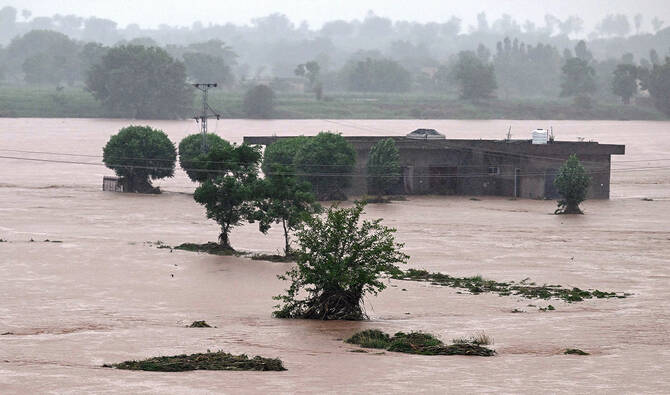
Local people catch fish in the floodwaters near a partially submerged house during heavy monsoon rains at the Ladian village of Rawalpindi, Pakistan, on July 17, 2025. (AFP/File)
Short Url
Updated 05 August 2025
Follow

Pakistan issues fresh flood alert as major rivers swell, monsoon deaths surpass 300

  • Monsoon currents actively entering upper and central Pakistan, with westerly trough persisting in the north
  • NDMA warns of flood risk in Ravi and Chenab tributaries, urges residents to stay alert during heavy rainfall

ISLAMABAD: Pakistan’s disaster management authority on Tuesday issued a fresh flood alert as monsoon-related deaths rose to 303, with authorities warning that intensifying rainfall could swell all major rivers and trigger flash floods across the country’s upper and central regions.

According to the National Disaster Management Authority (NDMA), more than half of the deaths since July 26 have occurred due to house collapses, followed by drownings and flash floods, while over 700 people have been injured during the ongoing monsoon season.

The latest alert cites the combined effect of active monsoon currents penetrating upper and central Pakistan and a westerly trough persisting over the north, with heavy rainfall forecast between August 5 and 8.

“Increased inflows are anticipated in all major rivers, especially Indus, Chenab and Ravi, with nullahs of Ravi and Chenab likely to reach up to medium flood levels,” the NDMA’s National Emergencies Operation Center (NEOC) said in a statement.

“NDMA urges residents living near rivers, streams and nullahs to stay vigilant for sudden rises in water levels, especially at night and during periods of intense rainfall,” it added.

According to the alert, Tarbela, Guddu, and Sukkur barrages are already at low flood stage, while continued rain may push Chashma and Taunsa toward similar levels.

River Chenab at Marala is projected to reach low flood, with rising water levels also recorded in River Jhelum near Mangla Dam, and in tributaries of River Kabul, Swat and Panjkora.

Gilgit-Baltistan’s mountain streams in Hunza, Shigar and Ghanche may also be prone to localized flash floods.

Earlier, the NDMA warned of a potential flood situation along the Sutlej River due to sharp increases in water discharge and forecast heavy rainfall across northern India. The Sutlej runs from the Himalayas through India into eastern Pakistan.

The NDMA also urged residents in flood-prone areas to prepare emergency kits, relocate livestock and valuables and identify safe evacuation routes. Urban centers in northeastern and central Punjab were advised to activate dewatering systems to manage water accumulation, and the public was warned not to cross submerged roads or causeways.

Pakistan is among the countries most vulnerable to climate change and has experienced a series of extreme weather events in recent years, including heatwaves, droughts and floods.

In 2022, record monsoon rains submerged a third of the country, killing over 1,700 people, affecting more than 30 million and causing an estimated $35 billion in damages.

NDMA said it is monitoring the evolving situation round the clock through NEOC and remains in close coordination with provincial and district authorities to ensure a timely response.


Pakistan, global crypto exchange discuss modernizing digital payments, creating job prospects 

Updated 05 December 2025
Follow

Pakistan, global crypto exchange discuss modernizing digital payments, creating job prospects 

  • Pakistani officials, Binance team discuss coordination between Islamabad, local banks and global exchanges
  • Pakistan has attempted to tap into growing crypto market to curb illicit transactions, improve oversight

ISLAMABAD: Pakistan’s finance officials and the team of a global cryptocurrency exchange on Friday held discussions aimed at modernizing the country’s digital payments system and building local talent pipelines to meet rising demand for blockchain and Web3 skills, the finance ministry said.

The development took place during a high-level meeting between Finance Minister Muhammad Aurangzeb, Pakistan Virtual Assets Regulatory Authority (PVARA) Chairman Bilal bin Saqib, domestic bank presidents and a Binance team led by Global CEO Richard Teng. The meeting was held to advance work on Pakistan’s National Digital Asset Framework, a regulatory setup to govern Pakistan’s digital assets.

Pakistan has been moving to regulate its fast-growing crypto and digital assets market by bringing virtual asset service providers (VASPs) under a formal licensing regime. Officials say the push is aimed at curbing illicit transactions, improving oversight, and encouraging innovation in blockchain-based financial services.

“Participants reviewed opportunities to modernize Pakistan’s digital payments landscape, noting that blockchain-based systems could significantly reduce costs from the country’s $38 billion annual remittance flows,” the finance ministry said in a statement. 

“Discussions also emphasized building local talent pipelines to meet rising global demand for blockchain and Web3 skills, creating high-value employment prospects for Pakistani youth.”

Blockchain is a type of digital database that is shared, transparent and tamper-resistant. Instead of being stored on one computer, the data is kept on a distributed network of computers, making it very hard to alter or hack.

Web3 refers to the next generation of the Internet built using blockchain, focusing on giving users more control over their data, identity and digital assets rather than big tech companies controlling it.

Participants of the meeting also discussed sovereign debt tokenization, which is the process of converting a country’s debt such as government bonds, into digital tokens on a blockchain, the ministry said. 

Aurangzeb called for close coordination between the government, domestic banks and global exchanges to modernize Pakistan’s payment landscape.

Participants of the meeting also discussed considering a “time-bound amnesty” to encourage users to move assets onto regulated platforms, stressing the need for stronger verifications and a risk-mitigation system.

Pakistan has attempted in recent months to tap into the country’s growing crypto market, crack down on money laundering and terror financing, and promote responsible innovation — a move analysts say could bring an estimated $25 billion in virtual assets into the tax net.

In September, Islamabad invited international crypto exchanges and other VASPs to apply for licenses to operate in the country, a step aimed at formalizing and regulating its fast-growing digital market.