

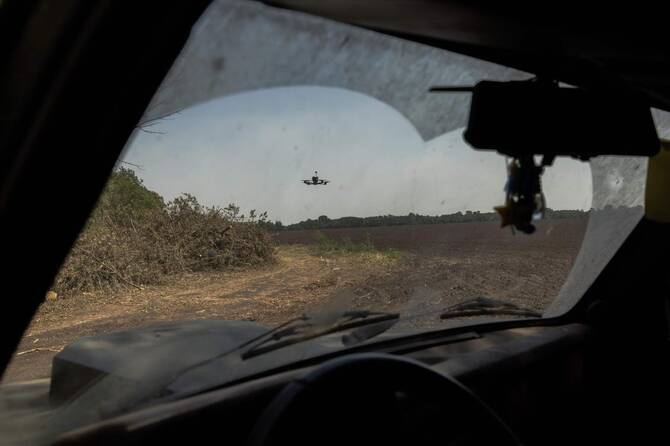

MEZHOVA: Gazing out at his vast, sun-drenched field of wheat in eastern Ukraine, farmer Sergii Dozhenko is nervous.
“Each year, the front line gets closer,” he told AFP. “I’m scared.”
One year ago, he said, it was some 60 kilometers (37 miles) away. Russian forces have closed in half that distance since.
What’s more, their drones have in recent weeks killed farmers across his central region of Dnipropetrovsk which has largely been spared fighting that has ravaged swathes of eastern and southern Ukraine.
Following months of clashes, Russian troops claimed to have captured three villages in the region in July — a first in nearly three and a half years of war.
Ukraine has denied those claims but Sergii still is constantly scanning the sky for Russian explosive drones.
“Fields are burning. People are fleeing, leaving behind barren land,” he said.
To counter the advances, Kyiv is building defensive lines further westwards, and parts of Sergii’s land have been dug up for trenches and lined with barbed wire.
“This might be the last year we harvest here ... It will probably be the last,” he said.
In Mezhove, a garrison town close to the fighting, Ukrainian soldiers reject Russia’s claim of having captured the village of Dachne.
They said the troops only entered before being driven out.
“Russians love symbols. They send soldiers to die just to plant a flag,” said Andrii, a regiment commander, who declined to give his last name.
But few civilians venture south of the town onto a road that leads to the battles some 12 kilometers (seven miles).
Sitting on a bench, pensioners Olga and Zoya watch a cloud of black smoke rising above a charred field — another farmer targeted by a drone.
A week earlier, one of their friends was killed the same way, they said.
Olga, 71, said the situation worsened in early July when Moscow reached the region’s border.
Zoya, who like Olga declined to give her last name, said she was reluctantly planning to evacuate but did not want to leave behind her cow, Lypka.
“I don’t know how much time I have left,” she said, breaking into tears.
“Not enough to see Ukraine’s victory,” she added.
Eighty kilometers away, a large center for displaced people is now always full.
AFP reporters saw evacuees being dropped off in vans. Their suitcases, plastic bags and pets piled up.
Some were crying on the phone, others had a vacant stare.
Among them were some who had already fled their homes further east and are now forced to move again.
Alla Ryabtseva, a 57-year-old coordinator at the center who is herself a displaced person from eastern Ukraine, said these people had no hesitation about moving again.
“They have already experienced fear and understand the danger,” she explained.
She said the first large wave of displaced people arrived at the center in early June as fighting intensified near the region and the authorities issued evacuation orders.
The Kremlin has already laid claim to five regions of Ukraine — an annexation that is not recognized by the international community.
Dnipropetrovsk would be a sixth.
At a Pavlograd hospital, Natan, a psychiatrist, said people living in the region were suffering from “anxiety, excessive worry, insomnia.”
Above all, he said, there is a “fear of not knowing what will happen next — whether to stay or leave.”
Even though there is daily anxiety from air strikes “when reports say our troops have pushed back the Russians, people become more calm,” the 44-year-old doctor, who declined to give his last name, told AFP.
In the hospital corridors, men with drawn faces waited outside the office of Marina Huebner, head of the rehabilitation department.
“The front is getting closer. There are bombings, sleepless nights,” she told AFP.
The hospital is the last before the front line and it sends out medical teams closer to combat areas to help stranded civilians.
“We are essentially like a fortress here, on the first line,” Huebner said.


