Ethiopians told to ‘avoid irregular routes’ after Yemen disaster

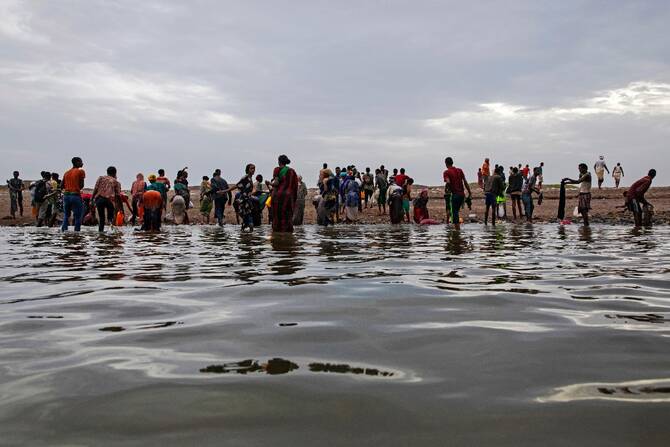
Ethiopian migrants walk on the shores of Ras al-Ara, Lahj, Yemen in 2019. (AP)
Short Url
Updated 05 August 2025
Follow

Ethiopians told to ‘avoid irregular routes’ after Yemen disaster

ADDIS ABABA: Ethiopia on Tuesday asked citizens to “avoid irregular routes,” two days after a boat carrying mostly Ethiopian migrants sank off Yemen, killing at least 76 and leaving dozens missing.
The International Organization for Migration (IOM) said 157 people were on board when the vessel sank on Sunday in the Gulf of Aden.
It was headed for the Abyan governorate in southern Yemen, a popular destination for boats smuggling Africans hoping to reach wealthy Gulf states.
“Ethiopia mourns the tragic loss of 60+ (plus) citizens in a maritime disaster off Yemen’s coast,” Ethiopia’s permanent mission in Geneva wrote on X adding that authorities in Addis Ababa are “working with partners to investigate and urges citizens to avoid irregular routes.”
Thousands of Africans travel from Djibouti to Yemen across the Red Sea, hoping to reach oil-rich Gulf states to work as laborers or domestic workers.
Many are from Ethiopia’s northern Tigray region, which was ravaged by war between 2020 and 2022.
The Red Sea migrant route is one of the world’s most dangerous, according to IOM, which documented at least 558 deaths last year.
In March, at least 180 people were reported missing off the Yemeni coast, the vast majority of them Ethiopians.


Report highlights role of British Muslim charitable giving in supporting UK public services

Updated 05 December 2025
Follow

Report highlights role of British Muslim charitable giving in supporting UK public services

  • The study, “Building Britain: British Muslims Giving Back,” finds that donations from British Muslims are helping to bolster overstretched service

LONDON: British Muslim charitable giving is playing an increasingly significant role in supporting frontline public services across the UK, according to a new report by policy and research organization Equi.

The study, “Building Britain: British Muslims Giving Back,” finds that donations from British Muslims are helping to bolster overstretched services, including local councils, the NHS and welfare systems, at a time of growing financial pressure.

The report estimates that Muslim donors contribute around £2.2 billion ($2.9 billion) annually, making them the UK’s most generous community.

This figure is around four times the national giving average and rises to almost 10 times the average among higher earners.

According to the findings, Muslim-led charities are providing a wide range of support, including housing assistance, emergency cash grants, food provision and mental health services, easing demand on statutory services.

Equi points to evidence from 2023 showing that housing support delivered by the National Zakat Foundation helped prevent evictions that would have cost councils an estimated £28.8 million, with every £1 of charitable spending generating £73 in public sector savings.

The report also highlights a generational shift, with younger British Muslims increasingly directing their donations toward domestic causes such as homelessness, child poverty and mental health challenges.

Despite their growing impact, Muslim charities face a number of barriers, including de-banking, restrictive funding rules, securitization measures and what the report describes as limited recognition from government. Equi argues that these challenges are constraining the sector’s ability to maximize its contribution.

“British Muslim giving is not just generosity but a lifeline for public services that needs recognizing,” said Equi Managing Director Prof. Javed Khan.

“From preventing evictions to supporting mental health, these donations are saving millions for the taxpayer and strengthening communities across Britain. The evidence is clear that Muslim-led action is delivering frontline support where the state is struggling,” he added.

Equi is calling on policymakers to engage more closely with Muslim-led charities and to move beyond what it describes as symbolic recognition.

The report recommends measures such as UK-based match-funding schemes and greater faith literacy within policymaking, which it says could unlock billions of pounds in additional domestic spending while maintaining the UK’s global humanitarian commitments.

The study concluded that with greater collaboration between government and Muslim charities, charitable giving could play an even more transformative role in strengthening public services and social cohesion across the country.