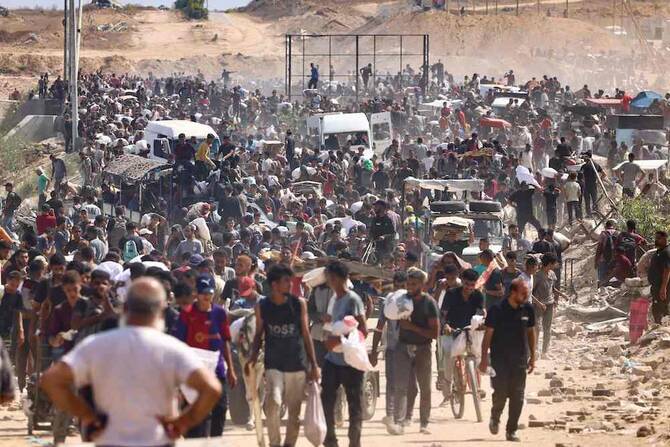

LONDON: A UN expert who raised the alarm over deliberate mass starvation in Gaza a year and a half ago said governments and corporations “cannot act surprised” now at the escalating humanitarian catastrophe in the territory.
“Israel has built the most efficient starvation machine you can imagine,” Michael Fakhri, the UN’s special rapporteur on the right to food, told The Guardian newspaper on Monday.
“So while it’s always shocking to see people being starved, no one should act surprised. All the information has been out in the open since early 2024.
“Israel is starving Gaza. It’s genocide. It’s a crime against humanity. It’s a war crime. I have been repeating it and repeating it and repeating it; I feel like Cassandra,” he added, referencing the Greek mythological figure whose accurate prophecies were ignored.
In a recent alert, the Integrated Food Security Phase Classification warned that “the worst-case scenario of famine is currently playing out” in Gaza.
Fakhri was one of the first to sound the alarm about the crisis. In February 2024, he told The Guardian: “We have never seen a civilian population made to go so hungry so quickly and so completely; that is the consensus among starvation experts. Intentionally depriving people of food is clearly a war crime. Israel has announced its intention to destroy the Palestinian people, in whole or in part, simply for being Palestinian. This is now a situation of genocide.”
The following month, the International Court of Justice acknowledged the risk of genocide and ordered Israel to ensure the delivery of humanitarian aid, including food and medicine. In May, following an investigation by the International Criminal Court, Israeli Prime Minister Benjamin Netanyahu and the country’s defense minister at the time, Yoav Gallant, became the first individuals formally accused by an international court of deliberate starvation, a war crime.
A group of UN experts, including Fakhri, declared famine in Gaza in July 2024 after the first deaths from starvation were reported. Fakhri also published a UN report documenting Israel’s long-standing control over food supplies in Gaza, a stranglehold that meant 80 percent of Gazans were aid-dependent even before the current siege started. Despite this, little action has been taken to stop what Fakhri described as a systematic campaign by Israeli authorities.
“Famine is always political, always predictable and always preventable,” he said. “But there is no verb to famine. We don’t famine people, we starve them — and that inevitably leads to famine if no political action is taken to avoid it.
“But to frame the mass starvation as a consequence of the most recent blockade is a misunderstanding of how starvation works and what’s going on in Gaza. People don’t all of a sudden starve, children don’t wither away that quickly. This is because they have been deliberately weakened for so long.
“The State of Israel itself has used food as a weapon since its creation. It can and does loosen and tighten its starvation machine in response to pressure; it has been fine-tuning this for 25 years.”
Netanyahu continues to deny such accusations, stating last week that “there is no policy of starvation in Gaza.” But aid agencies, including UNICEF, say malnutrition has surged since March this year, when Israel reimposed a total blockade on the territory following the collapse of a ceasefire agreement with Hamas.
In May, Israel and the Trump administration backed the creation of the Gaza Humanitarian Foundation, a private logistics group that replaced hundreds of established UN aid hubs with just four distribution sites secured by private contractors and Israeli troops. On June 1, 32 people were reportedly killed trying to obtain food at the foundation’s sites, followed by more than 1,300 others since then.
“This is using aid not for humanitarian purposes but to control populations, to move them, to humiliate and weaken people as part of their military tactics,” said Fakhri.
“The GHF is so frightening because it might be the new militarized dystopia of aid of the future.”
The GHF has dismissed reports of deaths at its sites as “false and exaggerated statistics,” and accuses the UN of failing to cooperate.
“If the UN and other groups would collaborate with us, we could end the starvation, desperation and violent incidents almost overnight,” a spokesperson for the foundation said.
The deaths from starvation are in addition to at least 60,000 Palestinians reported killed by Israeli air and ground attacks since the conflict between Israel and Hamas began in October 2023. Researchers say the true death toll is likely to be higher, though international media and observers remain barred from entering Gaza.
Fakhri and other UN officials have urged governments and businesses to take concrete steps, including the introduction of international sanctions and the halting of arms sales, to stop the violence and famine.
“I see stronger political language, more condemnation, more plans proposed, but despite the change in rhetoric we’re still in the phase of inaction,” he said. “The politicians and corporations have no excuse; they’re really shameful.
“The fact that millions of people are mobilizing in growing numbers shows that everyone in the world understands how many different countries, corporations and individuals are culpable.”
The UN General Assembly must step in to deploy peacekeepers and provide escorts for humanitarian aid, Fakhri added.
“They have the majority of votes and, most importantly, millions of people are demanding this,” he said. “Ordinary people are trying to break through an illegal blockade to deliver humanitarian aid, to implement international law their governments are failing to do. Why else do we have peacekeepers if not to end genocide and prevent starvation?”
Special rapporteurs are part of what is known as the special procedures of the UN Human Rights Council. They are independent experts who work on a voluntary basis, are not members of UN staff and are not paid for their work.