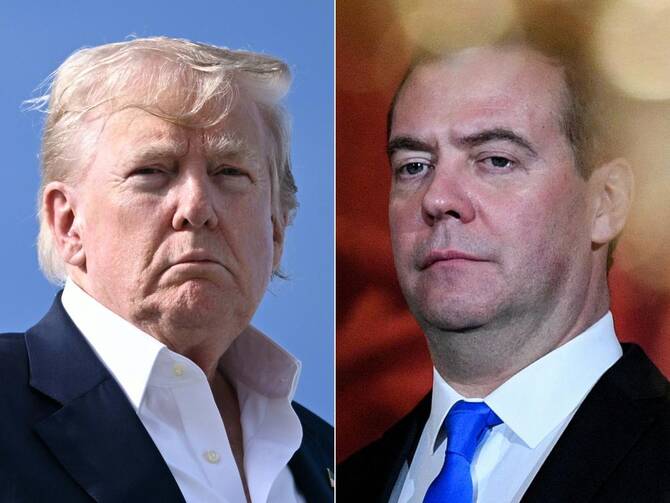
MOSCOW: Russia urged caution on Monday after US President Donald Trump said he would deploy two nuclear submarines following an online row with former Russian president Dmitry Medvedev.
Trump said he had ordered the deployment in response to what he alleged were highly provocative comments by Medvedev, saying the submarines would be positioned in “appropriate regions.”
Trump did not say whether he meant nuclear-powered or nuclear-armed submarines.
He also did not elaborate on the locations, which are kept secret by the US military.
“Russia is very attentive to the topic of nuclear non-proliferation. And we believe that everyone should be very, very cautious with nuclear rhetoric,” Kremlin spokesman Dmitry Peskov told reporters, including from AFP, on Monday.
The row between Medvedev and Trump erupted against the backdrop of the US leader’s ultimatum for Russia to end its military offensive in Ukraine or face fresh economic sanctions, including on its remaining trading partners.
Medvedev — one of Russia’s most prominent anti-Western hawks — accused Trump of “playing the ultimatum game” and said that Trump “should remember” that Russia was a formidable force.
“Each new ultimatum is a threat and a step toward war. Not between Russia and Ukraine, but with his own country,” he said.
Medvedev, who has not posted on social media since the spat, is currently the deputy chairman of Russia’s Security Council.
He served one term as president from 2008 to 2012, effectively acting as a placeholder for Putin, who was able to circumvent constitutional term limits and de facto remain in power.
The chief of staff to Ukrainian President Volodymyr Zelensky on Monday backed Trump’s actions.
“The concept of peace through strength works,” Andriy Yermak wrote on social media.
“The moment American nuclear submarines appeared, one Russian drunk — who had just been threatening nuclear war on X — suddenly went silent.”

Russia urges caution in nuclear ‘rhetoric’ after Trump comments
Short Url
https://arab.news/gns67
Russia urges caution in nuclear ‘rhetoric’ after Trump comments
- Trump said he had ordered the deployment in response to what he alleged were highly provocative comments by Medvedev, saying the submarines would be positioned in “appropriate regions.”
US, Japan defense chiefs say China harming regional peace
- Japan’s top envoy: China ‘disseminating information that is completely contrary to the facts’ about the radar incident
TOKYO: Beijing’s actions are “not conducive to regional peace,” Japan’s defense minister and US counterpart Pete Hegseth agreed during a call after Chinese aircraft locked radar on Japanese jets near Taiwan, Tokyo said Friday.
The December 6 radar incident came after comments by Prime Minister Sanae Takaichi on Taiwan that infuriated China.
It was followed this week by Chinese-Russian air patrols around Japan.
Hegseth and Shinjiro Koizumi “exchanged candid views on the increasingly severe security situation in the Indo-Pacific region, including the radar incident,” the Japanese defense ministry said after the call.
They “expressed serious concern over any actions to increase regional tensions, as China’s actions are not conducive to regional peace and stability,” the statement added.
Koizumi said on X that he told Hegseth that China was “disseminating information that is completely contrary to the facts” about the radar incident.
“However, Japan has made clear that it does not seek escalation and that we are responding calmly while making necessary rebuttals, and we are keeping the door open for dialogue,” Koizumi added.
Hegseth’s office said that they “discussed... China’s military activities” among other issues including “Japan’s efforts to increase its defense spending and strengthen its capabilities.”
“Secretary Hegseth and Defense Minister Koizumi reaffirmed the importance of the US-Japan Alliance and underscored their commitment to deterring aggression in the Asia-Pacific,” the US statement added.
‘Tactical exercises’
Takaichi had suggested on November 7 that Japan would intervene with military force in any Chinese attack on Taiwan, which Beijing claims as its own and has not ruled out seizing by force.
Last week, J-15 jets from China’s Liaoning aircraft carrier twice locked radar on Japanese aircraft that had scrambled in international waters near Okinawa, according to Japan.
Fighter jets use their radar for fire control to identify targets as well as for search and rescue operations.
But China’s foreign ministry on Wednesday accused Japan of sending the jets “to intrude into the Chinese training area without authorization, conduct close-range reconnaissance and harassment, create tense situations, and... maliciously hype up the situation.”
On Tuesday two Russian Tu-95 nuclear-capable bombers flew from the Sea of Japan to rendezvous with two Chinese H-6 bombers in the East China Sea, then conducted a joint flight around the country, Japan said.
Japan said that it scrambled fighter jets in response.
A day later, Japan and the United States air forces conducted their own joint air drills, Tokyo said.
The “tactical exercises” over the Sea of Japan involved two US B52 bombers, three Japanese F-35 fighter jets and three Japanese F-15s, Tokyo said.
South Korea said Tuesday that Russian and Chinese warplanes also entered its air defense zone, with Seoul also deploying fighter jets that same day.
Beijing confirmed on Tuesday that it had organized drills with Russia’s military according to “annual cooperation plans.”
Moscow also described it as a routine exercise, saying it lasted eight hours and that some foreign fighter jets followed the Russian and Chinese aircraft.
The December 6 radar incident came after comments by Prime Minister Sanae Takaichi on Taiwan that infuriated China.
It was followed this week by Chinese-Russian air patrols around Japan.
Hegseth and Shinjiro Koizumi “exchanged candid views on the increasingly severe security situation in the Indo-Pacific region, including the radar incident,” the Japanese defense ministry said after the call.
They “expressed serious concern over any actions to increase regional tensions, as China’s actions are not conducive to regional peace and stability,” the statement added.
Koizumi said on X that he told Hegseth that China was “disseminating information that is completely contrary to the facts” about the radar incident.
“However, Japan has made clear that it does not seek escalation and that we are responding calmly while making necessary rebuttals, and we are keeping the door open for dialogue,” Koizumi added.
Hegseth’s office said that they “discussed... China’s military activities” among other issues including “Japan’s efforts to increase its defense spending and strengthen its capabilities.”
“Secretary Hegseth and Defense Minister Koizumi reaffirmed the importance of the US-Japan Alliance and underscored their commitment to deterring aggression in the Asia-Pacific,” the US statement added.
‘Tactical exercises’
Takaichi had suggested on November 7 that Japan would intervene with military force in any Chinese attack on Taiwan, which Beijing claims as its own and has not ruled out seizing by force.
Last week, J-15 jets from China’s Liaoning aircraft carrier twice locked radar on Japanese aircraft that had scrambled in international waters near Okinawa, according to Japan.
Fighter jets use their radar for fire control to identify targets as well as for search and rescue operations.
But China’s foreign ministry on Wednesday accused Japan of sending the jets “to intrude into the Chinese training area without authorization, conduct close-range reconnaissance and harassment, create tense situations, and... maliciously hype up the situation.”
On Tuesday two Russian Tu-95 nuclear-capable bombers flew from the Sea of Japan to rendezvous with two Chinese H-6 bombers in the East China Sea, then conducted a joint flight around the country, Japan said.
Japan said that it scrambled fighter jets in response.
A day later, Japan and the United States air forces conducted their own joint air drills, Tokyo said.
The “tactical exercises” over the Sea of Japan involved two US B52 bombers, three Japanese F-35 fighter jets and three Japanese F-15s, Tokyo said.
South Korea said Tuesday that Russian and Chinese warplanes also entered its air defense zone, with Seoul also deploying fighter jets that same day.
Beijing confirmed on Tuesday that it had organized drills with Russia’s military according to “annual cooperation plans.”
Moscow also described it as a routine exercise, saying it lasted eight hours and that some foreign fighter jets followed the Russian and Chinese aircraft.
© 2025 SAUDI RESEARCH & PUBLISHING COMPANY, All Rights Reserved And subject to Terms of Use Agreement.


