



BEIRUT: In a hospital room in the mountains of Mount Lebanon, 47-year-old Lara Hayek lies motionless. Five years after the catastrophic Beirut port explosion left her in a vegetative state, her mother Najwa maintains a daily vigil, clinging to hope that justice will finally arrive.
“Every single day, I wait for Lebanon’s courts to prosecute those who perpetrated this crime against defenseless civilians,” Najwa told Arab News.
The blast’s impact on Lara was devastating. Shrapnel from the explosion penetrated her eye, causing severe brain hemorrhaging that led to cardiac arrest.
Her frail body now depends entirely on medical intervention — breathing through a tracheostomy tube and receiving nutrition through a feeding tube inserted into her abdomen.

This combination of pictures created from UGC footage taken on August 4, 2020 and filmed from a high-rise shows a fireball exploding while smoke is billowing at the port of the Lebanese capital Beirut. (AFP)
“Medically speaking, my daughter died that day,” her mother said. “Emergency responders could not reach her quickly because every hospital was flooded with hundreds of casualties.”
Lara had been unwinding on her couch after work, in an apartment mere blocks from the Foreign Ministry, when the Aug. 4, 2020, explosion — comparable in force to an earthquake — tore through Beirut. Her mother’s late departure from work that day likely saved her life.
The daily hospital visits have become Najwa’s ritual of remembrance and protest. She speaks to her unresponsive daughter about her frustrations.

Wounded men are evacuated following of an explosion at the port of Beirut on August 4, 2020. (AFP)
“I buried my husband just one year before Lara’s accident. My son fled Lebanon. Now I am entirely alone, after they destroyed the daughter I sacrificed everything to raise.”
She added: “The government ignores her existence, refuses to cover her medical expenses — just like countless other victims forced to shoulder their own healthcare costs.”
The tragedy extends beyond her immediate family — her sister’s household, her brother-in-law’s family, all bear scars from that Tuesday evening.
FASTFACTS
• The Beirut port blast had a force equivalent to 1,000-1,500 tons of TNT, or 1.1 kilotons.
• Felt over 200 km away in Cyprus, causing damage to buildings up to 10 km from the port.
• It registered as a 3.3-magnitude earthquake, with shockwaves disrupting the ionosphere.
Half a decade after the explosion sent tremors across Lebanon and into neighboring nations, the architects of this preventable catastrophe walk free.
Judicial proceedings have implicated an extensive network of culpable parties — including former prime ministers, cabinet members, and high-ranking military, security, customs and judicial personnel. Their alleged crimes span from “professional negligence” to “possible premeditated murder.”
The disaster unfolded during the evening commute on Aug. 4, 2020, at 5:15 p.m. local time, as residents traveled home or conducted routine business in offices and residences.

A ship is pictured engulfed in flames at the port of Beirut following a massive explosion that hit the heart of the Lebanese capital on August 4, 2020. (AFP)
A fire erupted in a port warehouse containing 2,750 tons of improperly stored ammonium nitrate, along with kerosene, oil, fireworks, and methanol — ignited during welding repairs on the facility’s entrance.
By 6:06 p.m., the blaze had escalated into a nuclear-scale detonation that obliterated sections of the capital, excavated a 40-meter underwater crater, and claimed over 220 lives instantaneously while leaving thousands more trapped, bleeding and dying across the metropolitan area.
Lebanon mourned as a nation that tragic day, its anguish spanning the country’s entire 10,452 square kilometers.
The death toll continues its grim climb as comatose patients succumb to their injuries. Cecile Roukoz, legal counsel for families of victims and sister of deceased victim Joseph Roukoz, says the current tally stands at “245 fatalities and over 6,500 wounded.”

Lebanese army soldiers carry away an injured man at a hospital in the aftermath of an explosion at the port of Lebanon's capital Beirut on August 4, 2020. (AFP)
Najwa’s voice betrayed the exhaustion born of futile advocacy. “We have screamed ourselves hoarse in street demonstrations, demanding accountability,” she said. “Five years later, we have nothing to show for it.”
She said many families have abandoned hope and emigrated. Those who remain cannot trust authorities who have absolved themselves of responsibility for the shedding of their citizens’ blood.
The international scope of the tragedy is reflected in its victims: 52 foreign nationals from France, Australia, Germany, the Netherlands, Iran, Pakistan, Ethiopia, the Philippines, Egypt and Bangladesh perished, alongside a Palestinian driver who suffered fatal cardiac arrest from the explosion’s shockwave near Hotel-Dieu Hospital.
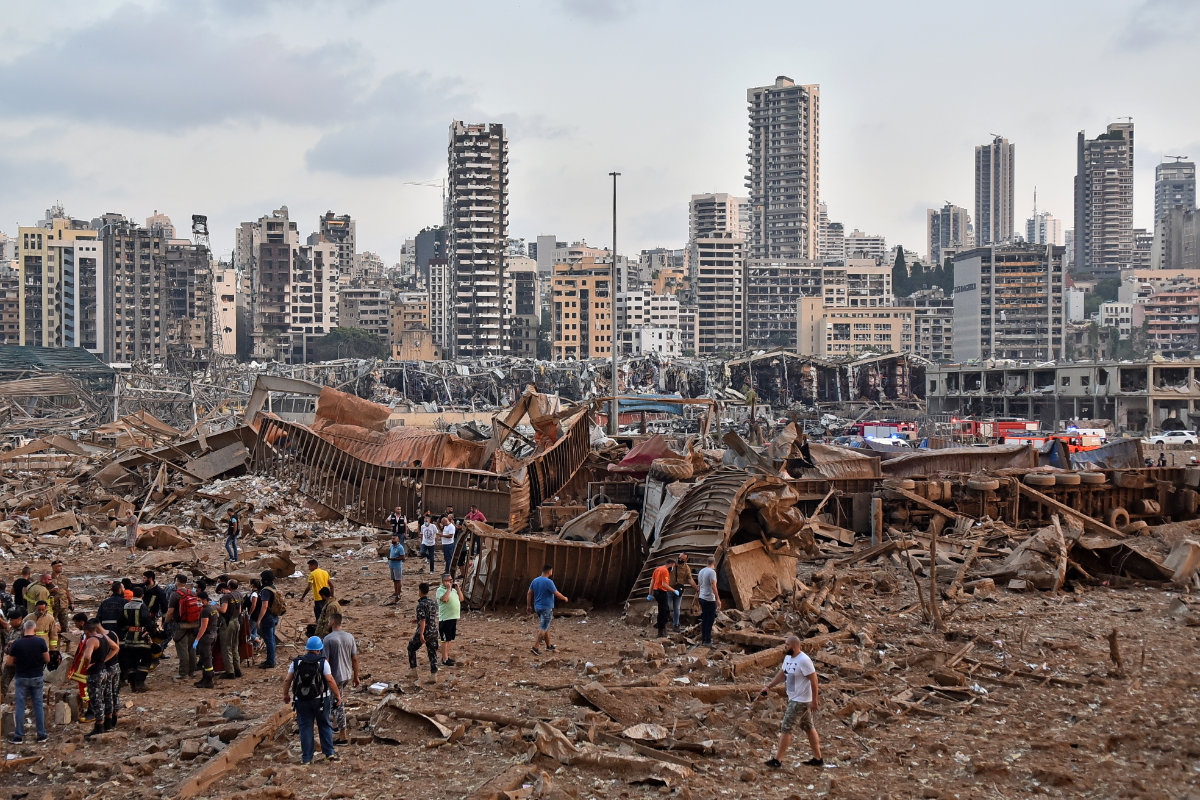
An aerial view shows the massive damage at Beirut port's grain silos and the area around it on August 5, 2020, one day after a massive explosion hit the heart of the Lebanese capital. (AFP)
This year, Prime Minister Nawaf Salam’s government decided to commemorate the anniversary by declaring a “national day of mourning, with flags flown at half-mast on official buildings, public administrations, and municipalities, and adjusting regular programming on radio and television stations to reflect the grief of the Lebanese people.”
The anniversary is accompanied by religious services in Beirut and marches organized by activists to raise their voices for “truth, accountability, and justice.”
Banners were raised in neighborhoods that were destroyed and later rebuilt, with messages written on them such as “We will not forget and we will not forgive” and “Aug. 4 is not a memory; it is a crime without punishment.”
Aside from that, the Lebanese people are still waiting for the indictment in the investigation led by Judge Tarek Bitar to be issued. He had promised to issue it this year in order to hold “every official and involved party accountable.”

This photo taken on October 14, 2021, shows supporters of Hezbollah and the Amal movement burning a portrait of Judge Tarek Bitar, the Beirut blast lead investigator, and US Ambassador to Lebanon Dorothy Shea, near the Justice Palace in Beirut during a gathering to demand the Judge's dismissal. (AFP)
Bitar, whose investigation was forcibly frozen for 13 months, resumed his work at the beginning of this year following the election of Aoun and Salam, amid a shift in the political power balance in Lebanon after the decline of Hezbollah’s influence domestically following its recent war with Israel.
Aoun and Salam pledged in the inaugural address and the ministerial statement to work on establishing “judicial independence, preventing interference in its work, and combating the culture of impunity.”
Judge Jamal Hajjar, public prosecutor at the Court of Cassation, annulled the decision of his predecessor, Judge Ghassan Oueidat, made more than two years ago, to halt all cooperation with Bitar. This was in response to Bitar’s charges against Oueidat; Judge Ghassan Khoury, the public prosecutor at the Court of Cassation; and several other judges in the explosion case.

In this photo taken on January 17, 2022, activists and relatives of victims of the August 4, 2020 Beirut port explosion are shown holding posters of Hezbollah leader Hassan Nasrallah (R) and Wafiq Safa, a top Hezbollah security official, with a slogan in Arabic that reads: "He knew," during a sit-in outside the Justice Palace, a government building affiliated with the judiciary, in the Lebanese capital on January 17, 2022. Nasrallah was killed in an Israeli airstrike on Lebanon last year, but Safa has survived. (AFP)
Bitar held his last interrogation session on Dec. 24, 2021, and his work was later obstructed by lawsuits for recusal and liability filed against him by officials facing accusations. The number of these lawsuits against Bitar reached 43, and the courts have yet to rule on them.
Hezbollah led a campaign demanding Bitar’s removal, plunging the judicial investigation into political entanglement and judicial chaos.
The militant group and its ally, the Amal movement, rejected the prosecution of their affiliated ministers before the ordinary judiciary, insisting on the Supreme Council for the Trial of Presidents and Ministers, which stems from Parliament.
Bitar’s conviction, according to a judicial source, is based on the belief that “the crime committed is not political but criminal and led to the killing of hundreds, and he refuses to split the case between the ordinary judiciary and the Supreme Council for the Trial of Presidents and Ministers and the High Judicial Council.”
Before his retirement, Oueidat, in an unprecedented decision and clear challenge to Bitar and his procedures, released all 17 detainees in the port crime case, most of whom are port officials, employees and military personnel, arguing that Bitar was “usurping the title of judicial investigator and abusing authority.”

Protesters lift portraits of relatives they lost in the Beirut port blast during a march on the fourth anniversary of the devastating explosion near the capital city's harbor on August 4, 2024. (AFP)
Hajjar decided to resume cooperation with Bitar and to receive all memos issued by him, including notices summoning defendants for interrogation sessions and preliminary defenses for legal review.
On Jan. 16, Bitar resumed his judicial procedures by charging 10 officials, including seven officers from the Lebanese Army, General Security and Customs, and three civil employees, and later interrogated them.
The past months of March and April witnessed an unprecedented surge in investigative sessions dedicated to questioning security and political leaders who had previously refused to appear before him.
These included notably Hassan Diab, former prime minister; Nohad Machnouk, former interior minister; Jean Kahwaji, former army commander; Abbas Ibrahim, former General Security chief; former State Security director Gen. Tony Saliba; and Brigadier General Asaad Al-Tufayli, former Higher Council of Customs head.
To date, the only two individuals who have not yet appeared before Bitar are Judge Oweidat and Ghazi Zeaiter, a former MP and minister affiliated with Amal.

A metal installation set up across from the Beirut port with a view of its destroyed silos, shows a judge's gavel with a message calling for justice on August 1, 2025, as Lebanon prepares to mark the 5th anniversary of the August 4 harbor explosion. (AFP)
The judicial source told Arab News that the number of defendants in this case has reached 70.
“Judge Bitar has not informed the defendants of any decision regarding their fate, leaving the matter until the investigation is completed,” he said. “He will overlook the failure of Oweidat and Zeaiter to appear before him for questioning and will proceed with the information already in his possession.”
The source noted that Bitar considers all individuals who have been released by Judge Oweidat as still under arrest and travel bans, except for one defendant who holds US citizenship and has left Lebanon.
A political source predicted that the indictment will be issued soon, as all the facts are now before Judge Bitar and he has political cover. “There is no justification for delaying the issuance in the coming weeks,” he said.

A picture shows a view of the destroyed Beirut port silos on August 1, 2025, as Lebanon prepares to mark the 5th anniversary of the August 4 harbor explosion that killed more than 250 people and injured thousands. (AFP)
Roukoz, the legal counsel for families of victims, expressed optimism that the indictment would be issued soon. She told Arab News that she attends all interrogation sessions and believes that Judge Bitar has the integrity and determination needed to bring this investigation to a conclusion and issue the indictment, despite the despair of the victims’ families and their loss of hope in justice.
Roukoz said that the families have hope in the new administration’s declared stance — that no corrupt individual or criminal is protected by anyone — will be translated into action.
“We believe that it is the state’s duty to determine who destroyed the city. Dozens of families have emigrated from Lebanon following the explosion, and it is necessary to restore people’s trust in their state and the sovereignty of the law.”


