

Scottish first minister calls Israel’s actions in Gaza a ‘genocide’

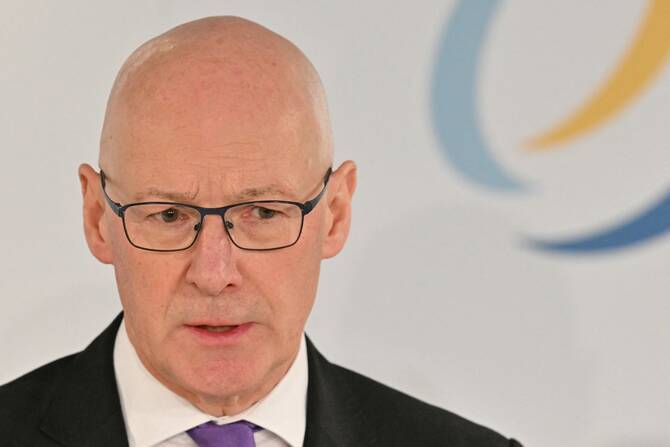
Scottish First Minister John Swinney has for the first time described Israel’s actions in Gaza as a “genocide,” becoming the second UK national leader to do so after Northern Ireland’s Michelle O’Neill. (AFP/File Photo)
Short Url
Updated 02 August 2025
Follow

Scottish first minister calls Israel’s actions in Gaza a ‘genocide’

  • Made comment at Edinburgh Fringe event repeatedly interrupted by pro-Palestinian protesters
  • Swinney’s statement follows similar language used last month by Northern Ireland First Minister O’Neill

LONDON: Scotland’s First Minister John Swinney has for the first time described Israel’s actions in Gaza as a “genocide,” becoming the second UK national leader to do so after Northern Ireland’s Michelle O’Neill, it was reported on Saturday.

Speaking at an Edinburgh Fringe event that was repeatedly interrupted by pro-Palestinian protesters, Swinney told reporters: “It’s quite clear that there is a genocide in Palestine, it can’t be disputed. I have seen reports of terrible atrocities which have the character of being genocide. I’ve expressed that and obviously it’s not reached all those individuals, but that’s my feeling.”

Swinney made his remarks following a disrupted appearance at the Stand Comedy Club in Edinburgh, where protesters stood up holding letters spelling “GENOCIDE” and chanted slogans including “Call it genocide.”

Security staff prevented demonstrators from approaching the stage as interruptions became increasingly forceful throughout the event.

His comments, reported by The Guardian, come amid mounting pro-Palestinian pressure from within the governing Scottish National Party, including from elected representatives in both Holyrood and Westminster.

Stephen Flynn, leader of the SNP’s nine MPs in the House of Commons in Westminster, recently urged the UK government to recognize the situation in Gaza as a genocide during a parliamentary exchange.

Israel has consistently denied committing genocide, maintaining that its military operations in Gaza are acts of self-defense in response to the Oct. 7, 2023, attacks led by Hamas that left almost 1,200 people dead in Israel, mostly civilians, and more than 250 kidnapped.

About 50 of those hostages remain in Gaza, with only 20 believed to be alive.

More than 60,000 Palestinians have been killed in the subsequent military action by Israel against Hamas, with a further 1,350 queuing for aid killed by Israeli troops since May, according to UN data published this week.

On Friday, at least 91 people were killed and hundreds more wounded in Gaza ahead of a visit by US envoy Steve Witkoff to Israel.

Two leading Israeli human rights organizations, B’Tselem and Physicians for Human Rights, have also accused Israel of committing genocide, asserting that western allies have a legal and moral duty to act.

Swinney’s statement follows similar language used last month by Northern Ireland First Minister O’Neill, who said: “It is inhumanity, it is genocide, it is wrong.” She also described Israel’s actions as “state terrorism.”

The Scottish government has previously faced criticism over public money being used to support apprenticeships at firms involved in weapons manufacturing, though it does not directly fund the production of munitions.

Defending that policy, Swinney said Scottish Enterprise, the government’s commercial investment body, applies “the strictest assessments imaginable about the purpose and the use of public expenditure in companies who may be related to defense industries.”

Pressed on funding staff who could end up building munitions, he added: “We are trying to enable companies to diversify their activities, that’s the purpose. That’s why the due diligence checks are applied and they are applied unreservedly.”


Trump orders blockade of ‘sanctioned’ Venezuela oil tankers

Updated 3 sec ago
Follow

Trump orders blockade of ‘sanctioned’ Venezuela oil tankers

WASHINGTON: US President Donald Trump announced Tuesday a blockade of “sanctioned oil vessels” heading to and leaving Venezuela, sharply escalating his pressure campaign against Caracas while issuing new demands for access to the country’s crude.
The United States has for months been building a major military deployment in the Caribbean — with the stated goal of combatting Latin American drug trafficking, but taking particular aim at Venezuela.
Caracas views the operation as a campaign to push out leftist strongman Nicolas Maduro — whom Washington and many nations view as an illegitimate president — and to “steal” Venezuelan oil.
Tensions have been mounting for weeks as Trump signals intent to launch military action inside Venezuela, ominously declaring that the country’s airspace should be considered “closed” and that efforts at halting drug trafficking “on land” would begin soon.
Last week, the United States opened a new front in the campaign, seizing an oil tanker that had left Venezuela and announcing sanctions on several other vessels and companies associated with the Venezuelan oil industry.
“Today, I am ordering A TOTAL AND COMPLETE BLOCKADE OF ALL SANCTIONED OIL TANKERS going into, and out of, Venezuela,” Trump wrote Tuesday evening on his Truth Social platform.
Referring to the many Navy and Marine forces assembled in the Caribbean — including the world’s largest aircraft carrier — Trump warned “Venezuela is completely surrounded by the largest Armada ever assembled in the History of South America.”

- ‘Stolen’ oil -

With Venezuela’s economy heavily reliant on crude exports, the move to cripple its oil sector is likely to further ramp up pressure on Maduro.
But Trump on Tuesday pointed to another goal — regaining US access to Venezuelan oil production.
The US armada “will only get bigger,” Trump said, until Venezuela returns “to the United States of America all of the Oil, Land, and other Assets that they previously stole from us.”
He did not specify what oil or land he was referring to, but Venezuela in the 1970s nationalized its oil industry.
Later, under Maduro’s predecessor Hugo Chavez, companies were forced to cede majority control to the Venezuelan state oil company, PDVSA.
A spokesperson for US company Chevron, which still operates in Venezuela under a special sanctions waiver, said Tuesday that its operations “continue without disruption and in full compliance with laws and regulations applicable to its business.”
Caracas blasted Trump’s announcement on Tuesday, saying he aimed at “stealing the riches that belong to our homeland.”
Venezuela has been sidestepping US oil sanctions for years, selling crude at a discounted price on the black market, mainly to China.
Venezuela is estimated to have oil reserves of some 303 billion barrels, according to the Organization of the Petroleum Exporting Countries (OPEC) — more than any other nation.
“If there are no oil exports, it will affect the foreign exchange market, the country’s imports... There could be an economic crisis,” Elias Ferrer of Orinoco Research, a Venezuelan advisory firm, told AFP recently.
“Not just a recession, but also shortages of food and medicine, because we wouldn’t be able to import.”

- ‘Terrorist’ regime -

The Pentagon has defended its operation, dubbed “Southern Spear,” by arguing it is targeting drug cartels designated under the Trump administration as foreign terrorist organizations.
The US military has thus far only struck boats in international waters it claims are trafficking drugs, killing at least 95 people, in what many experts say amount to extrajudicial killings.
But Trump’s administration has also given terrorist designation to an alleged Venezuelan group, the Cartel de los Soles — and claims that Maduro is its leader.
“For the theft of our Assets, and many other reasons, including Terrorism, Drug Smuggling, and Human Trafficking, the Venezuelan Regime has been designated a FOREIGN TERRORIST ORGANIZATION,” Trump said.