

State Minister Saqib, Trump aide discuss Pakistan plans to become regional Web3 innovation hub

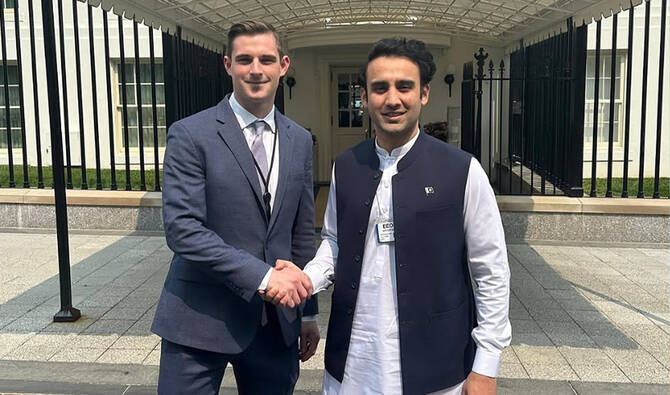
In a picture shared by Crypto Council Pakistan on June 3, 2025, State Minister for Minister for Crypto and Blockchain Bilal bin Saqib (right) is seen shaking hands with Bo Hines, Executive Director of US President, Donald Trump’s Council on Digital Assets in Washington, US. (@cryptocouncilpk/Instagram)
Short Url
Updated 01 August 2025
Follow

State Minister Saqib, Trump aide discuss Pakistan plans to become regional Web3 innovation hub

  • Web3 is a decentralized Internet built on blockchain, giving users control over data, identity and assets
  • The move follows landmark trade deal between Pakistan and United States, which includes reduced tariffs

KARACHI: Pakistan’s State Minister for Crypto and Blockchain Bilal bin Saqib has met with Bo Hines, President Donald Trump’s adviser on digital assets, and discussed with him Pakistan’s plans to become a regional Web3 innovation hub, the Pakistani finance ministry said on Friday, amid efforts by both countries to cooperate on crypto policy and legislation.

Web3 is a decentralized Internet built on blockchain, giving users control over their data, identity and digital assets by using peer-to-peer networks, smart contracts and cryptocurrencies to enable intermediary-free interactions. It supports decentralized apps like NFTs and DAOs to promote transparency and user ownership unlike Web2 which is dominated by platforms like Google and Facebook.

The move follows a landmark trade deal between Pakistan and the US, which includes reduced tariffs and a new partnership to develop Pakistan’s oil reserves, and the Pakistani ministry said the developments were discussed during Saqib’s meeting with Hines, executive director of Trump’s Council of Advisers on Digital Assets.

“The discussion centered on the global coordination of crypto policy and Pakistan’s ambitious plans to become a regional hub for Web3 innovation,” the Pakistani finance ministry said. “The alignment sends a strong signal: Pakistan and the US are no longer just trading partners. They are exploring now on how they can collaborate on crypto legislation.”

The meeting took place a day after the US unveiled its Digital Asset Framework, a blueprint for global regulation of digital assets.

Saqib and Hines also met in June at the White House to discuss aligning strategies on decentralized technology, fostering regulatory harmony and promoting innovation for youth engagement and financial inclusion.

While cryptocurrencies like Bitcoin are not officially regulated in Pakistan, they are not banned and the State Bank of Pakistan has not authorized any entity to trade or invest in digital assets.

In March, Islamabad launched the Pakistan Crypto Council (PCC) to develop a legal framework for cryptocurrency trading and attract global investment, with Binance co-founder and former CEO Changpeng Zhao appointed the PCC’s strategic adviser.

Pakistan introduced in April its first-ever policy framework to regulate virtual assets and service providers, aligning with compliance and financial integrity guidelines of the global Financial Action Task Force (FATF).

The country’s digital asset strategy includes allocating 2,000 megawatts of surplus power for Bitcoin mining and AI data zones to convert unused energy into economic growth, jobs and digital infrastructure.


Pakistan Air Force conducts ‘Exercise Golden Eagle’ to test combat readiness, agility

Updated 10 February 2026
Follow

Pakistan Air Force conducts ‘Exercise Golden Eagle’ to test combat readiness, agility

  • The exercise follows an intense, four-day Pakistan-India military conflict in May 2025
  • It focused on AI-enabled operations integrating disruptive technologies, military says

ISLAMABAD: The Pakistan Air Force (PAF) has conducted “Exercise Golden Eagle” that successfully validated its combat readiness and operational agility through synchronized employment of the PAF’s complete combat potential, the Pakistani military said on Tuesday.

It comes months after Pakistan’s four-day military conflict with India in May, with Islamabad claiming victory in the standoff after the PAF claimed to have shot down at least six Indian fighter aircraft, including the French-made Rafale. New Delhi acknowledged some losses but did not specify a number.

The exercise was conducted on a Two-Force construct, focusing on AI-enabled, net-centric operations while integrating indigenous niche, disruptive and smart technologies in line with evolving regional security dynamics, according to the Inter-Services Public Relations (ISPR), the Pakistani military’s media wing.

Operating within a robust Integrated Air Defense System, friendly forces shaped the battlespace through seamless fusion of kinetic operations with cyber, space and electro-magnetic spectrum operations.

“The kinetic phase featured First-Shoot, First-Kill swing-role combat aircraft equipped with long-range BVR air-to-air missiles, extended-range stand-off weapons and precision strike capabilities, supported by Airborne Early Warning & Control platforms and Air-to-Air Refuelers,” the ISPR said in a statement.

“A key highlight of the exercise was Manned–Unmanned Teaming, with deep-reach killer drones and loitering munitions operating in a highly contested, congested and degraded environment, validating PAF’s capability to conduct high-tempo operations in modern warfare.”

In recent months, many countries have stepped up defense engagement with Pakistan, while delegations from multiple nations have proposed learning from the PAF’s multi-domain air warfare capabilities that officials say were successfully employed during the May conflict.

“The successful conduct of Exercise Golden Eagle reaffirms Pakistan Air Force’s unwavering commitment to maintaining a high state of operational preparedness, leveraging indigenous innovation and effectively countering emerging and future security challenges,” the ISPR added.