El Salvador parliament adopts reform to allow Bukele to run indefinitely

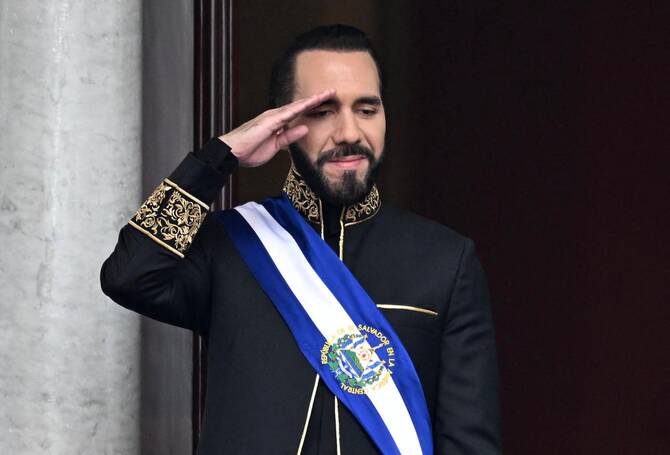
El Salvador President Nayib Bukele's government is facing accusations of repression against rights activists. (AFP)
Short Url
Updated 01 August 2025
Follow

El Salvador parliament adopts reform to allow Bukele to run indefinitely

  • Nayib Bukele, the 44-year-old self-described ‘cool dictator’, has been president since 2019
  • Bukele enjoys enormous support at home for his heavy-handed campaign against criminal gangs

SAN SALVADOR: El Salvador’s lawmakers on Thursday adopted a constitutional reform to abolish presidential term limits and allow current leader Nayib Bukele – who enjoys overwhelming majority support in parliament – to run indefinitely.

The reform, reviewed under an expedited procedure, was adopted by Bukele’s 57 supporters in the Legislative Assembly, and voted against by only three opposition members.

The move will allow re-election “without reservations,” extend the term in office from five to six years, and do away with a second round of voting in elections as Bukele tightens his grip on the Central American nation.

The 44-year-old self-described “cool dictator” has been president since 2019. He was re-elected in 2024 with a whopping majority after a Supreme Court ruling allowed him to bypass a constitutional ban on successive terms.

That election handed Bukele control over state institutions and the parliament, which adopted the changes slammed as anti-democratic by the opposition – the same day as it began debating them.

“Thank you for making history, fellow deputies,” said the president of the Legislative Assembly Ernesto Castro, from the ruling Nuevas Ideas party, after counting the votes.

“This day, democracy has died in El Salvador … The masks were removed,” said opposition lawmaker Marcela Villatoro during the parliamentary session, criticizing the proposal being brought to parliament as the country begins a week of summer holidays.

Lawmakers voted to synchronize legislative, presidential and municipal elections, and the shorten the current presidential term by two years from 2029, with general elections due in March 2027.

With the constitutional reforms, Bukele will be able to run again.

Bukele enjoys enormous support at home for his heavy-handed campaign against criminal gangs, which has reduced violence in the country to historic lows.

But it has also drawn sharp criticism from international rights groups.

His government is also facing accusations of repression against rights activists and critics of Bukele’s government, which has forced dozens of journalists and campaigners into exile.

“The reforms lead to a total imbalance in the democracy that no longer exists,” Miguel Montenegro, director of NGO the Human Rights Commission of El Salvador, told AFP.

In April 2024, the parliament approved a reform so that constitutional changes no longer require ratification in another legislative session.

Opposition politician Claudia Ortiz slammed the reform as “an abuse of power and a caricature of democracy.”


Crime, immigration dominate as Chile votes for president

Updated 4 sec ago
Follow

Crime, immigration dominate as Chile votes for president

  • Chileans are also choosing members of the Chamber of Deputies and Senate
  • A sharp increase in violent crime has sown terror in one of Latin America’s safest nations

SANTIAGO: Chileans stood in long lines on Sunday to vote in general elections dominated by far-right calls for an iron fist on crime and mass migrant deportations.
Pre-election polls showed the main left-wing candidate, Jeannette Jara, a 51-year-old communist running on behalf of a broad coalition, winning the first round of voting for president.
But far-right leader Jose Antonio Kast is tipped to prevail in December’s run-off with Donald Trump-style plans to expel all illegal migrants.
Chileans are also choosing members of the Chamber of Deputies and Senate in the first general elections with compulsory voting since 2012.
Results are expected within two hours of polls closing at 4:00 p.m. (1900 GMT).
A sharp increase in murders, kidnappings and extortion over the past decade has sown terror in what is still one of Latin America’s safest nations.

- Shot for a gold chain -

“Just a few steps from my house, a young boy was recently killed because he was wearing a gold chain; he was shot. And three years ago, on my street, a young girl was almost kidnapped,” Rosario Isidora Herrera Munoz, who voted in Santiago with her six-month-old baby, told AFP.
“I hope that some day we’ll go back to the way we were before,” said Mario Faundez, an 87-year-old retired salesman.
“If we have to kill (criminals), so be it,” he added.
Jara on Sunday accused her rivals of “exacerbating fear” and spreading “hate,” and said their proposals did not amount to a full plan for governing.
The vote is seen as a litmus test for South America’s left, which has been sent packing in Argentina and Bolivia, and faces a stiff challenge in Colombian and Brazilian elections next year.
Jara served as labor minister under outgoing center-left president Gabriel Boric, who cannot run for a second consecutive term.
Ultra-right candidate Johannes Kaiser, who was closing in on Jara and Kast in the final days of campaigning, told AFP the election was about ending Latin America’s “disconnection...from the United States and the free world.”

- Walls, fences, trenches -

Despite a declining murder rate, Chileans remain transfixed by the growing violence of criminals, which they blame on the arrival of gangs from Venezuela and elsewhere.
Kast has vowed to build walls, fences and trenches along Chile’s border with Bolivia to keep out newcomers from poorer countries to the north, such as Venezuela.
Maite Sanchez, a 34-year-old Cuban living legally in Chile, expressed dismay on Sunday over the demonization of migrants “who did things properly, arrived with the right paperwork...and are contributing to the country.
Former YouTube polemicist Kaiser, a fan of Argentina’s Javier Milei, is the most radical of the candidates.
The 49-year-old libertarian MP energized youth voters with rock-themed rallies and blunt language about crime, immigration and the left.
Conservative ex-minister Evelyn Matthei, the 72-year-old establishment choice, struggled to make her mark on the campaign.

- Uphill battle -

Jara faces an uphill battle to overcome strong anti-communist and anti-incumbent sentiment.
Boric defeated Kast in 2021 on a promise to establish a welfare state after mass demonstrations in 2019 over inequality.
But his presidency was fatally weakened after voters massively rejected a progressive new constitution that he had backed.
Jara campaigned as a moderate with a track record of social reforms — she lowered the working week from 45 hours to 40 and raised the minimum wage — and vowing to ensure “every Chilean family can easily make it to the end of the month.”
Patricia Orellana, a 56-year-old Jara voter, said she feared a rollback in women’s rights if Kast or Kaiser, both of whom oppose abortion, won.
Kast, if elected, would be the first far-right leader since the 1973-1990 military dictatorship of Augusto Pinochet.
The son of a German soldier in Hitler’s Nazi army, Kast has defended Pinochet, who overthrew a democratically elected socialist president in 1973 and oversaw a regime that killed thousands of dissidents.