Islamic Jihad publishes video of Israeli hostage held in Gaza

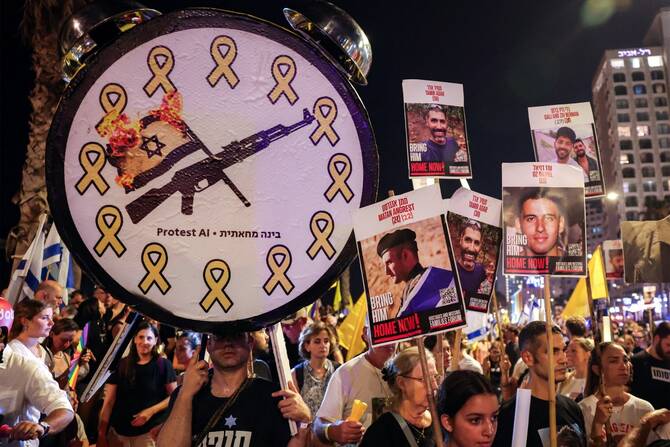
Demonstrators gather for an anti-government protest calling for action to secure the release of Israeli hostages held captive in the Gaza Strip by Palestinian militants, Tel Aviv, July 26, 2025. (AFP)
Short Url
Updated 31 July 2025
Follow

Islamic Jihad publishes video of Israeli hostage held in Gaza

  • Of the 251 people taken from Israel that day, 49 are still held in Gaza, 27 of whom are dead, according to the Israeli army
  • Rom Braslavksi was a security agent at the Nova music festival, one of the sites attacked in October 2023 by Hamas

GAZA CITY: The armed wing of Palestinian militant group Islamic Jihad published a video Thursday of an Israeli-German hostage who was abducted to Gaza in October 2023 during the attack that sparked the Gaza war.
In the six-minute video, the male hostage, speaking in Hebrew, is seen watching recent news footage of the hunger crisis in Gaza. He identifies himself and pleads with the Israeli government to secure his release.
AFP was not immediately able to confirm the authenticity of the video nor the date it was filmed, but was able — along with several Israeli news outlets — to identify the hostage as Rom Braslavksi, a German-Israeli dual national.
Islamic Jihad announced last week that it had lost contact with the hostage and repeats this in commentary at the beginning of the latest video, suggesting the images were filmed more than a week ago.
A previous video of Braslavski was released on April 16.
Originally from Jerusalem, Braslavski was a security agent at the Nova music festival, one of the sites attacked in October 2023 by Hamas and other Palestinian fighters, including members of Islamic Jihad.
The footage, distributed by a movement considered a terrorist organization by the United States and the European Union, shows the young man watching an Arabic-language television channel broadcasting a report on hunger in Gaza.
Before his abduction, he rescued several festivalgoers, according to witnesses who managed to escape.
Of the 251 people taken from Israel that day, 49 are still held in Gaza, 27 of whom are dead, according to the Israeli army.
Israel has been fighting Hamas in Gaza since the kidnappings, but a truce from January 19 to March 17 allowed the return of 33 hostages to Israel, eight of them dead, in exchange for the release of approximately 1,800 Palestinians from Israeli jails.


Iraq’s political future in limbo as factions vie for power

Updated 21 December 2025
Follow

Iraq’s political future in limbo as factions vie for power

  • The government that eventually emerges will be inheriting a security situation that has stabilized in recent years

BAGHDAD: Political factions in Iraq have been maneuvering since the parliamentary election more than a month ago to form alliances that will shape the next government.
The November election didn’t produce a bloc with a decisive majority, opening the door to a prolonged period of negotiations.
The government that eventually emerges will be inheriting a security situation that has stabilized in recent years, but it will also face a fragmented parliament, growing political influence by armed factions, a fragile economy, and often conflicting international and regional pressures, including the future of Iran-backed armed groups.
Uncertain prospects
Prime Minister Mohammed Shia Al-Sudani’s party took the largest number of seats in the election. Al-Sudani positioned himself in his first term as a pragmatist focused on improving public services and managed to keep Iraq on the sidelines of regional conflicts.
While his party is nominally part of the Coordination Framework, a coalition of Iran-backed Shiite parties that became the largest parliamentary bloc, observers say it’s unlikely that the Coordination Framework will support Al-Sudani’s reelection bid.
“The choice for prime minister has to be someone the Framework believes they can control and doesn’t have his own political ambitions,” said Sajad Jiyad, an Iraqi political analyst and fellow at The Century Foundation think tank.
Al-Sudani came to power in 2022 with the backing of the Framework, but Jiyad said that he believes now the coalition “will not give Al-Sudani a second term as he has become a powerful competitor.”
The only Iraqi prime minister to serve a second term since 2003 was Nouri Al-Maliki, first elected in 2006. His bid for a third term failed after being criticized for monopolizing power and alienating Sunnis and Kurds.
Jiyad said that the Coordination Framework drew a lesson from Al-Maliki “that an ambitious prime minister will seek to consolidate power at the expense of others.”
He said that the figure selected as Iraq’s prime minister must generally be seen as acceptable to Iran and the United States — two countries with huge influence over Iraq — and to Iraq’s top Shiite cleric, Grand Ayatollah Ali Al-Sistani.
Al-Sudani in a bind
In the election, Shiite alliances and lists — dominated by the Coordination Framework parties — secured 187 seats, Sunni groups 77 seats, Kurdish groups 56 seats, in addition to nine seats reserved for members of minority groups.
The Reconstruction and Development Coalition, led by Al-Sudani, dominated in Baghdad, and in several other provinces, winning 46 seats.
Al-Sudani’s results, while strong, don’t allow him to form a government without the support of a coalition, forcing him to align the Coordination Framework to preserve his political prospects.
Some saw this dynamic at play earlier this month when Al-Sudani’s government retracted a terror designation that Iraq had imposed on the Lebanese Hezbollah militant group and Yemen’s Houthi rebels — Iran-aligned groups that are allied with Iraqi armed factions — just weeks after imposing the measure, saying it was a mistake.
The Coalition Framework saw its hand strengthened by the absence from the election of the powerful Sadrist movement led by Shiite cleric Muqtada Sadr, which has been boycotting the political system since being unable to form a government after winning the most seats in the 2021 election.
Hamed Al-Sayed, a political activist and official with the National Line Movement, an independent party that boycotted the election, said that Sadr’s absence had a “central impact.”
“It reduced participation in areas that were traditionally within his sphere of influence, such as Baghdad and the southern governorates, leaving an electoral vacuum that was exploited by rival militia groups,” he said, referring to several parties within the Coordination Framework that also have armed wings.
Groups with affiliated armed wings won more than 100 parliamentary seats, the largest showing since 2003.
Other political actors
Sunni forces, meanwhile, sought to reorganize under a new coalition called the National Political Council, aiming to regain influence lost since the 2018 and 2021 elections.
The Kurdish political scene remained dominated by the traditional split between the Kurdistan Democratic Party and Patriotic Union of Kurdistan parties, with ongoing negotiations between the two over the presidency.
By convention, Iraq’s president is always a Kurd, while the more powerful prime minister is Shiite and the parliamentary speaker Sunni.
Parliament is required to elect a speaker within 15 days of the Federal Supreme Court’s ratification of the election result, which occurred on Dec. 14.
The parliament should elect a president within 30 days of its first session, and the prime minister should be appointed within 15 days of the president’s election, with 30 days allotted to form the new government.
Washington steps in
The incoming government will face major economic and political challenges.
They include a high level of public debt — more than 90 trillion Iraqi dinars ($69 billion) — and a state budget that remains reliant on oil for about 90 percent of revenues, despite attempts to diversify, as well as entrenched corruption.
But perhaps the most delicate question will be the future of the Popular Mobilization Forces, a coalition of militias that formed to fight the Daesh group as it rampaged across Iraq more than a decade ago.
It was formally placed under the control of the Iraqi military in 2016 but in practice still operates with significant autonomy. After the Hamas-led attack in southern Israel on Oct. 7, 2023 sparked the devastating war in Gaza, some armed groups within the PMF launched attacks on US bases in the region in retaliation for Washington’s backing of Israel.
The US has been pushing for Iraq to disarm Iran-backed groups — a difficult proposition, given the political power that many of them hold and Iran’s likely opposition to such a step.
Two senior Iraqi political officials, who spoke on condition of anonymity because they weren’t authorized to comment publicly, said that the United States had warned against selecting any candidate for prime minister who controls an armed faction and also cautioned against letting figures associated with militias control key ministries or hold significant security posts.
“The biggest issue will be how to deal with the pro-Iran parties with armed wings, particularly those... which have been designated by the United States as terrorist entities,” Jiyad said.