

Top Pakistani general meets Egyptian president, leadership to discuss military, counterterrorism cooperation

Short Url
Updated 31 July 2025
Follow

Top Pakistani general meets Egyptian president, leadership to discuss military, counterterrorism cooperation

  • Pakistan’s chairman joints chiefs of staff committee is in Cairo for the third round of Defense and Security Talks with Egypt
  • General Sahir Shamshad Mirza meets Al-Azhar’s grand imam to discuss importance of religious harmony, says Pakistan military

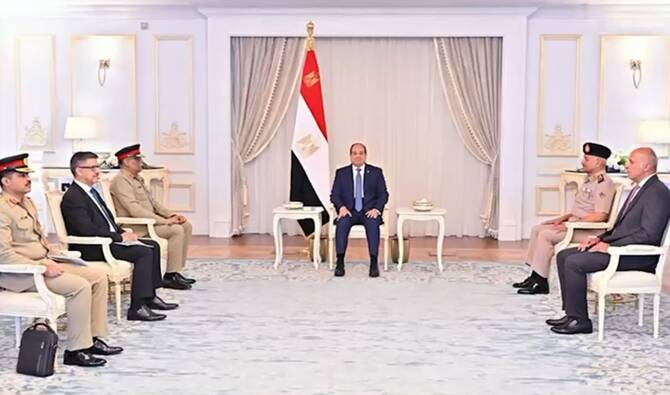
ISLAMABAD: A Pakistani top general met Egyptian President Abdel Fattah El-Sisi and the country’s senior civil and defense leadership on Thursday to discuss regional situation, military and counterterrorism cooperation, the Pakistani military’s media wing said. 

General Sahir Shamshad Mirza, who is Pakistan’s chairman joint chiefs of staff committee (CJCSC), is in Egypt for the third round of defense and security talks between the two countries. During the visit, he met senior Egyptian officials such as El-Sisi, General Abdel Mageed Ahmed Abdel Mageed Saqr, minister of defense and military production and commander-in-chief of the Egyptian Armed Forces, Admiral Osama Mounier Mohamed Rabie. 

He also met the chairman and managing director of the Suez Canal Authority, as well as Professor Dr. Ahmed Mohamed Ahmed El-Tayeb, the grand imam of the Al-Azhar institute, the Inter-Services Public Relations (ISPR), the Pakistani military’s media wing, said. 

“Discussions focused on bilateral military cooperation, security, counterterrorism and prevailing regional situation,” the ISPR said. “Dignitaries from both sides emphasized upon the shared interest in further strengthening and expanding existing military-to-military relationship in the domains of training, joint military exercises and defense cooperation.”

Speaking to El-Tayeb, Mirza highlighted the importance of religious and inter-faith harmony to promote tolerance, inclusivity and address the underlying causes of “terrorism,” the military’s media wing said. 

“Egyptian dignitaries lauded the professionalism of Pakistan Armed Forces and acknowledged their sacrifices in the fight against terrorism,” the ISPR said. 

Mirza was presented a guard of honor by an Egyptian Armed Forces contingent upon his arrival at the Ministry of Defense, the military’s media wing said. 

Pakistan and Egypt have cordial ties and both countries have resolved in recent years to facilitate businessmen with visas, exchange trade-related information and promote private-sector contacts.

Earlier this month, senior officials of Pakistan and Egypt discussed enhancing bilateral cooperation in agriculture, food security and farming, with Islamabad expressing interest in learning from Cairo’s successful experiences in these areas.


Return of millions of Afghans from Pakistan and Iran pushes Afghanistan to the brink, UN warns

Updated 14 February 2026
Follow

Return of millions of Afghans from Pakistan and Iran pushes Afghanistan to the brink, UN warns

  • Afghan authorities provide care packages for those returning that include food aid, cash, a telephone SIM card and transportation
  • But the returns have strained resources in a country struggling with a weak economy, severe drought and two devastating earthquakes

GENEVA: The return of millions of Afghans from neighboring Pakistan and Iran is pushing Afghanistan to the brink, the U.N. refugee agency said on Friday, describing an unprecedented scale of returns.

A total of 5.4 million people have returned to Afghanistan since October 2023, mostly from the two neighboring countries, UNHCR’s Afghanistan representative Arafat Jamal said, speaking to a U.N. briefing in Geneva via video link from Kabul, the Afghan capital.

“This is massive, and the speed and scale of these returns has pushed Afghanistan nearly to the brink,” Jamal said.

Pakistan launched a sweeping crackdown in Oct. 2023 to expel migrants without documents, urging those in the country to leave of their own accord to avoid arrest and forcible deportation and forcibly expelling others. Iran also began a crackdown on migrants at around the same time.

Since then, millions have streamed across the border into Afghanistan, including people who were born in Pakistan decades ago and had built lives and created businesses there.

Last year alone, 2.9 million people returned to Afghanistan, Jamal said, noting it was “the largest number of returns that we have witnessed to any single country.”

Afghanistan’s Taliban rulers have criticized the mass expulsions.

Afghanistan was already struggling with a dire humanitarian situation and a poor human rights record, particularly relating to women and girls, and the massive influx of people amounting to 12% of the population has put the country under severe strain, Jamal said.

Already in just the month and a half since the start of this year, about 150,000 people had returned to Afghanistan, he added.

Afghan authorities provide care packages for those returning that include some food aid, cash, a telephone SIM card and transportation to parts of the country where they might have family. But the returns have strained resources in a country that was already struggling to cope with a weak economy and the effects of a severe drought and two devastating earthquakes.

In November, the U.N. development program said nine out of 10 families in areas of Afghanistan with high rates of return were resorting to what are known as negative coping mechanisms — either skipping meals, falling into debt or selling their belongings to survive.

“We are deeply concerned about the sustainability of these returns,” Jamal said, noting that while 5% of those who return say they will leave Afghanistan again, more than 10% say they know of someone who has already left.

“These decisions, I would underscore, to undertake dangerous journeys, are not driven by a lack of a desire to remain in the country, on the contrary, but the reality that many are unable to rebuild their viable and dignified lives,” he said.