GAZA/CAIRO/JERUSALEM: In a makeshift tent on a Gazan beach, three-month-old Muntaha’s grandmother grinds up chickpeas into the tiniest granules she can to form a paste to feed the infant, knowing it will cause her to cry in pain, in a desperate race to keep the baby from starving.
“If the baby could speak, she would scream at us, asking what we are putting into her stomach,” her aunt, Abir Hamouda said.
Muntaha grimaced and squirmed as her grandmother fed her the paste with a syringe.
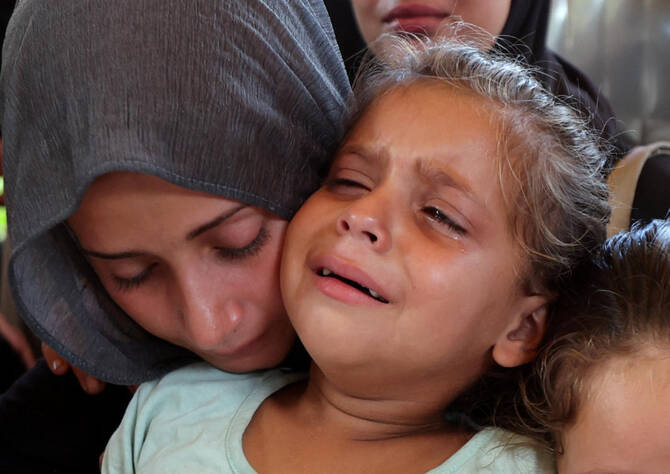
Muntaha’s family is one of many in Gaza facing dire choices to try to feed babies, especially those below the age of six months who cannot process solid food.
Infant formula is scarce after a plummet in aid access to Gaza. Many women cannot breastfeed due to malnourishment, while other babies are separated from their mothers due to displacement, injury or, in Muntaha’s case, death.
Her family says the baby’s mother was hit by a bullet while pregnant, gave birth prematurely while unconscious in intensive care, and died a few weeks later. The director of the Shifa Hospital described such a case in a Facebook post on April 27, four days after Muntaha was born.
“I am terrified about the fate of the baby,” said her grandmother, Nemah Hamouda. “We named her after her mother...hoping she can survive and live long, but we are so afraid, we hear children and adults die every day of hunger.”
Muntaha now weighs about 3.5 kilograms, her family said, barely more than half of what a full-term baby her age would normally weigh. She suffers stomach problems like vomiting and diarrhea after feeding.
Health officials, aid workers and Gazan families told Reuters many families are feeding infants herbs and tea boiled in water, or grinding up bread or sesame. Humanitarian agencies also reported cases of parents boiling leaves in water, eating animal feed and grinding sand into flour.
Feeding children solids too early can disrupt their nutrition, cause stomach problems, and risk choking, paediatric health experts say.
“It’s a desperate move to compensate for the lack of food,” said UNICEF spokesperson Salim Oweis. “When mothers can’t breastfeed or provide proper infant formula they resort to grinding chickpeas, bread, rice, anything that they can get their hands on to feed their children... it is risking their health because these supplies are not made for infants to feed on.”
BABY BOTTLES WITHOUT MILK
Gaza’s spiralling humanitarian crisis prompted the main world hunger monitoring body on Tuesday to say a worst-case scenario of famine is unfolding and immediate action is needed to avoid widespread death. Images of emaciated Palestinian children have shocked the world.
Gazan health authorities have reported more and more people dying from hunger-related causes. The total so far stands at 154, among them 89 children, most of whom died in the last few weeks.
With the international furor over Gaza’s ordeal growing, Israel announced steps over the weekend to ease aid access. But the UN World Food Programme said on Tuesday it was still not getting the permissions it needed to deliver enough aid.
Israel and the US accuse militant group Hamas of stealing aid — which the militants deny — and the UN of failing to prevent it. The UN says it has not seen evidence of Hamas diverting much aid. Hamas accuses Israel of causing starvation and using aid as a weapon, which the Israeli government denies.
Humanitarian agencies say there is almost no infant formula left in Gaza. The cans available in the market cost over $100 – impossible to afford for families like Muntaha’s, whose father has been jobless since the war closed his falafel business and displaced the family from their home.
In the paediatric ward of Al-Aqsa Martyrs Hospital in the central Gaza city of Deir Al-Balah, the infant formula supply is mostly depleted.
One mother showed how she poured thick tahini sesame paste into a bottle and mixed it with water.
“I am using this instead of milk, to compensate her for milk, but she won’t drink it,” said Azhar Imad, 31, the mother of four-month-old Joury.
“I also make her fenugreek, anize, caraway, any kind of herbs (mixed with water),” she said, panicked as she described how instead of nourishing her child, these attempts were making her sick.
Medical staff at the hospital spoke of helplessness, watching on as children’s health deteriorated with no way to safely feed them.
“Now, children are being fed either water or ground hard legumes, and this is harmful for children in Gaza,” said doctor Khalil Daqran.
“If the hunger continues ... within three or four days, if the child doesn’t get access to milk immediately, then they will die,” he said.

‘If the baby could speak, she would scream’: the risky measures to feed small babies in Gaza
Short Url
https://arab.news/wnabe
‘If the baby could speak, she would scream’: the risky measures to feed small babies in Gaza
- Gazan families forced to feed infants ground chickpeas, herbs
- Little formula available, many mothers unable to breastfeed
How succession works in Iran and who will be the country’s next supreme leader?
DUBAI: The death of Iran’s Supreme Leader Ayatollah Ali Khamenei after almost 37 years in power raises paramount questions about the country’s future. The contours of a complex succession process began to take shape the morning after Khamenei’s assassination.
Here is what to know:
A temporary leadership council assumes duties
As outlined in its constitution, Iran on Sunday formed a council to assume leadership duties and govern the country.
The council is made up of Iran’s sitting president, the head of the country’s judiciary and a member of the Guardian Council chosen by Iran’s Expediency Council, which advises the supreme leader and settles disputes with parliament.
Iran’s reformist President Masoud Pezeshkian and hard-line judiciary chief Gholamhossein Mohseni Ejei are its members who will step in and “temporarily assume all the duties of leadership.”
A panel of clerics selects a new supreme leader
Though the leadership council will govern in the interim, an 88-member panel called the Assembly of Experts “must, as soon as possible” pick a new supreme leader under Iranian law.
The panel consists entirely of Shiite clerics who are popularly elected every eight years and whose candidacies are approved by the Guardian Council, Iran’s constitutional watchdog. That body is known for disqualifying candidates in various elections in Iran and the Assembly of Experts is no different. The Guardian Council barred former Iranian President Hassan Rouhani, a relative moderate whose administration struck the 2015 nuclear deal with world powers, from election for the Assembly of Experts in March 2024.
Khamenei’s son could be a possible contender
Clerical deliberations about succession and machinations over it take place far from the public eye, making it hard to gauge who may be a top contender.
Previously, it was thought Khamenei’s protégé, hard-line President Ebrahim Raisi, may try to take the mantle. However, he was killed in a May 2024 helicopter crash. That has left one of Khamenei’s sons, Mojtaba, a 56-year-old Shiite cleric, as a potential candidate, though he has never held government office. But a father-to-son transfer in the case of a supreme leader could spark anger, not only among Iranians already critical of clerical rule, but also among supporters of the system. Some may see it as un-Islamic and in line with creating a new, religious dynasty after the 1979 collapse of the US-backed Shah Mohammad Reza Pahlavi’s government.
A transition like this has happened only once before
There has been only one other transfer of power in the office of supreme leader of Iran, the paramount decision-maker since the country’s 1979 Islamic Revolution.
In 1989, Grand Ayatollah Ruhollah Khomeini died at age 86 after being the figurehead of the revolution and leading Iran through its bloody eight-year war with Iraq. This transition now comes after Israel launched a 12-day war against Iran in June 2025 as well.
The vast powers of a supreme leader
The supreme leader is at the heart of Iran’s complex power-sharing Shiite theocracy and has final say over all matters of state.
He also serves as the commander-in-chief of the country’s military and the powerful Revolutionary Guard, a paramilitary force that the United States designated a terrorist organization in 2019 and which Khamenei empowered during his rule. The Guard, which has led the self-described “Axis of Resistance,” a series of militant groups and allies across the Middle East meant to counter the US and Israel, also has extensive wealth and holdings in Iran.
Here is what to know:
A temporary leadership council assumes duties
As outlined in its constitution, Iran on Sunday formed a council to assume leadership duties and govern the country.
The council is made up of Iran’s sitting president, the head of the country’s judiciary and a member of the Guardian Council chosen by Iran’s Expediency Council, which advises the supreme leader and settles disputes with parliament.
Iran’s reformist President Masoud Pezeshkian and hard-line judiciary chief Gholamhossein Mohseni Ejei are its members who will step in and “temporarily assume all the duties of leadership.”
A panel of clerics selects a new supreme leader
Though the leadership council will govern in the interim, an 88-member panel called the Assembly of Experts “must, as soon as possible” pick a new supreme leader under Iranian law.
The panel consists entirely of Shiite clerics who are popularly elected every eight years and whose candidacies are approved by the Guardian Council, Iran’s constitutional watchdog. That body is known for disqualifying candidates in various elections in Iran and the Assembly of Experts is no different. The Guardian Council barred former Iranian President Hassan Rouhani, a relative moderate whose administration struck the 2015 nuclear deal with world powers, from election for the Assembly of Experts in March 2024.
Khamenei’s son could be a possible contender
Clerical deliberations about succession and machinations over it take place far from the public eye, making it hard to gauge who may be a top contender.
Previously, it was thought Khamenei’s protégé, hard-line President Ebrahim Raisi, may try to take the mantle. However, he was killed in a May 2024 helicopter crash. That has left one of Khamenei’s sons, Mojtaba, a 56-year-old Shiite cleric, as a potential candidate, though he has never held government office. But a father-to-son transfer in the case of a supreme leader could spark anger, not only among Iranians already critical of clerical rule, but also among supporters of the system. Some may see it as un-Islamic and in line with creating a new, religious dynasty after the 1979 collapse of the US-backed Shah Mohammad Reza Pahlavi’s government.
A transition like this has happened only once before
There has been only one other transfer of power in the office of supreme leader of Iran, the paramount decision-maker since the country’s 1979 Islamic Revolution.
In 1989, Grand Ayatollah Ruhollah Khomeini died at age 86 after being the figurehead of the revolution and leading Iran through its bloody eight-year war with Iraq. This transition now comes after Israel launched a 12-day war against Iran in June 2025 as well.
The vast powers of a supreme leader
The supreme leader is at the heart of Iran’s complex power-sharing Shiite theocracy and has final say over all matters of state.
He also serves as the commander-in-chief of the country’s military and the powerful Revolutionary Guard, a paramilitary force that the United States designated a terrorist organization in 2019 and which Khamenei empowered during his rule. The Guard, which has led the self-described “Axis of Resistance,” a series of militant groups and allies across the Middle East meant to counter the US and Israel, also has extensive wealth and holdings in Iran.
© 2026 SAUDI RESEARCH & PUBLISHING COMPANY, All Rights Reserved And subject to Terms of Use Agreement.


