

Pakistan’s KP to hold tribal council meetings from this weekend over concerns amid Bajaur military operation

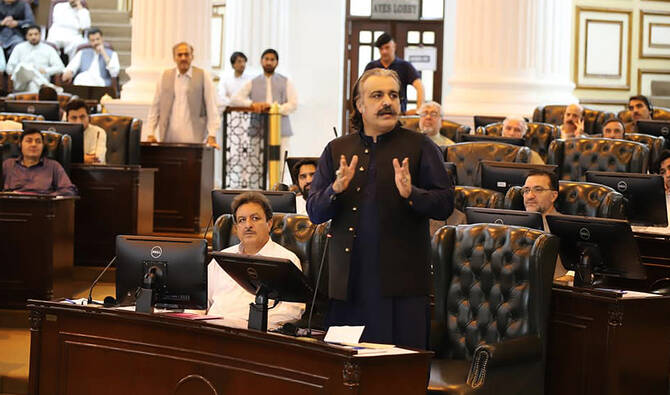
In this file photo, taken on June 3, 2024, Pakistan’s Khyber Pakhtunkhwa Chief Minister Ali Amin Gandapur speaks at the provincial assembly in Peshawar. (Photo courtesy: Facebook/pakpgov/File)
Short Url
Updated 30 July 2025
Follow

Pakistan’s KP to hold tribal council meetings from this weekend over concerns amid Bajaur military operation

  • Province’s local elders, political parties and representatives, stakeholders will be part of councils, says KP chief minister
  • Development takes place amid protests over deteriorating law and order situation in northwestern Bajaur district

PESHAWAR: The chief minister of Pakistan’s Khyber Pakhtunkhwa (KP) province, Ali Amin Gandapur, announced on Wednesday that the provincial government will hold a series of tribal council meetings or jirgas from August 2 to address people’s concerns, amid protests over the deteriorating law and order situation amid a fresh military operation in the restive Bajaur district.

Located in KP along the Afghan border, the northwestern Bajaur district has long experienced militant violence and multiple military operations, especially during the peak of the Tehreek-e-Taliban Pakistan (TTP) insurgency.

Hundreds of protesters, including tribal elders and youth, rallied on Wednesday in Bajaur district to express concern over the deteriorating law and order situation in the area, as the military launched an operation against militants that has left at least three civilians dead and seven injured, according to local representatives. Residents say they are opposing the latest offensive out of fear of displacement, as previous operations in the tribal belt, led to evacuations and long-term instability.

The unrest erupted following a three-day curfew imposed across 16 villages in Bajaur’s Loi Mamund tehsil, where the Pakistan Army began a counterterrorism operation codenamed “Sarbakaf” on July 29. The curfew, announced in a notification by the district’s deputy commissioner, aimed to “ensure public safety” amid intelligence reports of militant activity.

“I am starting jirgas [tribal councils] and from August 2, god willing, our jirgas will begin,” Gandapur said in a video message released by his office.

He added that at first, the jirgas will be held at the division level where all of the province’s local elders, political parties, political representatives, and stakeholders will sit together for consultations.

“The purpose of the consultations is to address the reservations and after these jirgas, we will hold a grand jirga in which we will give our policy, our plan and future strategy after sitting with all institutions,” the chief minister added.

The Pakistani military’s offensive triggered intense clashes with suspected militants, as local residents say the crossfire spilled into civilian areas, forcing many families to flee.

“The situation remains tense, and some families have already relocated to safer areas within the district,” Dr. Hamid ur Rehman, a provincial lawmaker from Bajaur affiliated with the Pakistan Tehreek-e-Insaf (PTI) party, told Arab News over the phone while confirming civilian casualties.

“The operation has been paused today, but there’s still fear in the air,” he added.

He said a provincial assembly session scheduled for August 1 would discuss the crisis.

Pakistan’s military did not respond to a request for comment from Arab News when this report was filed.

Nisar Muhammad, spokesperson for the provincial information department, said the government was “closely monitoring” the situation and had convened an apex committee meeting to review the security response.

“The curfew will be lifted in phases, depending on the ground situation,” he added. “Civilian safety is our priority.”

The escalation has drawn sharp criticism from political leaders.

Aimal Wali Khan, president of the Awami National Party, denounced the violence in a social media statement, saying, “The bloodshed in Bajaur must end.”

Malik Farman Ullah, a tribal elder, voiced frustration over the recurring violence in the region.

“Our people are exhausted from burying the dead,” he said. “We demand that militants and security forces keep their clashes away from civilian homes.”

The Bajaur operation comes amid renewed concerns about the TTP’s presence along the Afghan border and a broader uptick in militant violence across Khyber Pakhtunkhwa.

The provincial administration, led by Gandapur, has called for greater provincial involvement in security decisions, emphasizing the need to balance counterterrorism with civilian protections.

As tensions rise, the federal and provincial governments face growing pressure to restore stability without repeating past cycles of violence in the tribal belt.


IMF warns against policy slippage amid weak recovery as it clears $1.2 billion for Pakistan

Updated 11 December 2025
Follow

IMF warns against policy slippage amid weak recovery as it clears $1.2 billion for Pakistan

  • Pakistan rebuilt reserves, cut its deficit and slowed inflation sharply over the past one year
  • Fund says climate shocks, energy debt, stalled reforms threaten stability despite recent gains

ISLAMABAD: Pakistan’s economic recovery remains fragile despite a year of painful stabilization measures that helped pull the country back from the brink of default, the International Monetary Fund (IMF) warned on Thursday, after it approved a fresh $1.2 billion disbursement under its ongoing loan program.

The approval covers the second review of Pakistan’s Extended Fund Facility (EFF) and the first review of its climate-focused Resilience and Sustainability Facility (RSF), bringing total disbursements since last year to about $3.3 billion.

Pakistan entered the IMF program in September 2024 after years of weak revenues, soaring fiscal deficits, import controls, currency depletion and repeated climate shocks left the economy close to external default. A smaller stopgap arrangement earlier that year helped avert immediate default, but the current 37-month program was designed to restore macroeconomic stability through strict monetary tightening, currency adjustments, subsidy rationalization and aggressive revenue measures.

The IMF’s new review shows that Pakistan has delivered significant gains since then. Growth recovered to 3 percent last year after shrinking the year before. Inflation fell from over 23 percent to low single digits before rising again after this year’s floods. The current account posted its first surplus in 14 years, helped by stronger remittances and a sharp reduction in imports. And the government delivered a primary budget surplus of 1.3 percent of GDP, a key program requirement. Foreign exchange reserves, which had dropped dangerously low in 2023, rose from US$9.4 billion to US$14.5 billion by June.

“Pakistan’s reform implementation under the EFF arrangement has helped preserve macroeconomic stability in the face of several recent shocks,” IMF Deputy Managing Director Nigel Clarke said in a statement after the Board meeting.

But he warned that Islamabad must “maintain prudent policies” and accelerate reforms needed for private-sector-led and sustainable growth.

The Fund noted that the 2025 monsoon floods, affecting nearly seven million people, damaging housing, livestock and key crops, and displacing more than four million, have set back the recovery. The IMF now expects GDP growth in FY26 to be slightly lower and forecasts inflation to rise to 8–10 percent in the coming months as food prices adjust.

The review warns Pakistan against relaxing monetary or fiscal discipline prematurely. It urges the State Bank to keep policy “appropriately tight,” allow exchange-rate flexibility and improve communication. Islamabad must also continue raising revenues, broadening the tax base and protecting social spending, the Fund said.

Despite the progress, Pakistan’s structural weaknesses remain severe.

Power-sector circular debt stands at about $5.7 billion, and gas-sector arrears have climbed to $11.3 billion despite tariff adjustments. Reform of state-owned enterprises has slowed, including delays in privatizing loss-making electricity distributors and Pakistan International Airlines. Key governance and anti-corruption reforms have also been pushed back.

The IMF welcomed Pakistan’s expansion of its flagship Benazir Income Support Program, which raises cash transfers for low-income families and expands coverage, saying social protection is essential as climate shocks intensify. But it warned that high public debt, about 72 percent of GDP, thin external buffers and climate exposure leave the country vulnerable if reform momentum weakens.

The Fund said Pakistan’s challenge now is to convert short-term stabilization into sustained recovery after years of economic volatility, with its ability to maintain discipline, rather than the size of external financing alone, determining the durability of its gains.