

EU urges respect for Somalia sovereignty after Israel Somaliland recognition

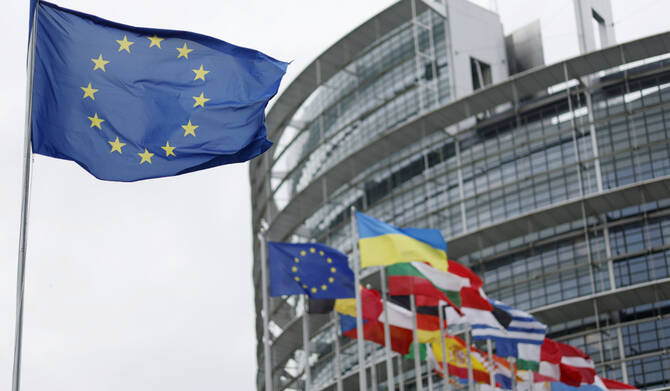
The European flag, left, flies at the European Parliament in Strasbourg, eastern France, on April 18, 2023. (AP)
Short Url
Updated 28 December 2025
Follow

EU urges respect for Somalia sovereignty after Israel Somaliland recognition

  • After Israel’s move, Mogadishu denounced a “deliberate attack” on its sovereignty, while Egypt, Turkiye, the six-nation Gulf Cooperation Council and the Saudi-based Organization of Islamic Cooperation all condemned the decision

BRUSSELS, Belgium: The European Union on Saturday insisted Somalia’s sovereignty should be respected after Israel formally recognized its northern region of Somaliland as an independent state.
Israel said on Friday it was officially recognizing Somaliland, a first for the self-proclaimed republic that in 1991 declared it had unilaterally seceded from Somalia.
EU foreign affairs spokesman Anouar El Anouni said the bloc “reaffirms the importance of respecting the unity, the sovereignty and the territorial integrity of the Federal Republic of Somalia pursuant of its constitution, the Charters of the African Union and the United Nations.”
“This is key for the peace and stability of the entire Horn of Africa region,” the spokesman said in a statement.
“The EU encourages meaningful dialogue between Somaliland and the Federal Government of Somalia to resolve long standing differences,” he added.
After Israel’s move, Mogadishu denounced a “deliberate attack” on its sovereignty, while Egypt, Turkiye, the six-nation Gulf Cooperation Council and the Saudi-based Organization of Islamic Cooperation all condemned the decision.
A self-proclaimed republic, Somaliland enjoys a strategic position on the Gulf of Aden and has its own money, passports and army.
But it has been diplomatically isolated since unilaterally declaring independence.


Afghanistan says working with Tajikistan to investigate deadly border clash

Updated 9 sec ago
Follow

Afghanistan says working with Tajikistan to investigate deadly border clash

  • Tajikistan shares a mountainous border of about 1,350 kilometers (839 miles) with Afghanistan and has had tense relations with Kabul’s Taliban authorities, who returned to power in 2021

KABUL: Afghanistan’s Taliban authorities said Saturday they were working with neighboring Tajikistan to investigate a border clash earlier this week that killed five people, including two Tajik guards.
Tajikistan announced on Thursday that three members of a “terrorist” group had crossed into the Central Asian country “illegally” at Khatlon province, which borders Afghanistan.
Tajik security forces killed the trio, but two border guards also died in the clash, the Tajik national security committee said.
Afghan Foreign Minister Amir Khan Muttaqi said on Saturday that “we have started serious investigations into” the recent “incidents” on Tajik soil.
“I spoke to the foreign minister of Tajikistan and we are working together to prevent such incidents,” he told an event in Kabul.
“We are worried that some malicious circles want to destroy the relations between two neighboring countries,” the minister added, without elaborating.
Tajikistan shares a mountainous border of about 1,350 kilometers (839 miles) with Afghanistan and has had tense relations with Kabul’s Taliban authorities, who returned to power in 2021.
Unlike other Central Asian leaders, Tajik President Emomali Rakhmon, who has been in power since 1992, has criticized the Taliban and urged them to respect the rights of ethnic Tajiks in Afghanistan.
At least five Chinese nationals were killed and several wounded in two separate attacks along the border with Afghanistan in late November and early December, according to Tajik authorities.
According to a UN report in December, the jihadist group Jamaat Ansarullah “has fighters spread across different regions of Afghanistan” with a primary goal “to destabilize the situation in Tajikistan.”
Dushanbe is also concerned about the presence in Afghanistan of members of the terrorist organization Daesh in Khorasan.