

Cultural and architectural heritage on display at Ali bin Rumman Castle in Saudi Arabia’s Tayma

1 / 2
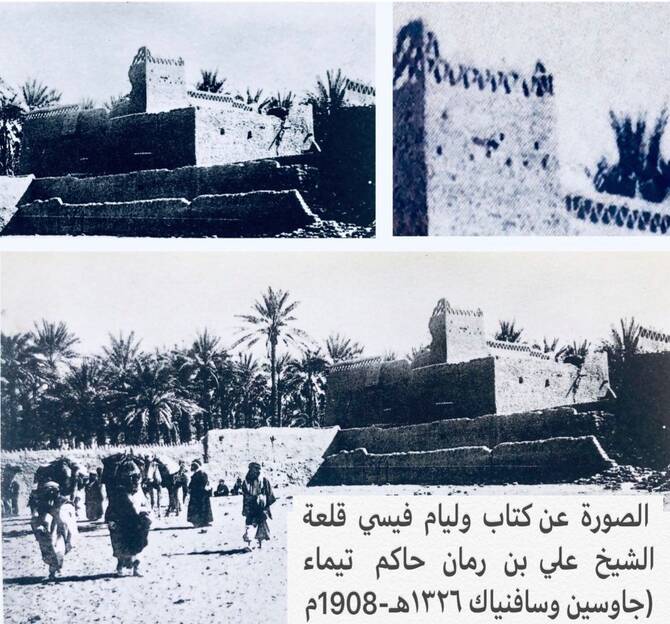
Ali bin Rumman Castle has become a prominent tourist and cultural landmark, attracting visitors from within and beyond the Kingdom. (Supplied)
2 / 2
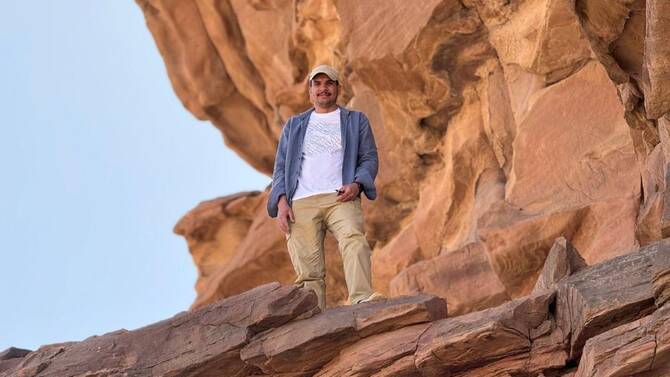
Abdul-Ilah Al-Fares, a member of the Saudi Heritage Preservation Society, emphasized the cultural significance of the site. (Supplied)
Short Url
Updated 31 July 2025
Follow

Cultural and architectural heritage on display at Ali bin Rumman Castle in Saudi Arabia’s Tayma

  • Castle is one of the most prominent heritage and cultural landmarks in the region, representing a key era in the evolution of traditional architecture
  • Tells the story of generations who laid the foundations of an enduring civilization, one whose legacy lives in the Tayma oasis today

MAKKAH: In the Tayma oasis is Ali bin Rumman Castle, an architectural gem and symbol of the heritage of the Tabuk region.

The castle is one of the most prominent heritage and cultural landmarks in the region, representing a key era in the evolution of traditional architecture in northern Saudi Arabia.

It tells the story of generations who laid the foundations of an enduring civilization, one whose legacy lives in the Tayma oasis today.

In an interview with Arab News, Abdul-Ilah Al-Fares, a member of the Saudi Heritage Preservation Society, emphasized the cultural significance of the site, describing the castle as “a reflection of our identity, a unique architectural landmark that has retained its form for more than three centuries.”

He said: “The castle is a true example of local building traditions in Tayma, where people relied on natural materials like stone, clay and mud bricks,” he added.

“They designed it with a sophisticated architectural style that blends beauty with function.”

Al-Fares said the castle’s history dates from 1720, when it was founded by Hutaimi bin Saad Al-Ali, Prince Al-Ruman’s father.

It later became the headquarters of his son, Prince Ali, who used it as a residence and a center for managing his family’s affairs and the surrounding farms and orchards.

“The castle has preserved its majesty despite the circumstances and upheavals it has undergone.

“The towers, buildings, climate and gates still bear witness to the precision and beauty of its architecture, and to the castle’s position in the social and political life of that era,” Al-Fares added.

He said that the restoration work led by Sheikh Nahar Abdul Karim Al-Rumman had a significant influence in bringing the landmark back to life.

The sheikh oversaw the restoration and rehabilitation work in 2018 under his direct supervision, ensuring the preservation of the castle’s identity and original structure.

The restoration “was a project aimed at preserving the history of a nation and a heritage that reflects a vital part of the local community’s collective memory. The work followed architectural guidelines faithful to the original style, while enhancing external facilities and applying paint to highlight the site’s aesthetic value,” he said.

Al-Fares pointed out the castle’s unique features, including massive watchtowers, a mosque in the southwestern corner, stables, guest house and mud wall surrounding the entire site, in addition to the large gates for horses and camels.

He also said that castle was a focal point of the Al-Rumman family’s life, with some of its buildings used as warehouses, and a reception center, evidenced by its reception of King Saud bin Abdulaziz during his visit to Tayma in 1954.

“Today, the castle has become a prominent tourist and cultural landmark, attracting visitors from within and beyond the Kingdom.

“It stands as a living testament to the uniqueness of Najdi architecture and the rich historical and cultural heritage of the Tabuk region.

“Preserving it is a national duty, not merely as a collection of mud buildings, but as a symbol of our national memory and a source of inspiration for future generations,” Al-Fares said, emphasizing the importance of connecting this legacy to the Kingdom’s Vision 2030.


‘The Secret Agent’ — Brazilian political thriller lives up to the awards hype

Updated 13 February 2026
Follow

‘The Secret Agent’ — Brazilian political thriller lives up to the awards hype

DUBAI: Brazilian director Kleber Mendonca Filho’s political thriller may be set during his homeland’s turbulent 1970s — under a military dictatorship that committed extensive human rights abuses — but this ambitious, layered, and beautifully realized movie is loaded with timely reminders of what happens when political violence and moral turpitude are normalized, and — in one memorable fantastical scene — when fake news turns into mass hysteria.

The film follows Marcelo (the compelling Wagner Moura), an academic working in engineering, who discovered that a government minister was shutting down his university department in order to funnel its research into a private company in which the minister owned shares. When Marcelo points out the corruption, he becomes a marked man and must go on the run, leaving his young son with the parents of his late wife. He is moved to a safe house in Recife, run by the sweet-but-steely Dona Sebastiana (an effervescent Tania Maria) on behalf of a resistance group. They find him a job in the government department responsible for issuing ID cards.

Here he meets the despicable Euclides (Roberio Diogenes) — a corrupt cop whose department uses a carnival as cover to carry out extrajudicial murders — and his goons. He also learns that the minister with whom he argued has hired two hitmen to kill him. Time is running out. But soon he should have his fake passport and be able to flee.

“The Secret Agent” is much more than just its plot, though. It is subtle — sometimes oblique, even. It is vivid and darkly humorous. It takes its time, allowing the viewer to wallow in its vibrant colors and equally vibrant soundtrack, but always building tension as it heads towards an inevitable and violent climax. Filho shows such confidence, not just in his own skills, but in the ability of a modern-day audience to still follow stories without having to have everything neatly parceled and dumbed-down.

While the director deserves all the plaudits that have already come his way — and there will surely be more at the Oscars — the cast deserve equal praise, particularly the bad guys. It would’ve been easy to ham it up as pantomime villains. Instead, their casual cruelty is rooted in reality, and all the more sinister for it. Like everything about “The Secret Agent,” they are pitch perfect.