

Tabuk camel riders celebrate Eid to the rhythms of Al-Hijini

1 / 9
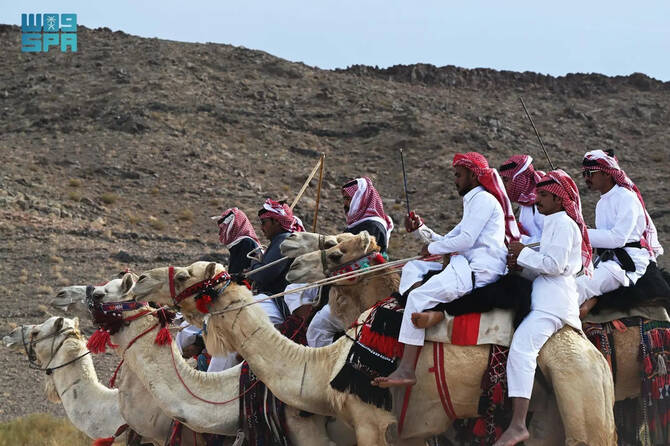
Noted for its simple melodies and brisk tempo, Al-Hijini naturally accompanies travelers and desert caravans. (SPA)
2 / 9
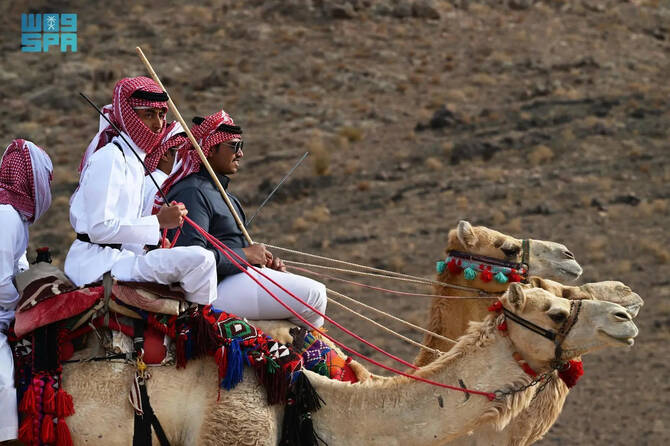
Al-Hijini is deeply tied to Bedouin culture, serving as a medium for expressing emotions. (SPA)
3 / 9
Al-Hijini is deeply tied to Bedouin culture, serving as a medium for expressing emotions. (SPA)
4 / 9
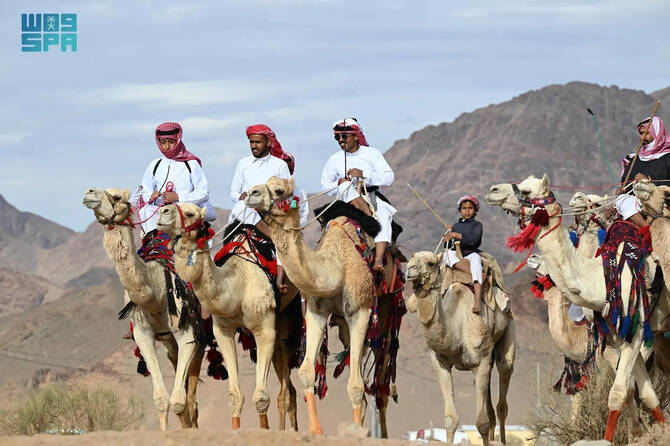
Noted for its simple melodies and brisk tempo, Al-Hijini naturally accompanies travelers and desert caravans. (SPA)
5 / 9
Noted for its simple melodies and brisk tempo, Al-Hijini naturally accompanies travelers and desert caravans. (SPA)
6 / 9
Noted for its simple melodies and brisk tempo, Al-Hijini naturally accompanies travelers and desert caravans. (SPA)
7 / 9
Noted for its simple melodies and brisk tempo, Al-Hijini naturally accompanies travelers and desert caravans. (SPA)
8 / 9
Noted for its simple melodies and brisk tempo, Al-Hijini naturally accompanies travelers and desert caravans. (SPA)
9 / 9
Noted for its simple melodies and brisk tempo, Al-Hijini naturally accompanies travelers and desert caravans. (SPA)
Short Url
Updated 02 April 2025
Follow

Tabuk camel riders celebrate Eid to the rhythms of Al-Hijini

  • The tempo of the verses aligns with the camels’ steady strides, creating a harmonious blend of words and motion
  • Traditionally performed solo, Al-Hijini often becomes a communal chant during celebrations

TABUK: In Tabuk’s vast, Eid is a radiant celebration infused with the scent of the land, the memory of ancestors and deeply rooted traditions passed down with pride across generations.

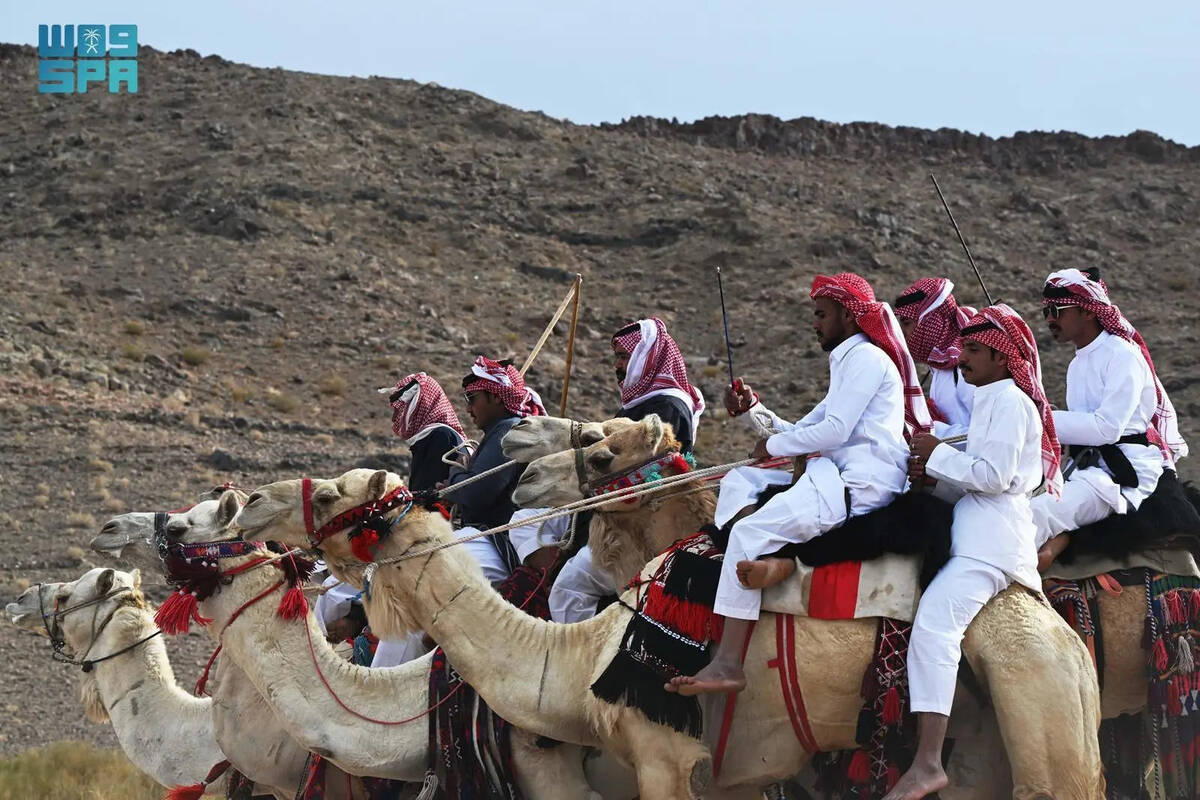
Here, where the sands stretch endlessly, camel riders known as hajjanah form majestic processions, offering greetings to locals while chanting Al-Hijini, poetry that stirs the heart tales of pride, love and loyalty, preserving the soul of the desert.
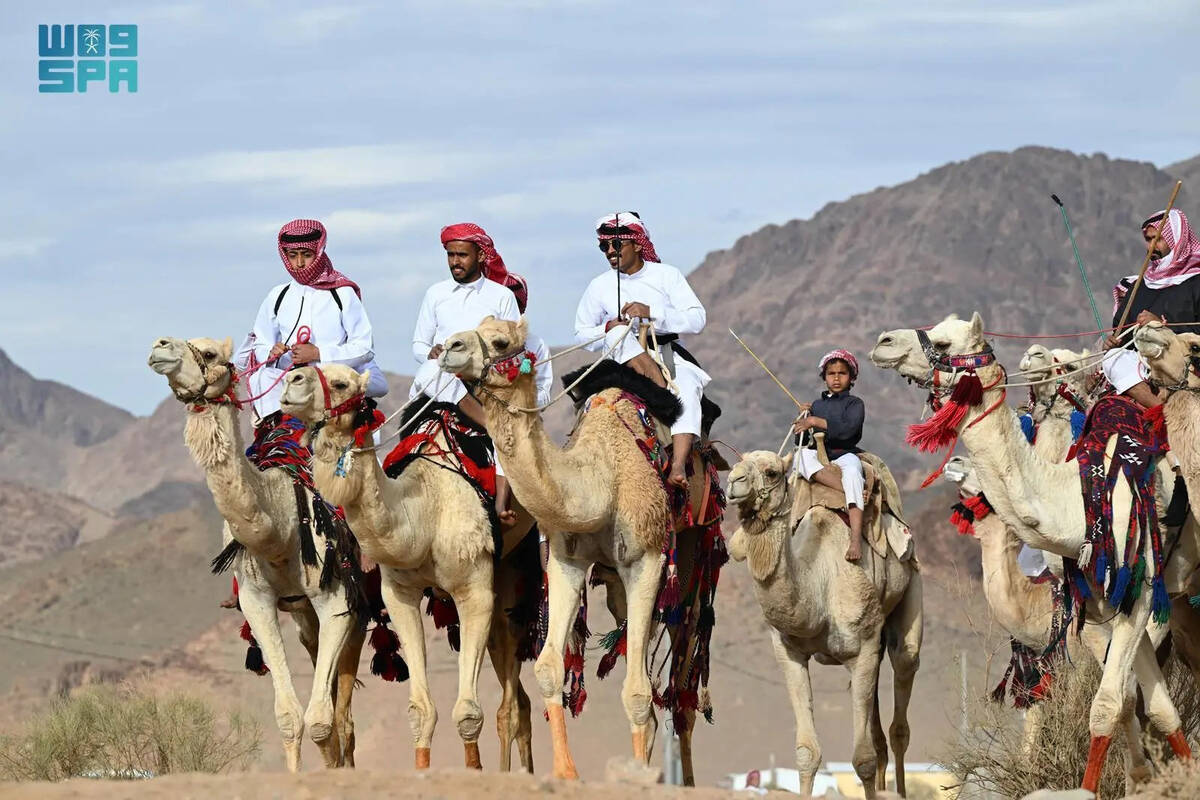


Al-Hijini is deeply tied to Bedouin culture, serving as a medium for expressing emotions. (SPA)

Among the people of Tabuk, customs steeped in authenticity and dignity come to life during vibrant Eid celebrations.

They are a blend of heritage and contemporary life, rooted in the nomadic rhythm of the desert. Camels, specially adorned for the occasion, play a central role in the festivities as riders set out across the sands, joyfully chanting traditional verses.

Al-Hijini poetry derives its name from the well-trained camels used for riding and racing. The riders recite lyrical verses that encompass various themes of life, often focusing on patriotism and romance. The rhythm matches the camels’ steady strides, creating a harmonious blend of words and motion.


Caption

Noted for its simple melodies and brisk tempo, Al-Hijini uplifts the spirits and eases the solitude of travelers and desert caravans. It is deeply tied to Bedouin culture, serving as a medium for expressing emotions, recording daily experiences, relaying wisdom and preserving ancestral proverbs.

Traditionally performed solo, Al-Hijini often becomes a communal chant during celebrations such as Eid, with collective recitation reflecting the unity and solidarity of Tabuk’s desert communities.
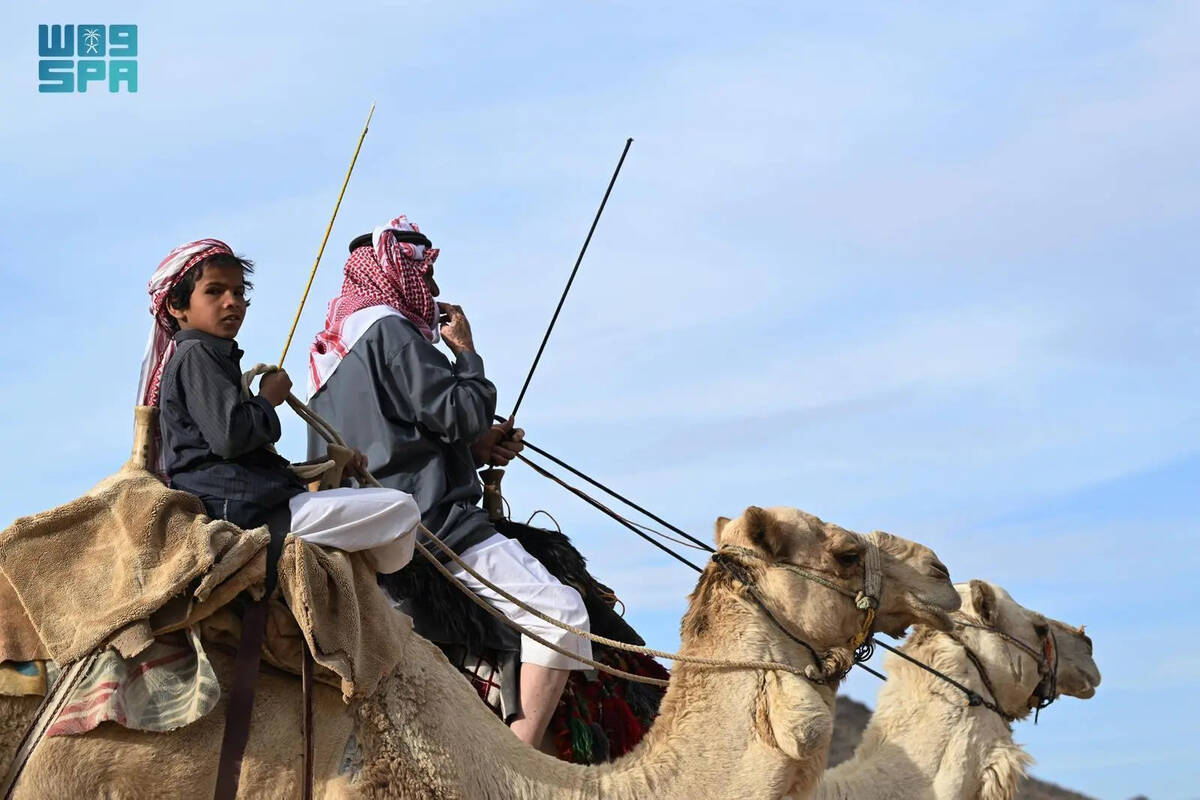


Noted for its simple melodies and brisk tempo, Al-Hijini naturally accompanies travelers and desert caravans. (SPA)


Shaping future society: How intellectual forums contribute to cultural development

Updated 7 sec ago
Follow

Shaping future society: How intellectual forums contribute to cultural development

RIYADH: Modern nations do not transform on technological progress alone, but evolve through various factors such as values, religion, culture and assumptions that guide how societies interpret development.

Philosophy is one aspect of understanding civilization. Although it is often seen as abstract or far from reality, it plays an essential role in shaping a nation’s understanding of modernization.

It impacts how people see progress and discuss cultural identity, along with measuring the ethical implications of joining the global mindset.

Yet, by examining the philosophical thoughts that shape national narratives, people gain a deeper understanding of why societies adopt certain ideologies for development, resist others, and struggle to balance tradition with innovation.

Saudi Arabia, for example, defines its place on the global stage and navigates the complex tensions between heritage, aspiration and global responsibility through its own philosophy.

The Philosophy Forum, organized in Riyadh this week for the fifth year, witnessed the attendance of both local and international thinkers. During the conference, some Arab philosophers shared their beliefs in the idea that there is no absolute truth; while other philosophers differed, considering the Arab view on truth, culture and relativism.

“We must distinguish between the existence of relativity in science — the world is changing because it is relative — and our belief in absolute truths within our culture. For example, the only truly absolute thing in the world is death, which is mentioned in the Holy Qur’an,” Essam Gameil, professor of logic and critical thinking at Cairo University, told Arab News on the sidelines of the forum.

He added: “Our morals are unchanging; ethical principles are fixed. For example, respecting others is a fundamental principle; how can it be altered?

“Some concepts can be changed within the framework of science, but not in the humanities, not in religion, not in ethics. There are constants.

“It is the moral principles and rules that drive me forward,” Gameil said, adding that philosophy was created to solve issues that occurred in society during the time of Aristotle and Plato.

“It appeared to solve social problems … it was created to address lying, deception and more. Socrates was a moral philosopher and nothing else,” he said.

Gameil described Saudi Arabia as an example of “an extraordinary leap” in the Arab world in terms of development and philosophy.

He said that the Kingdom’s interest in philosophy and its organization of a major conference in the field stems from a crucial concept discovered by the Saudi leadership, which is that humanity has two aspects: A spiritual aspect and a material aspect, represented by the body.

“Studies typically focus on the body — artificial intelligence, engineering, and so on — but have often neglected the spiritual dimension. Philosophy is a human science; the more you emphasize it, the more certain concepts become firmly established and ingrained,” said Gameil.

Eman Al-Mulhem, a researcher in the philosophy of science at King Faisal University in Al-Ahsa, believes that the Kingdom’s situation presents three very promising paths: The philosophy and ethics of artificial intelligence, science and technology studies, and a re-reading of the Arab philosophical heritage using contemporary methodologies.

“This field is no longer a luxury, but a necessity. The question is no longer: What can a machine do? Rather, it has become: How do we preserve our humanity in a world where we share the power of decision-making with machines?” she said, highlighting the philosophy and ethics of AI.

She added: “We have a rich heritage, but we need modern tools to understand and reconstruct it, not just explain it. These fields are not only promising, but they are also capable of reshaping the role of philosophy in the Arab world.”

Al-Mulhem also works to connect Arab philosophical heritage to questions of contemporary science. She believes that philosophy is not detached from reality, but rather helps to reevaluate our relationship with science, humanity and the world.

On the question of whether Arab philosophical heritage is still suffering from global misconceptions, she said: “(It) still suffers some global misconceptions, such as being reduced to a mere extension of Greek philosophy or a stagnant tradition.”

However, the Riyadh International Philosophy Conference, which hosts philosophical minds from around the world, is helping to correct this image, she added.

“They present Arab heritage in a dynamic context, through the voices of its own scholars. At this conference, the world encounters Arab thoughts that engage in dialogue, produce ideas and critique — not as a static heritage, but as an integral part of contemporary global philosophy,” said Al-Mulhem.

“Philosophy is not far removed from humanity; it is closer than we imagine. Every question we ask, every attempt to understand the world, is a philosophical step,” she said.

“I believe that the Arab region today has a great opportunity to reclaim its role in producing knowledge, not just consuming it. And the Arab researcher is capable — given the right environment — of making a lasting impact that transcends geographical boundaries,” she added.