

Australia’s first Muslim MP calls for country to recognize Palestine

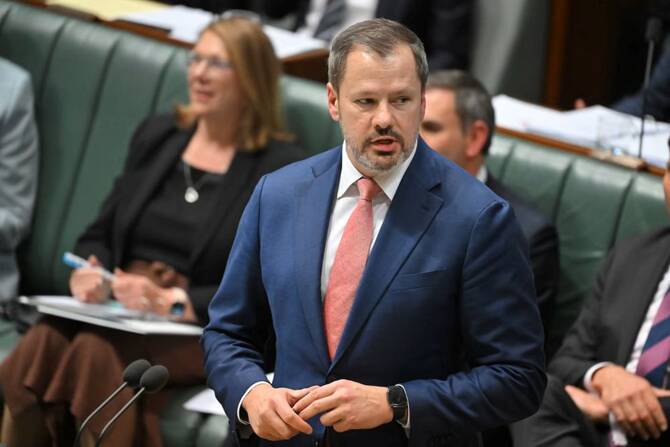
Ed Husic is the first Muslim to be elected to federal parliament, as well as the first Muslim to be made a minister in the Australian government. (AP)
Short Url
Updated 30 July 2025
Follow

Australia’s first Muslim MP calls for country to recognize Palestine

  • Ed Husic: Govt should follow in UK’s footsteps as part of tide of ‘moral momentum’
  • ‘Hamas is built largely on grievance. That grievance gets removed with the establishment of a state of Palestine’

LONDON: Australia’s first Muslim MP and government minister has said his country should recognize a Palestinian state, following in the footsteps of the UK as part of a tide of “moral momentum.”

The appeal by Labor’s Ed Husic, who was elected in 2010, came as Prime Minister Anthony Albanese is to hold further talks with his British counterpart Keir Starmer in the coming days.

Starmer pledged this week to recognize a Palestinian state in September if Israel fails to reach a ceasefire with Hamas, among other conditions.

If Australia does the same, it would deprive Hamas of its power in Gaza and expedite the peace process, Husic said.

“Hamas is built largely on grievance. That grievance gets removed with the establishment of a state of Palestine, nurtured with the cooperation and support of the international community, progressed through the development of democratic institutions,” he added.

The former minister said his Labor colleagues feel increasingly aggrieved over the situation in Gaza, calling on them to urge Australian recognition of a Palestinian state.

“There is a deep feeling within the caucus, about how right it is to recognize Palestine, and I would much rather that colleagues speak for themselves,” he added.

Foreign Minister Penny Wong signed an international statement calling for an immediate ceasefire between Israel and Hamas.

Albanese, however, declined to immediately follow Starmer’s decision despite Australia’s government previously signaling that it would move in unison with international partners on measures to address the crisis in Gaza.

“What I’ve said is that it’s not the timeline, that’s not what we’re looking at. What we’re looking at is the circumstances where recognition will advance the objective of the creation of two states,” Albanese said at Parliament House after speaking with Starmer this week.

“I’ve said for a long time, my entire political life, I’ve said I support two states … That’s my objective — not making a statement, not giving a political point, but achieving peace.”


Mali, Burkina say restricting entry for US nationals in reciprocal move

Updated 2 sec ago
Follow

Mali, Burkina say restricting entry for US nationals in reciprocal move

ABIDJAN: Mali and Burkina Faso have announced travel restrictions on American nationals in a tit-for-tat move after the US included both African countries on a no-entry list.
In statements issued separately by both countries’ foreign ministries and seen Wednesday by AFP, they said they were imposing “equivalent measures” on US citizens, after President Donald Trump expanded a travel ban to nearly 40 countries this month, based solely on nationality.
That list included Syrian citizens, as well as Palestinian Authority passport holders, and nationals of some of Africa’s poorest countries including also Niger, Sierra Leone and South Sudan.
The White House said it was banning foreigners who “intend to threaten” Americans.
Burkina Faso’s foreign ministry said in the statement that it was applying “equivalent visa measures” on Americans, while Mali said it was, “with immediate effect,” applying “the same conditions and requirements on American nationals that the American authorities have imposed on Malian citizens entering the United States.”
It voiced its “regret” that the United States had made “such an important decision without the slightest prior consultation.”
The two sub-Saharan countries, both run by military juntas, are members of a confederation that also includes Niger.
Niger has not officially announced any counter-measures to the US travel ban, but the country’s news agency, citing a diplomatic source, said last week that such measures had been decided.
In his December 17 announcement, Trump also imposed partial travel restrictions on citizens of other African countries including the most populous, Nigeria, as well as Ivory Coast and Senegal, which qualified for the football World Cup to be played next year in the United States as well as Canada and Mexico.