

Tens of thousands of Catholics head to Vatican’s Jubilee of Youth

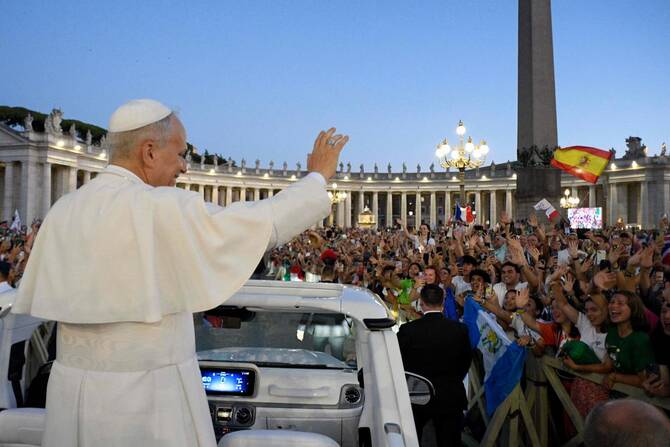
This handout photo taken on July 29, 2025 and released by the Vatican press office, Vatican Media, shows Pope Leo XIV waving as he unexpectedly arrives in the Pope Mobile to greet pilgrims waiting in St. Peter’s Square, for the opening mass for start the Youth Jubilee Mass at the Vatican. (AFP)
Short Url
Updated 30 July 2025
Follow

Tens of thousands of Catholics head to Vatican’s Jubilee of Youth

  • The Vatican had last week said it expected some half a million people from more than 150 countries to take part
  • Some 120,000 people attended the opening mass at St. Peter’s Basilica Tuesday evening

VATICAN CITY: Pope Leo XIV made a surprise appearance in a crowd of 120,000 young Catholics who gathered on Tuesday in Rome for the Vatican’s Jubilee of Youth — an event that takes place every 25 years.

The week-long event is taking place just over two months after Leo XIV became the head of the Catholic Church and the first American pope.

Since Monday, groups of pilgrims — chanting and draped in flags of their countries — have flooded the streets of Italy’s capital and the corners of the Vatican City.

The Vatican had last week said it expected some half a million people from more than 150 countries to take part, with this year’s events dedicated to faith and culture.

Some 120,000 people attended the opening mass at St. Peter’s Basilica Tuesday evening, according to the Vatican, where the Pope said he had a special welcome for people from regions affected by war, naming Ukraine and Palestine.

Afterwards, he made a surprise appearance in the crowd aboard his “Popemobile.”

The week will culminate with a giant mass led by Pope Leo on Sunday.

The Jubilee of Youth is aimed at people aged between 18 and 35.

Pilgrims told AFP the subjects they most wanted to discuss at the events were wars, climate change, social inequalities and the dangers linked to AI.

“The most important topic for me is war. Everyone is talking about it, thinking about it, and we want to know what the pope thinks about it and what he expects from us,” said 25-year-old Tiago Santos from Portugal.

The event is taking place after almost two years of Israeli bombardment of Gaza, which has left tens of thousands of Palestinians dead and UN groups warning of starvation in the blockaded territory.

Thousands have also been killed in Ukraine since Russia’s 2022 invasion, with Moscow continuing deadly attacks despite Western pressure to end its campaign.

Teophanie Nasta, a 26-year-old from Lebanon traveling overseas for the first time, said that despite the conflicts in the Middle East she was filled with “faith in humanity by seeing so many young people” gathered for the church.

In an unprecedented move, the Vatican dedicated a series of events to Catholic influencers — a sign of growing importance of social media for the church.

Speaking to them on Tuesday morning, Pope Leo warned against the dangers of undermining “human dignity” in the AI era.


Swiss government bans purchase and import of Russian gas

Updated 3 sec ago
Follow

Swiss government bans purchase and import of Russian gas

  • Switzerland is tightening restrictions on Russian diplomats accredited in the EU
  • It matched the EU’s economic sanctions on Russia since the invasion of Ukraine 4 years ago

GENEVA: Switzerland’s government on Wednesday announced that the purchase and import of Russian liquefied natural gas would soon be completely banned, as the Alpine nation aligns itself with the latest round of EU sanctions.
“From 25 April, a complete ban on the purchase and import of Russian liquefied natural gas (LNG) will apply in Switzerland,” the government said in a statement.
It added though that in the case of pre-existing long-term supply contracts, a transition period would apply until the end of the year.
“The measure aims to reduce Russia’s revenues from the sale of fossil fuels, which are a major source of funding for the war against Ukraine,” it said.
The move was among a number of measures adopted by the Swiss government on Wednesday to align with the European Union’s 19th package of sanctions against Russia, adopted by the bloc late last year.
Non-EU member Switzerland has since the start of Moscow’s full-scale invasion of Ukraine four years ago matched the bloc’s economic sanctions on Russia.
Bern said Wednesday it had decided on other measures in the financial sector which will come into force this week, including a ban on providing cryptocurrency services to Russian citizens and companies.
Transactions involving certain rouble-backed cryptocurrencies, such as stablecoin A7A5 have also been banned, the government said, adding that it had also extended the ban on using certain specialized messaging services for payment transactions.
Among other measures decided Wednesday was tightening restrictions on Russian diplomats accredited in the EU, who will now need to give advance notice if they transit through or enter Switzerland.