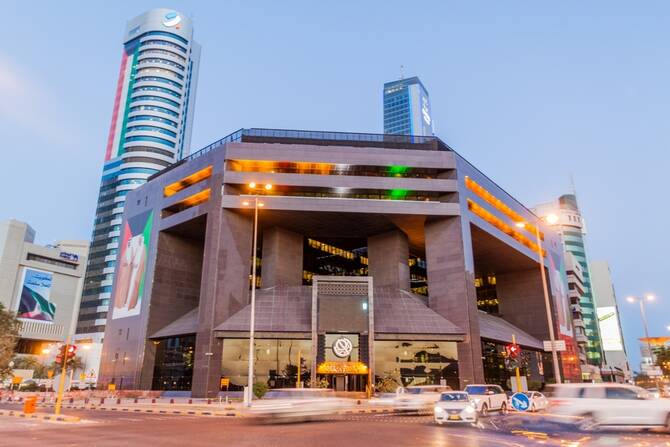

RIYADH: A rise in operating revenues and profitability drove Boursa Kuwait’s net profit to 15.11 million Kuwaiti dinars ($49.4 million) in the first half of 2025 — a 61.12 percent annual increase.
The growth was underpinned by a 41.13 percent year-on-year rise in total operating revenues to 24.20 million dinars, alongside a 59.53 percent boost in operating profit to 18.47 million dinars, according to a release.
Earnings per share surged in tandem, rising from 46.71 fils to 75.27 fils by June 30, while total assets reached 123.87 million dinars, reflecting a 9.26 percent increase year-on-year.
Shareholders’ equity attributable to equity holders of the parent company climbed 12.68 percent to 66.20 million dinars.
The Boursa’s growth aligns with the World Bank’s forecast for Kuwait’s non-oil sector, which is expected to expand by 1.6 percent in 2025, supported by renewed real credit growth and large-scale infrastructure projects such as the Northern Special Economic Zone and Silk City.
Boursa Kuwait Chairman Bader Al-Kharafi said: “These results reaffirm Boursa Kuwait’s capacity to navigate the complex geopolitical and economic challenges experienced worldwide while maintaining sustainable growth supported by revenue diversification and enhanced liquidity levels.”
He added: “This growth marks a significant milestone in our journey, giving us greater momentum to advance our development plans to modernize market infrastructure, diversify investment instruments and strengthen its appeal to both local and international investors.”
While the oil sector is projected to rebound with 2.2 percent real growth as OPEC+ production cuts ease from May, the broader fiscal outlook remains mixed, with the fiscal deficit forecast to widen to approximately 7.2 percent of gross domestic product due to weaker oil revenues.
The performance coincides with major enhancements introduced under Part Two of Phase Three of the Market Development Program, a collaborative initiative involving Boursa Kuwait, the Capital Markets Authority, and Central Bank of Kuwait, as well as Kuwait Clearing Co., local banks, and investment and brokerage firms.
Al-Kharafi credited the achievement to “seamless collaboration across the capital market apparatus and a shared determination to create tangible value for investors,” affirming the company’s commitment to “delivering transformative milestones that secure the long-term sustainability of the national economy.”
He also emphasized the role of the private sector, noting that this breakthrough “underscores the private sector’s agility and effectiveness in advancing development and forging impactful partnerships with the public sector.”
He extended his gratitude to stakeholders, including shareholders, executive management, regulatory authorities, and investors, stating: “Our commitment to deliver a superlative investment experience remains unwavering.”
The Kuwaiti capital market recorded a surge in activity during the first half of 2025, with traded value jumping 90.39 percent to 12.63 billion dinars, while traded volume rose 82.95 percent to 49.45 billion shares.
Market capitalization reached 50.53 billion dinars, a 23.20 percent increase year on year.
The “Premier” Market contributed significantly with traded value up 47.09 percent to 7.34 billion dinars and market capitalization up 24.45 percent to 42.27 billion dinars.
Meanwhile, the “Main” Market posted a 221.36 percent rise in traded value to 5.29 billion dinars, alongside a 17.20 percent growth in market capitalization to 8.27 billion dinars.
Boursa Kuwait CEO Mohammad Saud Al-Osaimi highlighted the effectiveness of recent regulatory and operational reforms.
“These positive indicators showcase the robustness of the Kuwaiti capital market’s regulatory framework and our continued efforts to enhance infrastructure, diversify products and elevate the investor experience,” he said.
He noted the strategic role of market segmentation, stating: “The ‘Premier’ Market has maintained stable trading values, while the ‘Main’ Market has shown remarkable activity.”
In pursuit of a stronger international presence, Boursa Kuwait has engaged in roadshows and corporate days in partnership with global financial institutions.
These included events in Asia and London, showcasing the exchange’s progress and investment potential.
Al-Osaimi said: “Through active engagement with world-renowned investment banks, sovereign wealth funds, pension funds and asset management firms, the exchange has cultivated a robust investor base.” He added that institutional investors account for 65.08 percent of participants.
The CEO reiterated the exchange’s commitment to expanding its product range, enhancing market efficiency, and strengthening investor confidence through transparency and governance.
Since its privatization in 2019 and self-listing in 2020, Boursa Kuwait has introduced multiple market development phases aimed at boosting its global standing and supporting Kuwait’s broader economic vision.