

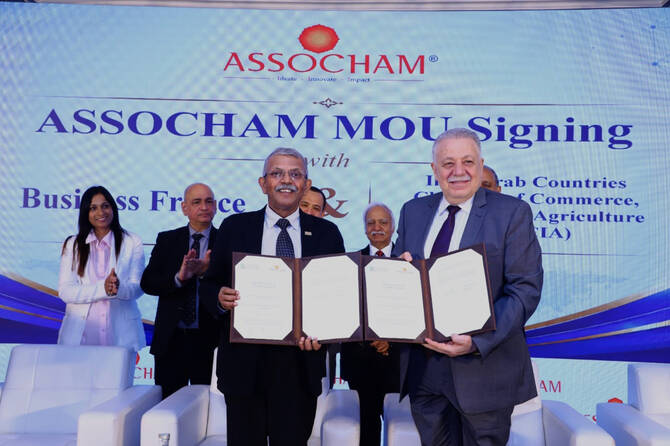

NEW DELHI: The India & Arab Countries Chamber of Commerce, Industry & Agriculture on Friday announced a new partnership with one of India’s largest apex industry bodies as it seeks to foster stronger business connections and strengthen India-Arab economic cooperation.
The IACCIA has signed a memorandum of understanding with the Associated Chambers of Commerce and Industry of India, under which both organizations committed to leverage India’s expanding network of trade and economic agreements to “unlock” new opportunities for Indian and Arab companies.
“India and the Arab countries actually share a heritage of a long bond; historical relations between India and the Arab world go (back) to hundreds of years. And for this reason, we believe that the trust built over the years deserves to be taken good care of and (turned into) a bridge … that together we can have an extensive network of Indian industry and Arab leaders,” Dr. Waiel Awwad, IACCIA’s acting secretary-general, told Arab News on Friday.
“With the India know-how and the technologies and the Arab capitals and the infrastructure, both can develop.”
The partnership comes against the backdrop of India’s expanding trade ties with Arab nations, which includes the India-Oman Comprehensive Economic Partnership Agreement and the India-UAE CEPA, which came into effect in June this year and May 2022 respectively.
Indian officials also launched negotiations in February for a free trade agreement with the Gulf Cooperation Council, which is India’s largest trading partner bloc.
“This MoU is not merely an agreement between two institutions; it is a commitment to creating practical business opportunities that connect Indian enterprises with the dynamic markets of the Arab world,” Awwad said.
Under the agreement, the two chambers will organize business delegations, trade missions and investment forums, facilitate meetings between Indian and Arab businesses, and promote joint ventures and technology transfer while also providing support for small businesses to access emerging opportunities across Arab markets, the IACCIA said in a statement.
They are also encouraging closer cooperation in specific sectors, such as renewable energy, pharmaceuticals and digital technologies, and intend to use the partnership to share market intelligence.
The IACCIA was a development of the Fifth Arab-Indian Partnership Conference in Muscat in 2016, established with the aim of advancing their economic ties through collaborations and increasing trade and investment.
The ASSOCHAM, meanwhile, was founded in 1920 and is one of India’s oldest and largest industry bodies, with around 450,000 members, most of which are medium and small enterprises.
Both organizations shared a vision “to build a stronger institutional bridge between India and the Arab world,” the IACCIA said.
The Arab world is one of India’s “most important strategic economic partners,” it added, citing more than $300 billion worth of India-Arab trade each year.
“The region plays a vital role in India's energy security, logistics, infrastructure development, investment flows, food security, and expanding commercial engagement with Africa and the wider Middle East,” it said.
“At the same time, India's strengths in pharmaceuticals, healthcare, information technology, manufacturing, engineering, agriculture, education and innovation present significant opportunities for deeper collaboration with Arab economies.”


