

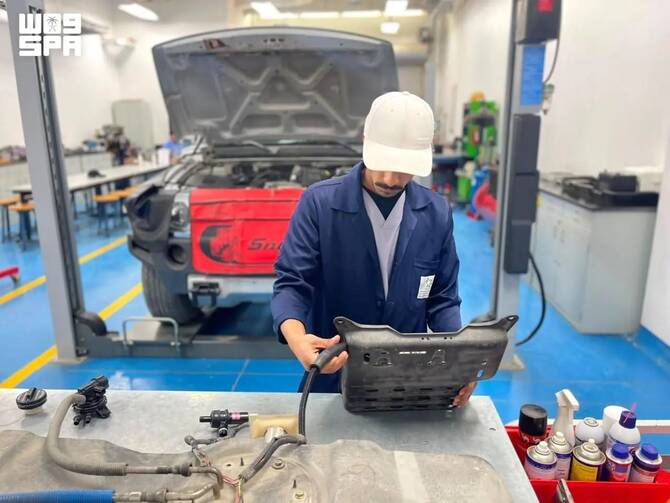


RIYADH: An increasing number of young Saudis are turning their passion for engines into successful careers and promising investment opportunities.
Mohammed Abdullah’s passion for cars began during his childhood, which led him to pursue automotive mechanical engineering.
With more than a decade of experience in the field, he has built extensive practical and technical expertise, further refining his skills and deepening his knowledge of the auto industry.
Abdullah said the car maintenance sector is witnessing a notable increase in the number of Saudi professionals entering the field. “Young Saudis have demonstrated their ability to compete and excel by delivering high-quality services grounded in technical expertise and supported by advanced diagnostic and maintenance equipment,” he said.
Car mechanic and electrician Nasser Al-Nasser echoed similar sentiments. “Car maintenance has emerged as an increasingly lucrative profession amid growing demand for qualified technicians.”
Al-Nasser explained that his journey began at home, where he repaired his own vehicles and those of relatives and friends. He later joined several specialized companies, gaining valuable hands-on experience and building a solid professional reputation that ultimately enabled him to open his own workshop.
Specialized technicians may earn between SR10,000-SR15,000 per month ($2,680 -$4,020). The income increases for professionals running the workshop.
Support and financing programs for small and medium-sized enterprises have encouraged many young Saudis to enter the sector and transform their technical expertise into successful business ventures.
Mohammed Al-Zahrani’s passion for car maintenance began in high school, drawing inspiration from the knowledge and experience passed on by his father. He later strengthened his expertise through specialized education and practical training in automotive mechanics and electrical systems.
He noted that social media and digital platforms have made “technical information and specialized guidance more accessible, creating greater opportunities for young people to learn and develop their skills.”
He explained that maintaining modern vehicles now extends far beyond traditional hands-on experience, requiring advanced electronic diagnostic equipment and strict adherence to manufacturer-approved specifications, including the use of torque wrenches to ensure components are tightened to precise standards.
With automotive electronics and software advancing rapidly, the sector increasingly depends on qualified Saudi professionals who possess the technical expertise and adaptability needed to keep pace with emerging technologies.
Mansour Mohammed Al-Thubaiti, a trainer in the automotive mechanics department at the Technical and Vocational Training Corp in Riyadh, explained that car maintenance has undergone a profound transformation with the evolution of modern vehicles.
“Today’s cars combine traditional mechanical components with advanced electronic systems, control units, and smart sensors, requiring technicians to possess specialized expertise in electronic diagnostics, fault-code analysis, system reprogramming, and the use of modern testing equipment.
“They must also remain up to date with the rapidly evolving technologies that have become central to the car industry.”
The Technical and Vocational Training Corp offers mechanical technology programs in fields such as automotive mechanics and electrical systems through a two-stage training pathway.
Trainees first earn a secondary diploma from industrial secondary institutes or prison training institutes, after which they are given priority to pursue an intermediate diploma at technical colleges across the Kingdom.
The programs follows comprehensive training plans designed to equip participants with the technical knowledge and practical skills needed to build successful careers in the automotive sector.


