UK museum finds 4,000-year-old handprint on Egypt tomb

1 / 5
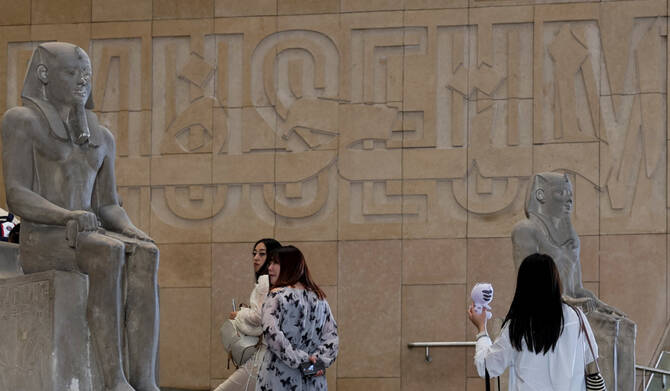
A tourist walks in front of a statue of King Ramses II at the entrance site of the Grand Egyptian Museum (GEM) which will officially open on 4th November 2025, on the 103rd anniversary of Tutankhamun's tomb discovery, following a partial opening last year in Giza, on the southwestern outskirts of the capital Cairo, Egypt, June 2, 2025. (REUTERS)
2 / 5
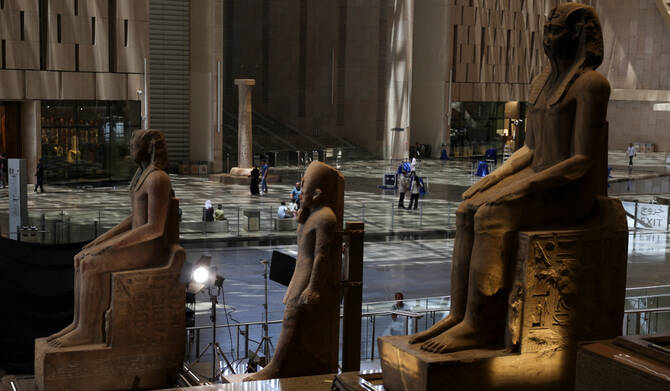
People visit the Grand Egyptian Museum (GEM) which will officially open on 4th November 2025, on the 103rd anniversary of Tutankhamun's tomb discovery, following a partial opening last year in Giza, on the southwestern outskirts of the capital Cairo, Egypt, June 2, 2025. (REUTERS)
3 / 5
Tourists and Egyptians visit the Grand Egyptian Museum (GEM) which will officially open on 4th November 2025, on the 103rd anniversary of Tutankhamun's tomb discovery, following a partial opening last year in Giza, on the southwestern outskirts of the capital Cairo, Egypt, June 2, 2025. (REUTERS)
4 / 5
People visit the Grand Egyptian Museum (GEM) which will officially open on 4th November 2025, on the 103rd anniversary of Tutankhamun's tomb discovery, following a partial opening last year in Giza, on the southwestern outskirts of the capital Cairo, Egypt, June 2, 2025. (REUTERS)
5 / 5
People pose for a picture in front of a statue of King Ramses II, as they visit the Grand Egyptian Museum (GEM) which will officially open on 4th November 2025, on the 103rd anniversary of Tutankhamun's tomb discovery, following a partial opening last year in Giza, on the southwestern outskirts of the capital Cairo, Egypt, June 2, 2025. (REUTERS)
Short Url
Updated 29 July 2025
Follow

UK museum finds 4,000-year-old handprint on Egypt tomb

LONDON: British researchers have discovered a rare handprint on a 4,000-year-old Egyptian artifact, a Cambridge museum said.
The ancient handprint was found by museum conservators on the base of an Egyptian soul house — a clay offering tray in the shape of a building which may have been used in tombs for laying out food offerings or as a dwelling for souls.
The unique discovery was made after the piece, crafted between 2055-1650 BC, was examined by conservation staff in preparation for a new exhibition.
“I have never seen such a complete handprint on an Egyptian object before,” said Helen Strudwick, senior curator and Egyptologist at the Fitzwilliam Museum in Cambridge.
The handprint was left by the maker of the soul house, when they picked it up before drying and firing the clay.
“When you see something like this, you feel very close to the person who left their mark on an object,” Strudwick said, describing the finding to AFP as an “exciting moment.”
“You can see all the fingers, and also where the heel of the hand rested,” she said.
The rare artifact will be on display at the museum’s Made in Ancient Egypt exhibition which opens on October 3.
The exhibition will focus on the makers of Egyptian artifacts such as jewelry, ceramics and sculptures.
It is important to understand how the ancient objects were made “in order to look after them properly,” the curator said.
The museum in southeast England has been researching how the artifacts were created since 2014, but little is known about the potters that worked in Ancient Egypt.
Since pottery was seen as having a low value, Egyptian potters may have been accorded a lower social status than other craftspeople.
“We can’t really say anything about the identity of the person from the handprint. It is quite small — about the same size as my own hand,” said Strudwick.
“If this is a man’s handprint, it’s possible that — given the scale of it — he was a younger person, or it may be that a more junior person in the workshop was responsible for moving these objects out to dry,” she speculated.
Strudwick says the history of Egyptian craftspeople was often overlooked by researchers.
But with new research methods, “we are able to know more and more about how they worked, lived and how they wanted to be remembered for all time,” she said.
The exhibition will include a large loan of antiquities from the Louvre museum in France, the most significant of its kind to visit the UK in almost 20 years.


Second doctor in Matthew Perry overdose case sentenced to home confinement

Updated 17 December 2025
Follow

Second doctor in Matthew Perry overdose case sentenced to home confinement

  • Dr. Mark Chavez, 55, a onetime San Diego-based physician, pleaded guilty in federal court in October
  • Judge Sherilyn Peace Garnett also sentenced Chavez to 300 hours of community service

LOS ANGELES: A second California doctor was sentenced on Tuesday to eight months of home confinement for illegally supplying “Friends” star Matthew Perry with ketamine, the powerful sedative that caused the actor’s fatal drug overdose in a hot tub in 2023.
Dr. Mark Chavez, 55, a onetime San Diego-based physician, pleaded guilty in federal court in October to a single felony count of conspiracy to distribute the prescription anesthetic and surrendered his medical license in November.
Judge Sherilyn Peace Garnett also sentenced Chavez to 300 hours of community service. As part of his plea agreement, Chavez admitted to selling ketamine to another physician Dr. Salvador Plasencia, 44, who in turn supplied the drug to Perry, though not the dose that ultimately killed the performer. Plasencia, who pleaded guilty to four counts of unlawful drug distribution, was sentenced earlier this month to 2 1/2 years behind bars.
He and Chavez were the first two of five people convicted in connection with Perry’s ketamine-induced death to be sent off to prison.
The three others scheduled to be sentenced in the coming weeks — Jasveen Sangha, 42, a drug dealer known as the “Ketamine Queen;” a go-between dealer Erik Fleming, 56; and Perry’s former personal assistant, Iwamasa, 60.
Sangha admitted to supplying the ketamine dose that killed Perry, and Iwamasa acknowledged injecting Perry with it. It was Iwamasa who later found Perry, aged 54, face down and lifeless, in the jacuzzi of his Los Angeles home on October 28, 2023.
An autopsy report concluded the actor died from the acute effects of ketamine,” which combined with other factors in causing him to lose consciousness and drown.
Perry had publicly acknowledged decades of substance abuse, including the years he starred as Chandler Bing on the hit 1990s NBC television series “Friends.”
According to federal law enforcement officials, Perry had been receiving ketamine infusions for treatment of depression and anxiety at a clinic where he became addicted to the drug.
When doctors there refused to increase his dosage, he turned to unscrupulous providers elsewhere willing to exploit Perry’s drug dependency as a way to make quick money, authorities said. Ketamine is a short-acting anesthetic with hallucinogenic properties that is sometimes prescribed to treat depression and other psychiatric disorders. It also has seen widespread abuse as an illicit party drug.