

Israel ‘using thirst as a weapon to kill Palestinians’ in Gaza, UN experts say

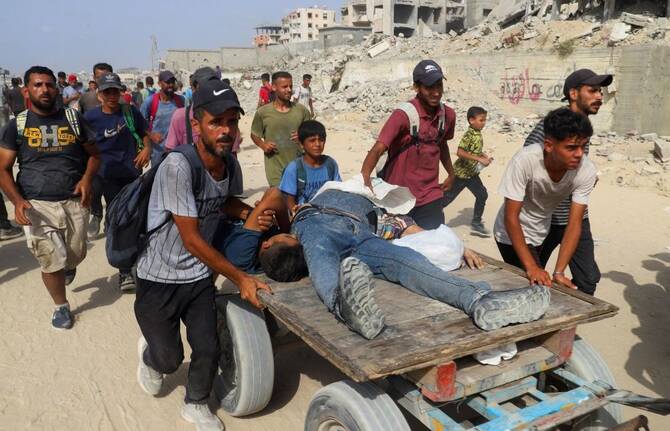
Palestinians wounded by Israeli fire are transported on a cart, as others carry aid supplies, Beit Lahia, northern Gaza Strip, July 29, 2025. (Reuters)
Short Url
Updated 29 July 2025
Follow

Israel ‘using thirst as a weapon to kill Palestinians’ in Gaza, UN experts say

  • ‘Cutting off water and food is a silent but lethal bomb that kills mostly children and babies,’ they warn
  • As summer temperatures soar and hygiene conditions deteriorate rapidly, fatalities from dehydration are increasing and outbreaks of waterborne diseases are spreading

NEW YORK CITY: A group of UN human rights experts on Monday accused Israeli authorities of deliberately depriving Palestinians in Gaza of access to clean drinking water. They described this alleged action as a grave violation of international law and a potential crime against humanity.

“Israel is using thirst as a weapon to kill Palestinians,” the experts said. “Cutting off water and food is a silent but lethal bomb that kills mostly children and babies.”

The independent experts, who are appointed by the UN Human Rights Council, said that water and sanitation systems in Gaza have been systematically targeted throughout the Israel’s ongoing military campaign.

Since the conflict began in October 2023, Israeli forces have destroyed or severely damaged wells, pipelines, desalination plants and sewage networks. According to the UN, nearly 90 percent of the territory’s water infrastructure is no longer functional, leaving more than 90 percent of the population without reliable access to safe water supplies.

As summer temperatures soar and hygiene conditions deteriorate rapidly, fatalities from dehydration are increasing and outbreaks of waterborne disease are spreading. Most of the 2 million residents of Gaza have been displaced, with many of them forced to drink contaminated water and live without even basic sanitation.

“This catastrophe was not only predictable, it was predicted,” the UN experts said. “The deliberate denial of water and essential supplies is part of a pattern of collective punishment and may amount to extermination under international law.”

The experts referred to an advisory opinion issued by the International Court of Justice in July 2024, which reaffirmed Israel’s obligations as an occupying power to ensure civilians are able to access adequate supplies of food and water.

Instead, the experts noted, Israeli authorities have further reduced the already limited flow of emergency water deliveries, and continue to block essential shipments of fuel required to power desalination and sanitation systems.

The UN Relief and Works Agency, the main humanitarian agency in Gaza, has warned that it will be forced to close several of its remaining wells entirely unless immediate authorization is granted for fuel deliveries to the territory. These sources currently provide hundreds of thousands of liters of water to people each day for drinking and hygiene purposes.

“With fuel supplies nearly exhausted, humanitarian organizations are scaling back life-saving work, including the distribution of water,” the UN experts said.

Describing the situation as “barbaric,” they added that the actions of the Israeli government meet the legal definition of genocide. They cited the Rome Statute, which established the International Criminal Court and defines genocide as “deliberate infliction of conditions of life calculated to bring about the destruction of a population.”

They urged the international community to act decisively, calling for the immediate deployment of naval humanitarian missions from Mediterranean ports to deliver fuel, water and aid workers to Gaza. They also called for urgent action to restore water and sanitation systems in Gaza, and an end to restrictions on humanitarian access.

“The international community must act now to end this inhumane and unlawful deprivation,” the experts said. “This is a test of global conscience — and failure is not an option.”

The statement was issued by seven of UN’s special rapporteurs and experts responsible for issues related to human rights, water and sanitation, food, health, displaced persons, and the occupied Palestinian territories. They operate independently, are not members of UN staff, work on a voluntary basis and do not speak on behalf of the organization.


Israel accused of move expanding Jerusalem borders for first time since 1967

Updated 4 sec ago
Follow

Israel accused of move expanding Jerusalem borders for first time since 1967

  • Planned development is formally a westward expansion of the Geva Binyamin, or Adam, settlement situated north-east of Jerusalem in the West Bank
  • Some 200,000 Israelis live in Israeli-annexed east Jerusalem, while more than 500,000 others live in West Bank settlements and outposts
JERUSALEM: Israeli NGOs have raised the alarm over a settlement plan signed by the government which they say would mark the first expansion of Jerusalem’s borders into the occupied West Bank since 1967.
Israel has occupied east Jerusalem since 1967 and later annexed it in a move not recognized by the international community.
Palestinians view east Jerusalem as the capital of their future state.
The proposal, published in early February but reported by Israeli media only on Monday, comes as international outrage mounts over creeping measures aimed at strengthening Israeli control over the West Bank.
Critics say these actions by the Israeli authorities are aimed at the de facto annexation of the Palestinian territory.
The planned development, announced by Israel’s Ministry of Construction and Housing, is formally a westward expansion of the Geva Binyamin, or Adam, settlement situated north-east of Jerusalem in the West Bank.
In a statement, the ministry said the development agreement included the construction of around 2,780 housing units for the settlement, with an investment of roughly 120 million Israeli shekels (around $38.7 million).
But the area to be developed lies on the Jerusalem side of the separation barrier built by Israel in the early 2000s, while Geva Binyamin sits on the West Bank side of the barrier, and the two are separated by a road.
In a statement, Israeli settlement watchdog Peace Now said there would be no “territorial or functional connection” between the area to be developed and the settlement.
“The new neighborhood will be integral to the city of Jerusalem,” Lior Amihai, Peace Now’s executive director, told AFP.
“What is unique about that one is that it will be connected directly to Jerusalem, but it will be beyond the annexed municipal border. So it will be in complete West Bank territory, but just adjacent to Jerusalem,” he said.

‘Living there as Jerusalemites’

The move comes days after Israel’s government approved a process to register land in the West Bank as “state property,” drawing widespread international condemnation and fears among critics that it would accelerate annexation of the Palestinian territory.
Days earlier, Israel’s security cabinet approved a series of measures to tighten control over areas of the West Bank administered by the Palestinian Authority under the Oslo accords.
Those measures, which also sparked international backlash, include allowing Jewish Israelis to buy West Bank land directly and allowing Israeli authorities to administer certain religious sites in areas under the Palestinian Authority’s control.
Amihai said that the current government — one of the most right-wing in Israel’s history — was “systematically working to annex the occupied territories and to prevent Palestinian statehood.”
The case of Jerusalem, he said, was particularly symbolic.
“Every change to Jerusalem is sensitive to both the Israeli public, but also to the Palestinians,” he told AFP.
Aviv Tatarsky, a researcher at Ir Amim, an Israeli NGO focusing on Jerusalem within the context of the Israeli-Palestinian conflict, said the latest planned development amounted to a de facto expansion of the city of Jerusalem.
“If it is built, and people live there, the people who will live there, they will be living there as Jerusalemites,” he told AFP.
“In all practical terms, it’s basically not the settlement that will be expanded, but Jerusalem.”

‘Facts on the ground’

The development agreement was signed by Israel’s Construction and Housing Ministry, the Finance Ministry and the Binyamin Regional Council, which represents settlements north of Ramallah in the central West Bank.
It has yet to be reviewed by the Civil Administration’s Higher Planning Committee, in a process which could take several months or years.
Tatarsky said that international pressure had so far made it difficult for recent Israeli governments to make formal declarations on annexation.
“It’s much easier to create facts on the ground, which, altogether... actually add up to annexation,” the researcher said.
The West Bank, occupied since 1967, would form the largest part of any future Palestinian state but is seen by many on the religious right as Israeli land.
Some 200,000 Israelis live in Israeli-annexed east Jerusalem, while more than 500,000 others live in West Bank settlements and outposts, which are illegal under international law.
Around three million Palestinians live in the territory.
The current Israeli government has fast-tracked settlement expansion, approving a record 52 settlements in 2025.