

Pakistan’s crackdown on black market dollar trade pushes deals online

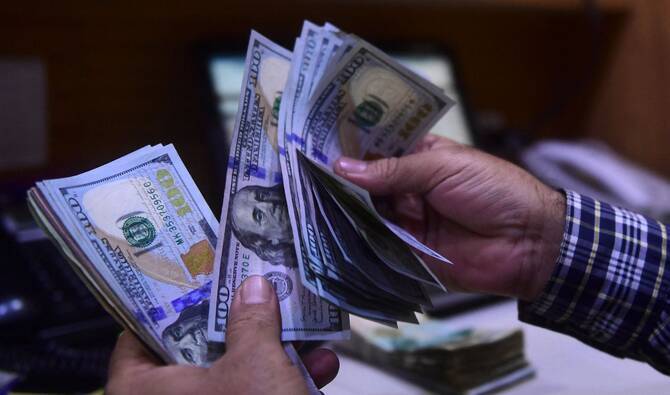
A dealer counts US dollars at a money exchange market in Karachi on March 2, 2023. (AFP/ file)
Short Url
Updated 29 July 2025
Follow

Pakistan’s crackdown on black market dollar trade pushes deals online

  • Many unlicensed exchange shops have been shut since July 22, when the military spy agency summoned representatives to explain dollar surge
  • Since the crackdown began, the Pakistani rupee has rebounded and firmed from Rs288.6 per dollar on July 19 to about Rs286 in recent sessions

KARACHI/PESHAWAR: Pakistan’s crackdown on black market dollar trading has strengthened the rupee, but traders say under-the-counter deals have swiftly shifted to smartphones and home deliveries instead.

Many unlicensed exchange shops have been shut since July 22, when the military spy agency summoned representatives of the sector to explain the US dollar’s rising cost in the open market. Soon after, raids were carried out by the Federal Investigation Agency, which tackles financial crime and smuggling.

Since the crackdown began, the rupee has rebounded from a sharp fall against the dollar earlier in July. In the open market, it firmed from 288.6 per dollar on July 19 to about 286 in recent sessions.

But traders and bankers say the trade continues, suggesting the crackdown’s effects could be short-lived.

The black market operates outside official channels and includes unlicensed dealers, personal networks, and digital peer-to-peer exchanges, with customers seeking to skip tax declarations, avoid burdensome paperwork and bypass limits on official currency purchases.

In Peshawar, a city near the Afghan border long known for black market currency deals, many shops in the historic Chowk Yadgar district remain shuttered, though some traders were still operating discreetly in back-alley booths.

“The trade didn’t stop. It just moved,” said Ahmad, a dealer whose family has been in the business for generations. “Now it’s on WhatsApp. If you know someone, the dollars come to your house.”

“The big players have shifted to safer locations and kept going,” said another trader, Gul. Both traders asked not to give their full names.

Even retail buyers are bypassing the formal foreign exchange market. Hassan, a manager at a multinational firm in Karachi, said stricter documentation drove him to an informal forex chat.

“Everyone there is a buyer or seller. No middleman, no commission. Sometimes it’s physical cash, sometimes bank transfers, sometimes crypto,” he said.
STRICTER FX DISCIPLINE

On Monday, Pakistan’s central bank called in bank treasury heads to address pressure on the rupee. Two bankers said they were told to stop buying dollars from exchange companies at above-official rates on the grounds it was skewing the market.

Banks were asked to rely on their own inflows from exports and remittances, but both sources have slowed. Exporters are delaying bringing money home, betting the rupee will weaken. Remittances are also tapering off as banks reduce incentives once offered to attract overseas inflows.

Authorities also pressed banks to keep the gap between the interbank rate and the open market rate narrow, a condition of Pakistan’s $7 billion IMF deal meant to discourage speculation.

“These meetings have been happening for years, but this one was more pointed,” one banker said, speaking on condition of anonymity.

The central bank is expected to cut rates on Wednesday, easing inflation but risking pressure on the rupee.​


Pakistan coach says dressing room hurting after India capitulation

Updated 7 sec ago
Follow

Pakistan coach says dressing room hurting after India capitulation

  • Ishan Kishan’s 77 powered India to 175-7 before bowlers sealed 61-run victory on Sunday
  • Pakistan collapsed to 13-3 and were bowled out for 114 in T20 World Cup Group A match

COLOMBO: Head coach Mike Hesson admitted Pakistan's players were hurting in the dressing room after their crushing 61-run defeat to arch-rivals India in Colombo on Sunday.

India dominated the T20 World Cup Group A match which had been in doubt until a few days ago when the Pakistan government cleared the team to play.

India, the defending champions, posted a fighting 175-7 after they were sent in to bat on a tacky R. Premadasa stadium pitch before they routed Pakistan for 114.

"There's a pretty disappointed dressing room in there at the moment, because they know how much it means to Pakistan," said Hesson, who was in charge for his fourth defeat in a row to India following three at last year's Asia Cup.

"We know that it's a huge event, Pakistan against India. We obviously won five games on the bounce before today so we were confident, but today we got outplayed," said Hesson.

Ishan Kishan's brilliant 77 helped India recover from a first-over dismissal of explosive opener Abhishek Sharma before Suryakumar Yadav (32) and Shivam Dube (27) lifted the total.

Pakistan slumped to 13-3 with India's Jasprit Bumrah removing Saim Ayub (six) and skipper Salman Agha (four) in the second over.

Usman Khan top-scored with 44 as Pakistan were bowled out in 18 overs, with 114 their third lowest total against India in all T20s.

Hesson defended the decision to bowl first at a stadium where three previous matches were won by the team batting first.

"I think the ball was spinning quite a lot initially and we started off well but I think the way Kishan played, he took the game away from us."

India's third win in as many games took them to the Super Eights stage while Pakistan now need to win their last game against Namibia on Wednesday.

The defeat further worsened Pakistan's win-loss record in World Cups against India to 1-8. They have lost all eight matches to India at the ODI World Cup.

"We have to pick ourselves up and make sure that we're very good in two or three days," said Hesson.

"We have played some good cricket in the lead-up to this World Cup so we're confident to do well in the tournament."