

Four dead, eight missing in China landslide after heavy rain

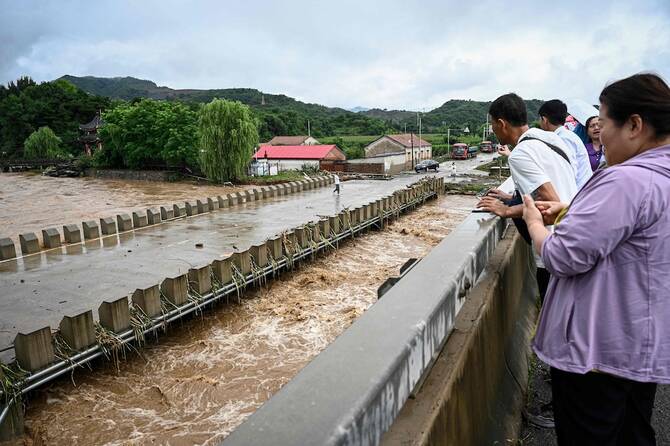
People check on high waters in a flood-affected area after heavy rains above a bridge at Xin’anzhuang village, in Miyun district, on the outskirts of Beijing on July 28, 2025. (AFP)
Short Url
Updated 28 July 2025
Follow

Four dead, eight missing in China landslide after heavy rain

  • Swathes of northern China have been inundated in recent days, with record rain in Hebei killing two people on Saturday
  • Natural disasters are common across China, particularly in the summer when some regions experience heavy rain

BEIJING: A landslide triggered by unusually heavy rain killed four people and left eight others missing in northern China’s Hebei province, state media said on Monday, as downpours force thousands to evacuate.

The landslide in a village near Chengde City was “due to heavy rainfall,” state broadcaster CCTV reported.

The national emergency management department said it dispatched a team to inspect the “severe” flooding in Hebei, which encircles the capital Beijing.

Swathes of northern China have been inundated in recent days, with record rain in Hebei killing two people on Saturday, state media said.

In Fuping County, more than 4,600 people were evacuated over the weekend, it said.

And in neighboring Shanxi province, one person was rescued and 13 were missing after a bus accident, CCTV reported.

Footage from the broadcaster showed roads in Shanxi and a crop field submerged in rushing water on Sunday.

In Beijing, more than 3,000 people in suburban Miyun district were evacuated due to torrential rains.

The area’s reservoir “recorded its largest inflow flood” since it was built more than six decades ago, state media reported.

On Monday in Mujiayu, a town just south of the reservoir, AFP journalists saw power lines swept away by muddy currents while military vehicles and ambulances plowed through flooded roads.

A river had burst its banks, sweeping away trees, while fields of crops were inundated with flood water.

Authorities in the capital issued the country’s second-highest warning for rainstorms and the highest for floods, state news agency Xinhua said.

The downpours are expected to last until Tuesday morning.

Natural disasters are common across China, particularly in the summer when some regions experience heavy rain while others bake in searing heatwaves.

China is the world’s biggest emitter of the greenhouse gases that scientists say drive climate change and contribute to making extreme weather more frequent and intense.

But it is also a global renewable energy powerhouse that aims to make its massive economy carbon-neutral by 2060.

Flash floods in eastern China’s Shandong province killed two people and left 10 missing this month.

A landslide on a highway in Sichuan province this month also killed five people after it swept several cars down a mountainside.


Bangladesh sets February date for first vote since 2024 mass uprising

Updated 59 min 23 sec ago
Follow

Bangladesh sets February date for first vote since 2024 mass uprising

  • At least 1,400 protesters were killed in violent crackdown under ex-PM Hasina’s rule
  • Interim government promises ‘all necessary support’ for upcoming elections

DHAKA: Bangladesh will hold national elections on Feb. 12, its chief election commissioner has announced, setting the timeline for the nation’s first vote since a student-led uprising that ousted long-serving Prime Minister Sheikh Hasina.

Hasina, whose Awami League party-led government was marred by allegations of human rights violations, rigged elections and corruption, was removed from office in August last year after 15 uninterrupted years in power.

Bangladesh has since been led by interim leader Muhammad Yunus, a Nobel Prize-winning economist, who took over governance after Hasina fled to India, where she is now in self-exile.

In a televised address on Thursday, chief election commissioner A.M.M. Nasir Uddin confirmed the voting date to elect 300 lawmakers and said a national referendum on political reforms would also be held on the same day.

“It’s a relief for the voters; it’s a relief for the country. It’s a relief for the investors, it’s a relief for the development partners and for the political parties and the people who did a massive job in July 2024 by sacrificing their lives and limbs to oust a tyranny,” said Prof. A.S.M. Amanullah, political analyst and vice chancellor of the National University in Dhaka.

Mass protests that broke out in 2024 began in early July as peaceful demonstrations, triggered by the reinstatement of a quota system for the allocation of civil service positions.

Two weeks later, they were met with a communications blackout and a violent crackdown by security forces.

A special tribunal in Dhaka found Hasina guilty of allowing lethal force to be used against the protesters, at least 1,400 people of whom died, according to estimates from the UN’s human rights office.

After a months-long trial, she was sentenced to death in November for crimes against humanity.

The February elections will take place in the aftermath of Hasina’s reign, with the Yunus-led administration banning all activities of Awami League, meaning the former ruling party would not be able to join the race next year.

Minor political tensions now revolve around the more than 40 million voters of the Awami League, as the public speculate “how they would move, in which party they would support or whether they would remain silent,” Amanullah said.

“(But) if you consider other than Awami League, if we consider the other political parties, I think the other political parties are sufficient, you know, to make the next poll participatory, and free and fair.”

Bangladesh last held elections in January 2024, which saw Hasina return to office for a fourth consecutive term. That vote was boycotted by the country’s main opposition parties, which accused her administration of rigging the polls.

“There is a growing demand within the society and in the community that they would cast their first vote after almost 15, 16 years. And that would be an (occasion) of big national celebration,” Amanullah said.

In February, more than 127.6 million Bangladeshis will be eligible to cast their vote. It will be Bangladesh’s 13th election since the country gained independence in 1971.

The long-awaited election process now begins with the filing of nominations from Dec. 12 to 29, which will then be reviewed over the following six days. The last date for withdrawing nominations is Jan. 20.

After the voting date was announced, Yunus pledged to “provide all necessary support” to encourage festivity, participation and fairness in the upcoming polls.

“After the historic mass uprising (last year), the country is now moving toward a new path,” he said in a statement. “This election and referendum will consolidate that trajectory, prioritize the will of the people and further strengthen the foundation of a new Bangladesh.”

For Malaika Nur, a 24-year-old Dhaka University student who took part in the 2024 protests, the elections are an opportunity for young people to formally take part in politics.

“Young people have been showing much interest in politics since July 2024. They showed us how the youth can reshape a country’s political condition. If they have a few seats in the parliament, it can be a game-changer for the future of politics in Bangladesh,” she said.

“I hope this election will be different from the last three elections held in the previous regime. There will be a festive mood, people will cast their valuable votes and will get to choose their representative … I hope the elected government will ensure safety and basic rights of every citizen, and will hold fair elections in the future and will not become another fascist.”