

Authorities seize 1,000 kilograms of donkey meat in Islamabad, arrest ‘foreign national’

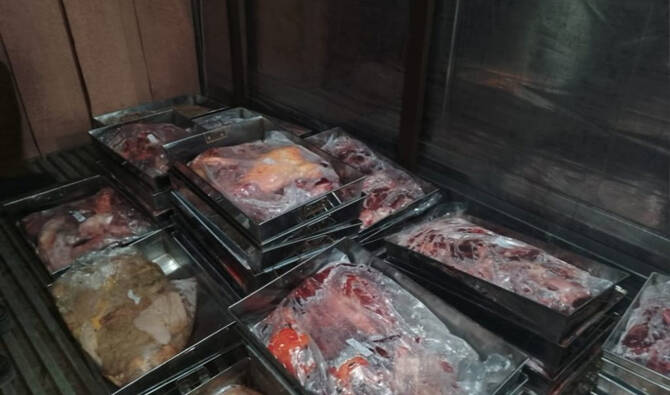
The handout photograph released by the Islamabad Food Authority on July 27, 2025, shows packets of donkey meat seized by the authorities at a farmhouse in Tarnol area of Islamabad, Pakistan. (IFA)
Short Url
Updated 27 July 2025
Follow

Authorities seize 1,000 kilograms of donkey meat in Islamabad, arrest ‘foreign national’

  • The seizure was made during a raid at a farmhouse in Islamabad’s Tarnol area, with authorities recovering 50 live donkeys as well
  • Official says the meat had been packed for ‘export to a neighboring country,’ more raids to be conducted to trace local facilitators

ISLAMABAD: Local administration in the Pakistani capital of Islamabad has seized around 1,000 kilograms of donkey meat from an illegal slaughterhouse and arrested a “foreign national,” officials said on Sunday.

The seizure was made during a joint raid by the Islamabad Food Authority (IFA), local police and the Islamabad district administration on a farmhouse in Tarnol area, according to the IFA.

Fifty live donkeys were also recovered from the site and an IFA team was destroying the meat under the supervision of Deputy Director Dr. Tahira Siddique.

Police have lodged a case against the arrested foreign national, who had been running the operation, and are looking for his local facilitators.

“A foreign national was arrested at the site which has been sealed and an investigation is underway,” Muhammad Nasir Butt, a spokesperson for the Islamabad district administration, told Arab News.

“We will conduct further raids as per the findings of the investigation and efforts are also underway to trace local individuals involved.”

Butt said the meat had been packed for “export to a neighboring country.”

“So far, we have not found any traces of meat being used in the local restaurants, but administration is investigating the matter from multiple angles,” he added.

According to a police report seen by Arab News, the farmhouse had no authorization to process donkey meat or export live donkeys.

“Due to the absence of records for [processing] haram meat, and on the basis of its supply and sale, legal action shall be taken against concerned individuals under Sections 11, 12, 13, and 14 of the Islamabad Capital Territory Food Safety Act, 2021,” the report said.

Pakistan is frequently listed among countries with the highest number of donkey populations worldwide. The country’s donkey population rose to 6 million in fiscal year 2024-25, which ended in June, compared to 5.9 million in 2023–24, according to the latest economic survey.

In May this year, Pakistan Customs had foiled an attempt to smuggle donkey hides worth approximately Rs80 million (around $283,800) to China. The staff deployed on the Risk Management Profiling System of the Karachi Customs

Collectorate detected a container number SEGU-3154225 cleared from the South Asia Pakistan Port (SAPT) terminal in Karachi, whose export documents showed 285 packages of leather products were being sent to China.

The animal’s meat and hides are quite popular in China. Gelatin derived from donkey hides is highly sought after in China for its use in Ejiao, a traditional medicinal remedy. Several Chinese eateries sell donkey meat and burgers for consumption.

Dr. Siddique, who was part of the team that raided the farmhouse, said the availability of safe and quality food in Islamabad was the top priority of the IFA.

“We are enforcing a zero-tolerance policy against those who endanger public health,” she was quoted as saying by the IFA.


Pakistan pitches digital finance reforms to foreign fintech investors

Updated 4 sec ago
Follow

Pakistan pitches digital finance reforms to foreign fintech investors

  • Khurram Schehzad highlights progress on digital banking and plans for regulating blockchain and virtual assets
  • Visiting delegation welcomes policy clarity, sees scope for long-term investment and partnerships in Pakistan

KARACHI: Pakistan on Saturday pitched its digital finance and fintech reforms to foreign investors as part of a broader effort to attract capital after macroeconomic stabilization, with a senior official highlighting progress on digital banking, payments infrastructure and regulatory overhaul.

The outreach came as Islamabad seeks to sustain reform momentum following a period of economic stress, positioning technology-led financial inclusion as a pillar of its recovery and growth strategy while courting international investors.

Khurram Schehzad, adviser to the finance minister, briefed a delegation of international fintech investors on Pakistan’s reform agenda and digital growth plans at a meeting in federal capital, according to a statement from the finance ministry.

“Consistent policy implementation and structural reforms have strengthened macroeconomic fundamentals and improved Pakistan’s investment outlook,” he said, highlighting the “renewed global confidence” in the economy.

Officials said the discussions focused on the government’s Digital Pakistan Vision, including efforts to expand digital payments, build public digital infrastructure and digitize government transactions to widen financial inclusion and formalize the economy.

Schehzad cited the role of Raast, Pakistan’s instant payment system, which enables real-time, low-cost and interoperable digital payments nationwide, as well as regulatory reforms introduced by the State Bank of Pakistan to modernize retail digital banking.

Under the new framework, easypaisa Digital Bank has been operational for nearly a year, while Mashreq Digital Bank has also begun operations, with several other digital banks moving toward launch, the statement said.

The adviser also outlined Pakistan’s plans to develop a regulatory framework for blockchain, Web3.0 and virtual assets, saying authorities were engaging with global platforms to support innovation while ensuring compliance and investor protection.

The investor delegation was led by John Sfakianakis, chairman of Fintech Solutions Holding, alongside the company’s chief executive Kirill Smolin, and was facilitated by local technology firm Tech Avenue.

The investors welcomed the “clarity of reforms and policy direction,” saying Pakistan’s combination of macroeconomic stabilization, digital infrastructure and emerging technologies offered opportunities for long-term investment and strategic partnerships, the finance ministry said.