Greece gets EU help to battle disastrous wildfires

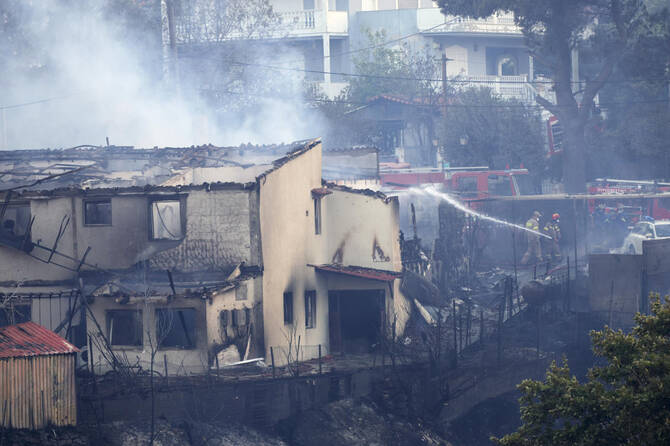
Firefighters try to extinguish a fire at a house during a wildfire in the northwestern suburb of Kryoneri, in Athens, Greece on July 26, 2025. (AP)
Short Url
Updated 27 July 2025
Follow

Greece gets EU help to battle disastrous wildfires

  • Five fires are still raging Sunday morning in the Peloponnese area west of the capital
  • There also also active fires on the islands of Evia, Kythera and Crete

ATHENS: Greece battled wildfires that have ravaged homes and sparked evacuations for a second day on Sunday, with the help of Czech firefighters and Italian aircraft expected to arrive later.

Five fires were still raging Sunday morning in the Peloponnese area west of the capital, as well as on the islands of Evia, Kythera and Crete, with aircraft and helicopters resuming their work in several parts of the country at dawn.

“Today is expected to be a difficult day with a very high risk of fire, almost throughout the territory,” fire brigade spokesman Vassilis Vathrakogiannis said Sunday, though he added that the situation was improving.

Forecasters predicted the strong winds that have fanned the flames would die down on Sunday in most areas but warned that Kythera, a popular tourist island with 3,600 inhabitants, continued to face “worrying” windy conditions.

Evacuation messages were sent to people on the island, which lies off the south-eastern tip of the Peloponnese, early on Sunday as the fire raged unabated.

“Houses, beehives, olive trees have been burnt,” Giorgos Komninos, deputy mayor of Kythera, told state-run ERT News channel.

“A monastery is in direct danger right now,” he said, adding that half of the island had been burnt.

Dozens of firefighters supported by three helicopters and two aircraft were battling the Kythera blaze, which erupted Saturday morning and forced the evacuation of a popular tourist beach.

Greece had earlier requested help from EU allies and two Italian aircraft were expected Sunday, according to the fire brigade, with units from the Czech Republic already at work.

Eleven regions of Greece still face a very high fire risk, according to officials.

Firefighters are working in several areas of the Peloponnese and there were numerous flare-ups overnight on the island of Evia, near Athens, where the flames have laid waste to swathes of forest and killed thousands of farm animals.

Workers have toiled since dawn to repair serious damage to Evia’s electricity network and some villages were facing problems with water supply.

Further south on Crete, reports said fires that broke out on Saturday afternoon and destroyed four houses and a church and largely been contained.

In Kryoneri north of Athens, police were reportedly bolstering security as fears grow that looters could target houses abandoned by residents fleeing a fire that erupted on Saturday afternoon but was mostly contained on Sunday.

“We are fighting here. What can we do,” asked Kryoneri Giorgos, wearing a mask to protect himself from the smoke.

He said on Saturday afternoon he and others were battling to save “the work of a lifetime.”

“By the time I got here the flames were already up here. It all happened so fast,” said Alexandros Andonopoulos, who rushed from Athens to the village.

“Fortunately the firemen arrived quickly.”

Prime Minister Kyriakos Mitsotakis wrote on social media that anyone who lost possessions “should know that the state will be by their side.”

He said Saturday was a “titanic” struggle but “the picture today looks better and the battle continues with all available resources.”

Greece has endured heatwave conditions for almost a week, with temperatures passing 40 degrees Celsius (104 degrees Fahrenheit) in many areas.

On Saturday, the temperature reached 45.2C in Amfilohia, in western Greece.

The extreme heat is expected to die down from Monday.

Last month, fires on Greece’s fifth-biggest island Chios, in the northern Aegean, destroyed 4,700 hectares of land, while early July a wildfire on Crete forced the evacuation of 5,000 people.

The most destructive year for wildfires in the country that is deemed a climate change hotspot, was 2023, when nearly 175,000 hectares were lost and there were 20 deaths.

Greece, like many countries is experiencing hotter summers stoked by human-induced climate change, which increases the length, frequency and intensity of wildfires.


US envoys juggle two crisis talks, raising questions about prospects for success

Updated 6 sec ago
Follow

US envoys juggle two crisis talks, raising questions about prospects for success

  • “Trump seems more focused on quantity over quality instead of the difficult detailed work of diplomacy,” said Bruen
  • A regional official close to Iran’s leadership said the US team’s double agenda in Geneva reinforced doubts

WASHINGTON/GENEVA/DUBAI: Even for a US president long fixated on deal-making, Donald Trump’s assignment of his favorite envoys to juggle two sets of negotiations – the Iranian nuclear standoff and Russia’s war in Ukraine — in a single day in Geneva has left many in the foreign policy world scratching their heads.
The shuttle diplomacy on Tuesday by US special envoy Steve Witkoff and Trump’s son-in-law Jared Kushner has raised questions not only about whether they are overstretched and outmatched, but about their serious prospects for resolving either of the twin crises, experts say.
Trump, who has frequently boasted about having ended multiple wars and conflicts in the first year of his second four-year term, has made clear he is looking to add more international deals that he can tout in his quest for the Nobel Peace Prize.
But the high-stakes negotiations over the two long-running issues were arranged quickly, and the choice of Geneva as the setting for both was never clearly explained, except for the city’s long history of hosting international diplomacy.
“Trump seems more focused on quantity over quality instead of the difficult detailed work of diplomacy,” said Brett Bruen, who was a foreign policy adviser in the Obama administration and now heads the Global Situation Room strategic consultancy. “Tackling both issues at the same time in the same place doesn’t make a lot of sense.”
Iran was the opening act in a carefully choreographed diplomatic dance in Geneva, where talks ⁠took place under ⁠high security in two locations on different sides of the Swiss, French-speaking city.
After 3-1/2 hours of indirect discussions between the US team and Iranian Foreign Minister Abbas Araqchi mediated by Oman, both sides indicated that some progress was made, but there was no suggestion that an agreement was imminent in the longstanding dispute over Iran’s nuclear program.
As long as the diplomatic process continues, Trump can keep expanding his massive military buildup near Iran, making clear that use of force remains on the table. That is likely to keep the Middle East on edge, with many fearing that US strikes could escalate into a wider regional war.

’OVERSTRETCH’?
With barely a pause on Tuesday, the US delegates went straight from the Iran talks at Oman’s diplomatic mission to the five-star InterContinental hotel for the first of two days of Russia-Ukraine ⁠negotiations over a war that Trump, during the 2024 presidential campaign, had promised to end in a day.
Expectations were low for a breakthrough in the latest round of talks to end Europe’s biggest war since World War Two ended in 1945.
A regional official close to Iran’s leadership said the US team’s double agenda in Geneva reinforced doubts about whether Washington was sincere about either of the diplomatic efforts.
“The approach risks overstretch,” the official, who spoke on condition of anonymity, told Reuters. “It resembles an emergency room with two critically ill patients and a single doctor unable to give either case sustained attention, increasing the likelihood of failure.”
Mohanad Hajj-Ali of the Carnegie Middle East Center in Beirut said there was too much at stake in the Iran crisis for the US to handle diplomacy this way.
“Having a team of Witkoff and Kushner tasked with resolving all the world’s problems is, frankly, a shocking reality,” he said.
Some experts said the two, both from Trump’s world of New York real estate development, lack the depth of knowledge and experience to go up against veteran negotiators like Araqchi and their Russian interlocutors and that they were in over their heads in such complicated conflicts.
Absent from the Geneva meetings was US ⁠Secretary of State Marco Rubio, Trump’s top ⁠diplomat, who is known as a foreign policy wonk.
Asked for comment, White House spokesperson Anna Kelly said Trump and his team “have done more than anyone to bring both sides together to stop the killing and deliver a peace deal” in Ukraine. She denounced anonymous “critics” of the president’s approach but did not provide answers to Reuters’ specific questions for this story.

’ENVOY FOR EVERYTHING’
Administration officials have long defended Witkoff and Kushner’s roles, citing their skills as dealmakers, the trust Trump puts in them, and the failings over the years of more traditional diplomatic approaches. Witkoff, a longtime Trump friend often called the “envoy for everything” due to his broad remit, played a key role in securing a ceasefire agreement last year between Israel and Hamas in the Gaza war, though progress has stalled toward a more permanent resolution. His diplomatic efforts with Iran and Russia have had little success so far.
In Trump’s first term, Kushner spearheaded the Abraham Accords, under which several Arab states forged landmark diplomatic relations with Israel. But the pact has not advanced much since Trump returned to office nearly 13 months ago.
Kushner and Witkoff’s ability to handle their latest diplomatic tasks has been undercut by Trump’s stripping down of the government’s foreign policy apparatus, both at the State Department and the National Security Council, where many veteran staffers were sent packing, some analysts say.
”We’ve seen a hollowing-out of our diplomatic bench,” said former Obama foreign policy adviser Bruen. “So there’s a question of whether we still have the right people to work on these big issues.”