

Russia starts first Moscow-Pyongyang passenger flights in decades

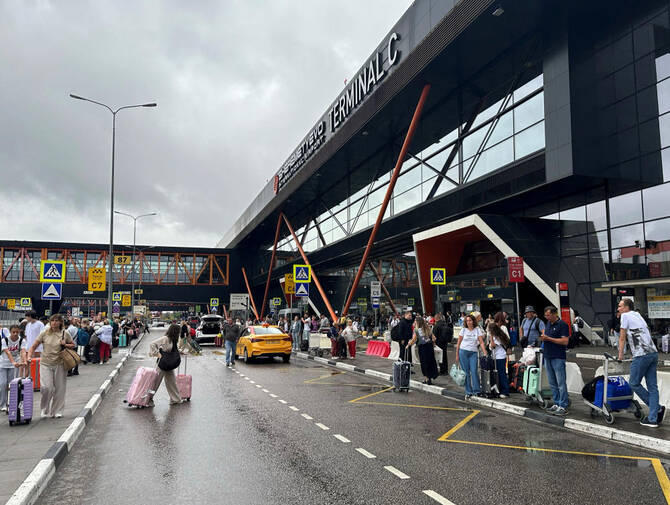
Direct passenger flights from Moscow to North Korea’s capital Pyongyang will leave Sheremetyevo airport, above. (Reuters)
Short Url
Updated 27 July 2025
Follow

Russia starts first Moscow-Pyongyang passenger flights in decades

  • The first flight will leave Sheremetyevo airport at 7 p.m. (1600 GMT), according to the airport’s timetable
  • The eight-hour flight will be operated by a Boeing 777-200ER with a capacity of 440 passengers

Russia will launch direct passenger flights from Moscow to North Korea’s capital Pyongyang on Sunday, Russian authorities said, as the two former communist bloc allies move to improve ties following Russia’s invasion of Ukraine in 2022.

The start of regular flights between the capitals for the first time since the mid-1990s, according to Russian aviation blogs, follows the resumption of Moscow-Pyongyang passenger rail service, a 10-day journey, in June.

The first flight will leave Sheremetyevo airport at 7 p.m. (1600 GMT), according to the airport’s timetable.

The eight-hour flight will be operated by a Boeing 777-200ER with a capacity of 440 passengers, Russia’s RIA state news agency said on Sunday. It said tickets started at 44,700 roubles ($563), and the first flight quickly sold out.

Russia’s civil aviation authority Rosaviatsia has granted Nordwind Airlines permission to operate flights between Moscow and Pyongyang twice a week. The transport ministry said in a statement that for now flights would operate once a month, “to help build stable demand.”

The only direct air route between Russia and North Korea has been flights by North Korean carrier Air Koryo to Vladivostok in Russia’s Far East three times a week.

Ukraine and its Western allies have accused North Korea of supplying Russia with artillery and ballistic missiles. Moscow and Pyongyang deny the allegations.

Pyongyang has deployed more than 10,000 troops and arms to Russia to back Moscow’s military campaign in Ukraine. North Korean leader Kim Jong Un said this month his country was ready to “unconditionally support” Moscow’s efforts to resolve the conflict in Ukraine.


US reaches nuclear deal with Armenia during Vance visit

Updated 3 sec ago
Follow

US reaches nuclear deal with Armenia during Vance visit

  • JD Vance’s visit to Armenia follows US-brokered peace accord with Azerbaijan mending relations after decades of war
  • Agreement will ‌allow ⁠up ​to $5bn in initial US exports to Armenia, plus an additional $4bn in longer-term fuel and maintenance contracts
TBILISI: Armenia and the United States agreed on Monday to cooperate in the civil nuclear sector as Washington sought to bolster ties with a former close ally of Russia, months after Washington brokered a peace agreement in the South Caucasus.
A statement on the nuclear sector deal was signed by Armenian Prime Minister Nikol Pashinyan and US Vice President JD Vance, who is on a two-day visit to the country.
The two said they had completed negotiations on what is known as a 123 Agreement, which allows the ‌US to legally license ‌nuclear technology and equipment to other countries.
The agreement will ‌allow ⁠up ​to $5 ‌billion in initial US exports to Armenia, plus an additional $4 billion in longer-term fuel and maintenance contracts, Vance said.
“This agreement will open a new chapter in the deepening energy partnership between Armenia and the United States,” Pashinyan said at a joint press conference with Vance.
Long heavily dependent on Russia and Iran for its energy supplies, Armenia is now reviewing proposals from US, Russian, Chinese, French and South Korean companies to construct a new nuclear reactor to replace its sole, aging ⁠Russian-built nuclear power plant, Metsamor.
No choice has yet been made, but Monday’s announcement paves the way for an American ‌project to be selected. That would deal a blow to ‍Russia, which traditionally has viewed the ‍South Caucasus as its sphere of influence but whose clout there has diminished as a ‍result of its invasion of Ukraine.

'Diversify partners’

“Considering Armenia’s multiplicity of dependencies on Russia, it is a political priority to diversify partners when it comes to nuclear cooperation,” said Narek Sukiasyan, a political scientist in Yerevan.
“The United States seems to be the preference now.”
Vance’s visit comes just six months after ​the Armenian and Azerbaijani leaders signed an agreement at the White House seen as the first step toward peace after nearly 40 years of war.
Vance ⁠was also seeking to advance the “Trump Route for International Peace and Prosperity (TRIPP),” a proposed 43-kilometer (27-mile) corridor that would run across southern Armenia and give Azerbaijan a direct route to its exclave of Nakhchivan and in turn to Turkiye, Baku’s close ally.
The route would better connect Asia to Europe while — crucially for Washington — bypassing Russia and Iran at a time when Western countries are keen on diversifying energy and trade routes away from Russia due to the Ukraine conflict.
The TRIPP corridor, which envisages new or updated rail infrastructure, oil and gas pipelines and fiber-optic cables, would transform the South Caucasus, a region riven by closed borders and longstanding ethnic conflicts.
“We’re not just making peace for Armenia,” Vance said. “We’re also creating real prosperity for Armenia and ‌the United States together.”
He is set to visit Azerbaijan on Wednesday and Thursday, according to the White House.