

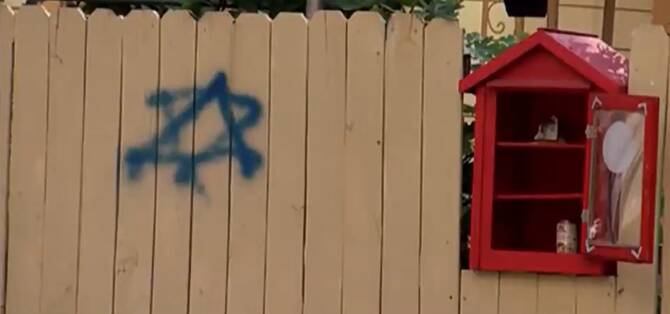
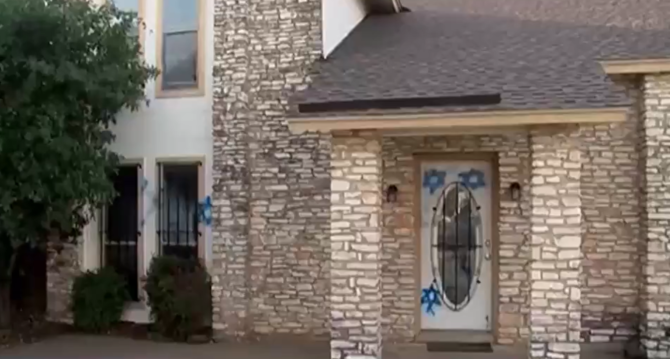
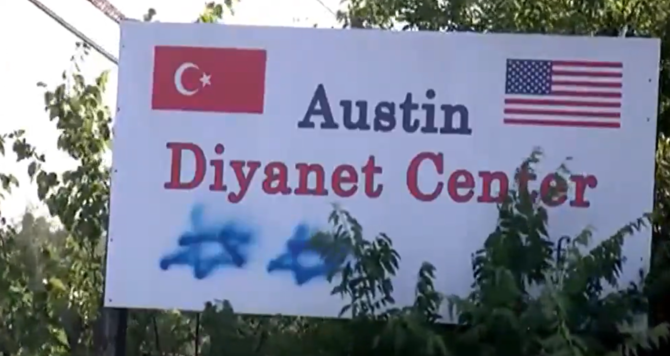

TEXAS: After a spate of vandalism reports involving graffiti at a few mosques in Texas and California, Muslim leaders there have stepped up existing efforts to keep their sacred spaces and community members safe.
The incidents and subsequent hypervigilance add to what many American Muslims say has already been a charged climate amid the fallout in the US from the Israel-Hamas war that has killed tens of thousands of Palestinians and devastated Gaza. The war started in October 2023 with a deadly attack by Hamas on Israel.
“The past two years have been extremely difficult for American Muslims,” said Edward Ahmed Mitchell, national deputy director of the Council on American-Islamic Relations, a Muslim civil rights and advocacy organization.
A constant stream of images showing the death, destruction and ongoing starvation in Gaza has taken a toll, said Mitchell, as has a rise in anti-Muslim and anti-Palestinian bigotry in the US
He pointed to one of the most egregious examples of that bigotry: After the war started, an Illinois man killed a 6-year-old Palestinian American Muslim boy and wounded his mother in a hate-crime attack.
Worry and frustration
The recent vandalism reports have left some worried and frustrated — but not entirely surprised.
“Since October 2023, we’ve definitely seen rise in Islamophobia,” said Rawand Abdelghani, who is on the board of directors of Nueces Mosque, one of the affected mosques in Austin, Texas. “Anti-Palestinian, anti-immigrant, all of that rhetoric that’s being said … it has contributed to things like this happening.”
Nueces security footage showed someone, their face partially covered, spray-painting what appears to be Star of David symbols at the property. CAIR Austin said similar incidents were reported at two other Austin mosques.
They all seemingly happened on the same night in May, in what the group described as part of “a disturbing pattern of hate-motivated incidents.” It called for increased security patrols and protective measures.
Shaimaa Zayan, CAIR Austin operations manager, called them an intimidation attempt.
Less than two weeks earlier, someone had spray-painted graffiti at the Islamic Center of Southern California, including the Star of David on an outer wall there, center spokesperson Omar Ricci said.
“In light of what’s going on within Palestine and the genocide in Gaza, it felt like an attack,” said Ricci, who’s also a reserve Los Angeles Police Department officer.
Some specifics remained unresolved. The LAPD said it opened a vandalism/hate crime investigation and added extra patrols, but added it has neither a suspect nor a motive and noted that nonreligious spaces were also targeted.
The Austin Police Department did not respond to Associated Press inquiries.
Nueces had already increased its security camera use following three incidents last year, including someone throwing rocks at the mosque, Abdelghani said. After the May vandalism, it also added overnight security, she added.
Nueces serves many university students and is considered a “home away from home,” Abdelghani said. It’s where they learn about their faith, meet other Muslims and find refuge, including during tense times, like when some students got arrested amid campus protests last year, she added.
CAIR says that in 2024, its offices nationwide received 8,658 complaints, the highest number it has recorded since its first civil rights report in 1996. It listed employment discrimination as the most common in 2024.
The group says last year, US Muslims, along with others of different backgrounds, “were targeted due to their anti-genocide … viewpoints.” Referencing former President Joe Biden, the CAIR report said that for “the second year in a row, the Biden-backed Gaza genocide drove a wave of Islamophobia in the United States.”
Israel has strongly rejected allegations it’s committing genocide in Gaza, where its war with Hamas has killed more than 59,000 Palestinians, according to Gaza health officials. The initial Hamas-led attack on Oct. 7, 2023, killed some 1,200 people, while about 250 were abducted.
Tensions in multiple spaces
The war has fueled tensions in myriad US settings. After it started, Muslim and Jewish civil rights groups reported a surge of harassment, bias and physical assaults reports against their community members. Pew Research Center in February 2024 found that 70 percent of US Muslims and nearly 90 percent of US Jews surveyed say they felt an increase in discrimination against their respective communities since the war began.
More recently, leaders of US Jewish institutions have called for more help with security after a firebomb attack in Colorado on demonstrators showing support for Israeli hostages in Gaza that left one person killed and others injured, as well as a fatal shooting of two Israeli Embassy staffers outside a Jewish museum in Washington, D.C.
Politically, the conflict loomed over last year’s presidential election, leaving many pro-Palestinian US voters feeling ignored by their own government’s support for Israel. It has roiled campuses and sparked debates over free speech and where political rhetoric crosses into harassment and discrimination.
There’ve been bitter disagreements, including among some Jewish Americans, about exactly what the definition of antisemitism should cover, and whether certain criticism of Israeli policies and Zionism should be included. That debate further intensified as President Donald Trump’s administration sought to deport some foreign-born pro-Palestinian campus activists.
The Islamic Center of Southern California has been targeted before, including vandalism in 2023 and separate threats that authorities said in 2016 were made by a man who was found with multiple weapons in his home.
Incidents like the latest one cause concern, Ricci said.
“People see that it’s not going to take very much to spark something in the city,” he said. “There’s a lot of emotion. There’s a lot of passion” on both the pro-Palestinian and pro-Israeli sides.
Salam Al-Marayati, president of the Muslim Public Affairs Council, said “if people think they can get away with graffiti, then the next step is to firebomb a mosque or even go attack worshippers.”
Opening doors and receiving support
Al-Marayati and others praised how many have shown support for the affected Muslim communities.
“The best preparation is what we did in Los Angeles and that’s to stand shoulder-to-shoulder with our allies and be there for one another,” he said.
In Texas, a gathering at Nueces brought together neighbors and others, including Christians and Jews, to paint over the vandalism, clean up the property and garden, Zayan said.
“It was beautiful,” she said.
“It’s really important to open your doors and open your heart and invite people and to rebuild this trust and connection,” she said. “For non-Muslims, it was a great opportunity for them to show their love and support. They really wanted to do something.”


