RAMALLAH, Palestinian Territories: The Israeli military’s top commander in the occupied West Bank condemned recent violence by Israeli settlers against police and “unacceptable” conduct by soldiers, in a video shared by the army on Friday.
A military statement said that Major General Avi Bluth addressed a “series of unusual incidents” while visiting Israeli police officers in the West Bank, near the site of a riot involving settlers earlier this week.
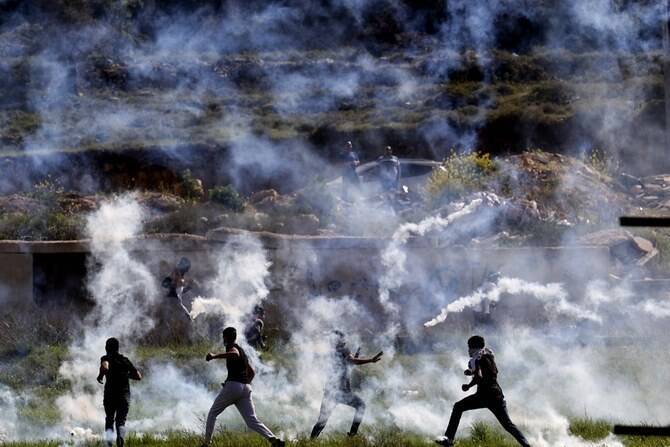
Israeli police said they had arrested 17 suspects over the “violent riot” on Wednesday near the settlement outpost of Givat Habaladim, northeast of the Palestinian city of Ramallah, during which Israeli settlers threw stones at officers and torched a police car.
Bluth “emphasized that these are exceptional incidents that must be addressed with the necessary severity,” the military statement said.
Referring to the settlers’ attack on Israeli forces, Bluth said in the video: “Beyond the fact that this is a red line that has been crossed and will be dealt with seriously, there is no greater act of ingratitude.”
Rights groups often accuse the army of protecting Israeli settlers in the West Bank, and the United Nations has said that settler attacks against Palestinians are taking place in a climate of “impunity.”
In a recent incident Bluth did not address in the video, the army said that this week “dozens of Israeli civilians... set fire to property” in the Palestinian village of Duma, injuring several people.
The Israeli general mentioned “vandalism and graffiti” by reserve soldiers during a military raid on Wednesday, in the Dheisheh refugee camp near Bethlehem.
While a major offensive since January has focused on refugee camps in the northern West Bank, Dheisheh in the south has seen an uptick in Israeli army raids in recent weeks.
Images shared on social media showed vandalized apartments, where furniture was broken and Israeli nationalist slogans spray painted on walls.
Bluth said that “the conduct in Dheisheh by our reserve soldiers is not what we stand for.”
“Vandalism and graffiti during an operational mission are, from our perspective, unacceptable incidents. It is inconceivable that IDF (army) soldiers do not act according to their commanders’ orders,” he said.
Since war began in October 2023 in the Gaza Strip — a separate Palestinian territory — violence has soared in the West Bank.
Israeli troops or settlers have killed at least 917 Palestinians, including militants, in the West Bank since October 2023, according to Palestinian health ministry figures.
Palestinian attacks and clashes during military raids have killed at least 33 Israelis, including soldiers, over the same period, according to official figures.
Israel has occupied the West Bank, home to about three million Palestinians, since 1967.
Excluding annexed east Jerusalem, around 490,000 Israelis live there in settlements and outposts that are illegal under international law. Outposts are also illegal under Israeli law.


![]()

Israeli general condemns West Bank settler riot, ‘vandalism’ by troops
Short Url
https://arab.news/gxc5r
Israeli general condemns West Bank settler riot, ‘vandalism’ by troops
- Major General Avi Bluth addressed a “series of unusual incidents” while visiting Israeli police officers in the West Bank
- Bluth “emphasized that these are exceptional incidents that must be addressed with the necessary severity“


Latest updates


Recommended


© 2026 SAUDI RESEARCH & PUBLISHING COMPANY, All Rights Reserved And subject to Terms of Use Agreement.