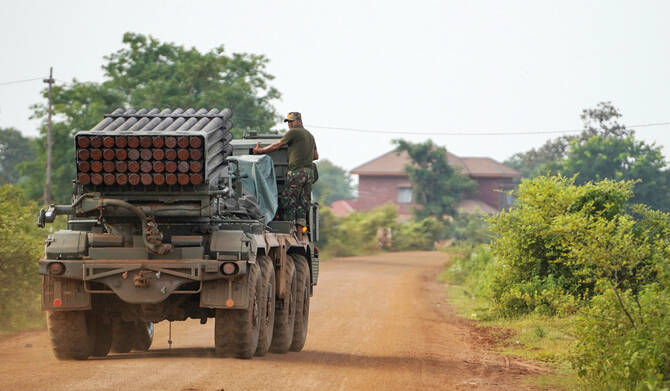

SAMRAONG, Cambodia: Thailand and Cambodia clashed for a third day on Saturday, as the death toll from their bloodiest fighting in years rose to 33 and Phnom Penh called for an “immediate ceasefire.”
A long-running border dispute erupted into intense conflict involving jets, artillery, tanks and ground troops on Thursday, prompting the UN Security Council to hold an emergency meeting on the crisis Friday.
Cambodia’s defense ministry said 13 people were now confirmed killed in the fighting, including eight civilians and five soldiers, with 71 people wounded.
In Thailand, the army said five soldiers were killed on Friday, taking the toll there to 20 – 14 civilians and six military.
The death toll across the two countries is now higher than the 28 killed in the last major round of fighting between 2008 and 2011.
Both sides reported a clash around 5:00 a.m. (2200 GMT Friday), with Cambodia accusing Thai forces of firing “five heavy artillery shells” into locations in Pursat province, which borders Thailand’s Trat province – on the coast some 250 kilometers (160 miles) southwest of the main frontlines.
AFP journalists in the Cambodian town of Samraong, near the ridge of forest-clad hills that marks the border and has seen the bulk of the fighting, heard the thump of artillery early Saturday afternoon.
A Thai villager reached by phone as he sheltered in a bunker in Sisaket province, just 10 kilometers from the frontier, also reported hearing artillery.
“I just want this to end as soon as possible,” Sutian Phiewchan said.
The fighting has forced more than 138,000 people to be evacuated from Thailand’s border regions, with more than 35,000 driven from their homes in Cambodia.
After the closed meeting of the Security Council in New York, Cambodia’s UN ambassador Chhea Keo said his country wanted a ceasefire.
“Cambodia asked for an immediate ceasefire – unconditionally – and we also call for the peaceful solution of the dispute,” he told reporters.
Thai Foreign Minister Maris Sangiampongsa said Saturday that for any ceasefire or talks to proceed, Cambodia needed to show “genuine sincerity in ending the conflict.”
“I urge Cambodia to stop violating Thai sovereignty and to return to resolving the issue through bilateral dialogue,” Maris told reporters.
Thai Foreign Ministry spokesman Nikorndej Balankura said Friday, before the UN meeting was held, that Bangkok was open to talks, possibly aided by Malaysia.
Malaysia currently holds the chair of the Association of Southeast Asian Nations regional bloc, of which Thailand and Cambodia are both members.
Both sides have blamed the other for firing first, while Thailand accused Cambodia of targeting civilian infrastructure, including a hospital hit by shells and a petrol station hit by at least one rocket.
Cambodia has accused Thai forces of using cluster munitions.
Former Thai prime minister Thaksin Shinawatra – still an influential figure in the kingdom – visited shelters on Saturday to meet evacuees.
“The military needs to complete its operations before any dialogue can take place,” Thaksin told reporters.
The 76-year-old said he had no plans to contact Hun Sen, Cambodia’s powerful ex-prime minister who was long a close ally.
“His actions reflect a disturbed mindset. He should reflect on his conduct,” Thaksin said of Hun Sen.
The fighting marks a dramatic escalation in a long-running dispute between the neighbors – both popular destinations for millions of foreign tourists – over their shared 800-kilometer border.
Dozens of kilometers in several areas are contested and fighting broke out between 2008 and 2011, leaving at least 28 people dead and tens of thousands displaced.
A UN court ruling in 2013 settled the matter for more than a decade, but the current crisis erupted in May when a Cambodian soldier was killed in a new clash.
Relations between the neighbors soured dramatically when Hun Sen last month released a recording of a call with Thai Prime Minister Paetongtarn Shinawatra focused on the border row.
The leak triggered a political crisis in Thailand as Paetongtarn – Thaksin’s daughter – was accused of not standing up for Thailand enough, and of criticizing her own army.
She was suspended from office by a court order.