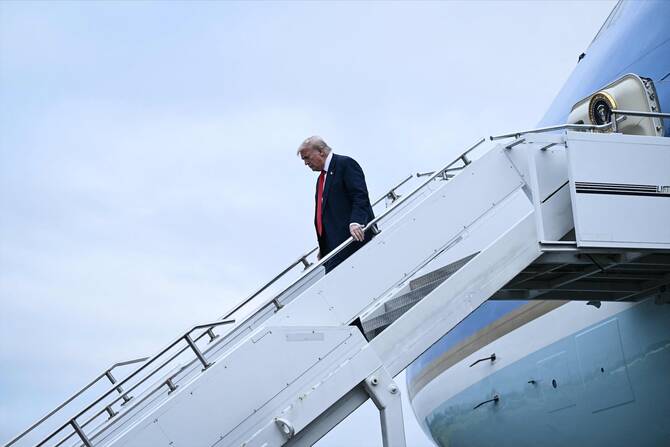
EDINBURGH/LONDON: US President Donald Trump, dogged by questions about his ties to disgraced financier and sex offender Jeffrey Epstein, arrived in Scotland on Friday for some golf and bilateral talks that could yield a trade deal with the European Union.
Trump told reporters upon his arrival that he will visit his two golf properties in Scotland and meet with British Prime Minister Keir Starmer and European Commission President Ursula von der Leyen, whom he called a “highly respected woman.”
As hundreds of onlookers cheered his arrival, Trump repeated his earlier comment about a 50-50 chance of securing a deal with the EU, adding it would be his administration’s biggest trade agreement thus far, if it came together.
However, he said there were still “sticking points” with Brussels on “maybe 20 different things.”
Trump said his meeting with Starmer would be more of a celebration of the trade deal already reached than continued work on it, adding, “It’s a great deal for both.” Before he left Washington, Trump said his administration was working hard on a possible trade deal with the EU, and Brussels was keen to make a deal. Von der Leyen said later she would meet Trump in Scotland on Sunday.
EU diplomats say a deal could result in a 15 percent tariff on EU goods, mirroring a framework accord with Japan reached this week and half of the 30 percent Trump is threatening to impose by August 1.
Trump has sought to reorder the global economy after imposing a 10 percent tariff on nearly all trading partners in April and threatening sharply higher rates for many countries to kick in a week from now. Trump says the moves will reduce the US trade deficit and bring in extra revenue, but economists warn the new trade policies could drive up inflation.
Trump, facing the biggest domestic political crisis of his second term, expressed frustration about ongoing questions about his administration’s handling of investigative files related to Epstein’s criminal charges and his 2019 death in prison.
“You make it a very big thing over something that’s not a big thing,” Trump told reporters in Scotland, urging them to focus on other prominent Americans with ties to Epstein, including former President Bill Clinton.
“Talk about Clinton. Talk about the former president of Harvard. Talk about all of his friends. Talk about the hedge fund guys that were with him all the time. Don’t talk about Trump,” he said. “What you should be talking about is the fact that we have the greatest six months in the history of a presidency.”
The Epstein issue has caused a rare breach with some of Trump’s most loyal Make America Great Again supporters, and majorities of Americans and Trump’s Republicans say they believe the government is hiding details on the case, according to Reuters/Ipsos polling.
White House officials are hoping the controversy dies down while Trump is abroad, two people familiar with the matter said.
Trump will stay at his Turnberry property on Scotland’s west coast this weekend, before traveling on Monday to a golf property in Aberdeen, where he will open a second 18-hole course named in honor of his mother, Mary Anne MacLeod. MacLeod was born and raised on a Scottish island before emigrating to the US
As he left the White House, Trump said he looked forward to meeting both Starmer and Scottish leader John Swinney, who had publicly backed Democratic candidate Kamala Harris in the 2024 US presidential election. The trip gives Trump and Starmer a chance to deepen their already warm ties, with key issues on the agenda to include ending Russia’s war in Ukraine, British and US sources said. The deteriorating situation in Gaza is also likely to come up. Starmer on Thursday said he would hold an emergency call with France and Germany over what he called the “unspeakable and indefensible” suffering and starvation being reported there, and called on Israel to allow aid to enter the Palestinian enclave.
Gaza health authorities say more than 100 people have died from starvation, most in recent weeks. Human rights groups have said mass starvation is spreading even as tons of food and other supplies sit untouched just outside the territory. Since being elected last year, Starmer has prioritized good relations with Trump, stressing the importance of Britain’s defense and security alliance with the US, while working to clinch the first tariff-reduction deal with the US in May.
The framework agreement reaffirmed quotas and tariff rates on British automobiles and eliminated tariffs on the UK’s aerospace sector, but left steel tariffs in place.
Starmer is expected to press for lower steel tariffs, but sources close to the matter said it was unclear if any breakthrough was possible during Trump’s visit.
Trump has described Scotland as a “very special place” and made a similar trip there in 2016 during his earlier run for the presidency, but he will not necessarily get a warm welcome. About 70 percent of Scots have an unfavorable opinion of Trump, while 18 percent have a favorable opinion, an Ipsos poll in March found.
Scottish police are girding for protests on Saturday in both Aberdeen and in Edinburgh, the country’s capital.
Trump will return to Britain from September 17-19 for a state visit hosted by King Charles. It will make Trump the first world leader in modern times to undertake two state visits to Britain. The late Queen Elizabeth hosted him at Buckingham Palace for a three-day state visit in June 2019.


![]()

Trump arrives in Scotland for golf and bilateral talks as EU trade deal nears
Short Url
https://arab.news/6mdj3
Trump arrives in Scotland for golf and bilateral talks as EU trade deal nears
- Trump and Starmer to discuss US-UK trade deal and Ukraine war
Latest updates


© 2026 SAUDI RESEARCH & PUBLISHING COMPANY, All Rights Reserved And subject to Terms of Use Agreement.