Gold falls on firmer US dollar and rising trade optimism

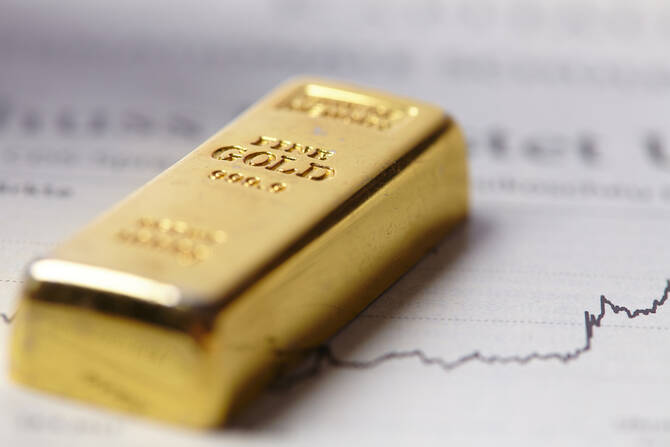
Gold typically performs well during periods of uncertainty and in low-interest-rate environments. Shutterstock
Short Url
Updated 25 July 2025
Follow

Gold falls on firmer US dollar and rising trade optimism

BENGALURU: Gold prices fell on Friday, pressured by a recovery in the US dollar and optimism over progress in trade talks between the US and the EU.

Spot gold was down 0.7 percent at $3,343.0 per ounce by 1:50 p.m. Saudi time. US gold futures fell 0.9 percent to $3,344.50.

The US dollar index rebounded from more than a two-week low, making bullion more expensive for overseas buyers, while benchmark 10-year US Treasury yields rose.

A resurgence in risk appetite driven by optimism over potential tariff negotiations, and better-than-expected jobless claims reinforcing the view that the US Federal Reserve is unlikely to cut rates, is pressuring gold, said Ricardo Evangelista, senior analyst at brokerage firm ActivTrades.

“There is an element of uncertainty that still lingers ... with a strong support around $3,300, I see the potential for gold prices to rise should new episodes of volatility be triggered,” he said.

The European Commission said on Thursday a negotiated trade solution with the US is within reach — while EU members voted to approve counter-tariffs on €93 billion euros ($109 billion) of US goods in case the talks collapse.

Data showed the number of Americans filing new applications for jobless benefits fell to a three-month low last week, pointing to stable labor market conditions.

Meanwhile, President Donald Trump pressed Fed Chair Jerome Powell to lower interest rates in a tense visit to the US central bank on Thursday, less than a week before the next rate-setting meeting where policymakers are expected to hold interest rates steady.

Markets are pricing in a potential rate cut in September.

Gold typically performs well during periods of uncertainty and in low-interest-rate environments.

Elsewhere, spot silver fell 0.5 percent to $38.90 per ounce, but was on track for a weekly gain, up about 1.9 percent so far. Platinum lost 0.6 percent to $1,400.02 and palladium slipped 0.7 percent to $1,219.20. 


Education spending surges 251% as students return from autumn break: SAMA

Updated 12 December 2025
Follow

Education spending surges 251% as students return from autumn break: SAMA

RIYADH: Education spending in Saudi Arabia surged 251.3 percent in the week ending Dec. 6, reflecting the sharp uptick in purchases as students returned from the autumn break.

According to the latest data from the Saudi Central Bank, expenditure in the sector reached SR218.73 million ($58.2 million), with the number of transactions increasing by 61 percent to 233,000.

Despite this surge, overall point-of-sale spending fell 4.3 percent to SR14.45 billion, while the number of transactions dipped 1.7 percent to 236.18 million week on week.

The week saw mixed changes between the sectors. Spending on freight transport, postal and courier services saw the second-biggest uptick at 33.3 percent to SR60.93 million, followed by medical services, which saw an 8.1 percent increase to SR505.35 million.

Expenditure on apparel and clothing saw a decrease of 16.3 percent, followed by a 2 percent reduction in spending on telecommunication.

Jewelry outlays witnessed an 8.1 percent decline to reach SR325.90 million. Data revealed decreases across many other sectors, led by hotels, which saw the largest dip at 24.5 percent to reach SR335.98 million. 

Spending on car rentals in the Kingdom fell by 12.6 percent, while airlines saw a 3.7 percent increase to SR46.28 million.

Expenditure on food and beverages saw a 1.7 percent increase to SR2.35 billion, claiming the largest share of the POS. Restaurants and cafes retained the second position despite a 12.6 percent dip to SR1.66 billion.

Saudi Arabia’s key urban centers mirrored the national decline. Riyadh, which accounted for the largest share of total POS spending, saw a 3.9 percent dip to SR4.89 billion, down from SR5.08 billion the previous week.

The number of transactions in the capital settled at 74.16 million, down 1.4 percent week on week.

In Jeddah, transaction values decreased by 5.9 percent to SR1.91 billion, while Dammam reported a 0.8 percent surge to SR713.71 million.

POS data, tracked weekly by SAMA, provides an indicator of consumer spending trends and the ongoing growth of digital payments in Saudi Arabia. 

The data also highlights the expanding reach of POS infrastructure, extending beyond major retail hubs to smaller cities and service sectors, supporting broader digital inclusion initiatives. 

The growth of digital payment technologies aligns with the Kingdom’s Vision 2030 objectives, promoting electronic transactions and contributing to the nation’s broader digital economy.