

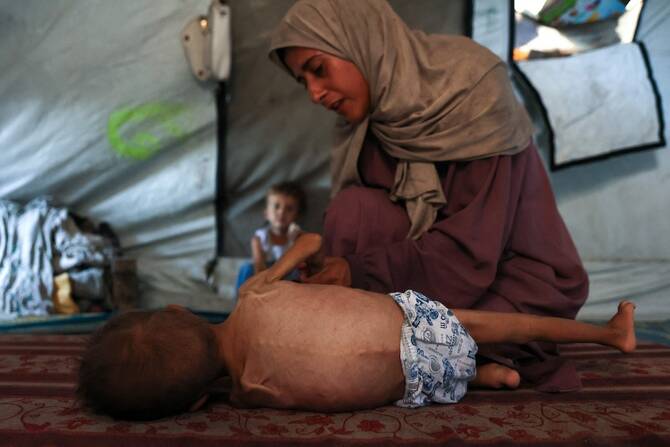

GAZA STRIP, Palestinian Territories: Aid groups warned of surging numbers of malnourished children in war-ravaged Gaza as a trio of European powers prepared to hold an “emergency call” Friday on the deepening humanitarian crisis.
Doctors Without Borders (MSF) said that a quarter of the young children and pregnant or breastfeeding mothers it had screened at its clinics last week were malnourished, a day after the United Nations said one in five children in Gaza City were suffering from malnutrition.
With fears of mass starvation growing, Britain, France and Germany were set to hold an emergency call to push for a ceasefire between Israel and Hamas and discuss steps toward Palestinian statehood.
“I will hold an emergency call with E3 partners tomorrow, where we will discuss what we can do urgently to stop the killing and get people the food they desperately need while pulling together all the steps necessary to build a lasting peace,” British Prime Minister Keir Starmer said.
The call comes after hopes of a new ceasefire in Gaza faded on Thursday when Israel and the United States quit indirect negotiations with Hamas in Qatar.
US envoy Steve Witkoff accused the Palestinian militant group of not “acting in good faith.”
President Emmanuel Macron said Thursday that France would formally recognize a Palestinian state in September, drawing a furious rebuke from Israel.
Palestinian president Mahmud Abbas on Friday welcomed the announcement, calling it a “victory for the Palestinian cause.”
Israeli Prime Minister Benjamin Netanyahu has long opposed a Palestinian state, calling it a security risk and a potential haven for “terrorists.”
On Wednesday, a large majority in Israel’s parliament passed a symbolic motion backing annexation of the occupied West Bank, the core of any future Palestinian state.
More than 100 aid and human rights groups warned this week that “mass starvation” was spreading in Gaza.
Israel has rejected accusations it is responsible for the deepening crisis, which the World Health Organization has called “man-made.”
Israel placed the Gaza Strip under an aid blockade in March, which it only partially eased two months later.
The trickle of aid since then has been controlled by the Israeli- and US-backed Gaza Humanitarian Foundation, replacing the longstanding UN-led distribution system.
Aid groups have refused to work with the GHF, accusing it of aiding Israeli military goals.
The GHF system, in which Gazans have to travel long distances and join huge queues to reach one of four sites, has often proved deadly, with the UN saying that more than 750 Palestinian aid-seekers have been killed by Israeli forces near GHF centers since late May.
An AFP photographer saw bloodied patients, wounded while attempting to get humanitarian aid, being treated on the floor of Nasser hospital in the southern city of Khan Yunis on Thursday.
Israel has refused to return to the UN-led system, saying that it allowed Hamas to hijack aid for its own benefit.
Accusing Israel of the “weaponization of food,” MSF said that: “Across screenings of children aged six months to five years old and pregnant and breastfeeding women, at MSF facilities last week, 25 percent were malnourished.”
It said malnutrition cases had quadrupled since May 18 at its Gaza City clinic and that the facility was enrolling 25 new malnourished patients every day.
On Thursday, the UN agency for Palestinian refugees (UNRWA) said that one in five children in Gaza City were malnourished.
Agency chief Philippe Lazzarini said: “Most children our teams are seeing are emaciated, weak and at high risk of dying if they don’t get the treatment they urgently need.”
He also warned that “UNRWA frontline health workers, are surviving on one small meal a day, often just lentils, if at all.”
Lazzarini said that the agency had “the equivalent of 6,000 loaded trucks of food and medical supplies” ready to send into Gaza if Israel allowed “unrestricted and uninterrupted” access to the territory.


