MANILA: China should recognize that the Philippines is an independent and sovereign state whose actions and decisions are driven entirely by national interest and not at the direction of other countries, Manila’s foreign ministry said on Monday.
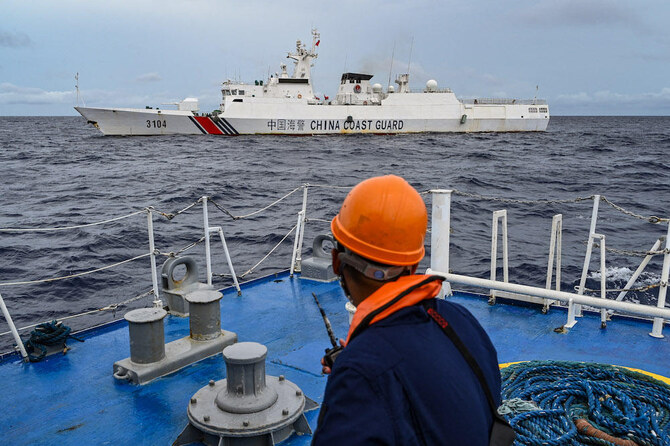
The Philippines’ foreign ministry also said the “real issue is China’s refusal to abide by international law” and how its “illegal, coercive, aggressive and deceptive behavior at sea” have affected Filipino communities.
“We call on countries to be circumspect and to avoid actions and words that only contribute to tensions in the region,” it said in a statement responding to comments from China that Manila was being directed by external forces.
At a press conference on March 7, Chinese foreign minister Wang Yi said the Philippines’ actions in the South China Sea were not independent but part of a “screenplay written by external forces,” to smear China.
The Chinese embassy in Manila did not immediately respond to a request for comment on the foreign ministry’s statement.
The Philippines has embarked on what it calls a transparency initiative to shed light on China’s actions in the South China Sea, including embedding journalists on maritime patrols and resupply missions.
Its approach has resonated with allies, including the United States, who support the 2016 ruling by the Permanent Court of Arbitration that found China’s vast South China Sea claims had no legal basis. China rejects that finding.

Philippines says it is acting in its national interest in South China Sea
https://arab.news/2vut7
Philippines says it is acting in its national interest in South China Sea
- The Philippines’ foreign ministry says ‘real issue is China’s refusal to abide by international law’
- China’s ‘illegal, coercive, aggressive and deceptive behavior at sea’ have affected Filipino communities
Japan to test mine rare-earth mud from deep seabed
TOKYO: Japan will conduct test mining of rare-earth-rich mud from the deep seabed off Minamitori Island, some 1,900 kilometers (1,180 miles) southeast of Tokyo, from January 11 to February 14, the head of the government-backed project said on Tuesday.
The operation will mark the world’s first attempt to continuously lift rare-earth mud from a depth of around 6,000 meters on to a vessel.
Tokyo, like its Western allies, is seeking to secure stable supplies of critical minerals as China, the dominant supplier of rare earths, tightens export controls.
“One of our missions is to build a supply chain for domestically produced rare earths to ensure stable supply of minerals essential to industry,” Shoichi Ishii, program director of the Cabinet Office’s national platform for innovative ocean developments, told reporters.
The Japanese government is pressing ahead with a national project as part of broader efforts to strengthen maritime and economic security.
The January test will focus on connecting the deep-sea mining system and confirming its ability to lift 350 metric tons of rare-earth mud per day. Environmental impacts will be monitored both on board and on the seabed throughout the operation.
No production target has been set, but if successful, a full-scale mining trial will be conducted in February 2027.
The government-funded project has spent about 40 billion yen ($256 million) since 2018, Ishii said, though estimated reserves have not been disclosed.
Ishii also said that while their research vessel was conducting rare-earth surveys within Japan’s exclusive economic zone (EEZ) around Minamitori Island from May 27 to June 25, a Chinese naval fleet entered the waters on June 7.
“We feel a strong sense of crisis that such intimidating actions were taken, despite our activities being limited to seabed resource surveys within our EEZ,” he said.
China’s foreign ministry said the activities of its military vessels are in line with international law and international conventions, and called on Japan to “refrain from hyping up threats and provoking confrontation,” in a reply to Reuters’ request for comment.