LONDON: US President Donald Trump ‘s trip to Scotland this week will be a homecoming of sorts, but he’s likely to get a mixed reception.
Trump has had a long and at times rocky relationship with the country where his mother grew up in a humble house on a windswept isle.
He will be met by both political leaders and protesters during the visit, which begins Friday and takes in his two Scottish golf resorts. It comes two months before King Charles III is due to welcome him on a formal state visit to the UK
A daughter of Scotland
Trump’s mother was born Mary Anne MacLeod in 1912 near the town of Stornoway on the Isle of Lewis, one of the Outer Hebrides off Scotland’s northwest coast.
“My mother was born in Scotland — Stornoway, which is serious Scotland,” Trump said in 2017.
She was raised in a large Scots Gaelic-speaking family and left for New York in 1930, one of thousands of people from the islands to emigrate in the hardscrabble years after World War I.
MacLeod married the president’s father, Fred C. Trump, the son of German immigrants, in New York in 1936. She died in August 2000 at the age of 88.
Trump still has relatives on Lewis, and visited in 2008, spending a few minutes in the plain gray house where his mother grew up.
A long golf course battle
Trump’s ties and troubles in Scotland are intertwined with golf.
He first proposed building a course on a wild and beautiful stretch of the North Sea coast north of Aberdeen in 2006.
The Trump International Scotland development was backed by the Scottish government. But it was fiercely opposed by some local residents and conservationists, who said the stretch of coastal sand dunes was home to some of the country’s rarest wildlife, including skylarks, kittiwakes, badgers and otters.
Local fisherman Michael Forbes became an international cause célèbre after he refused the Trump Organization’s offer of 350,000 pounds ($690,000 at the time) to sell his family’s rundown farm in the center of the estate. Forbes still lives on his property, which Trump once called “a slum and a pigsty.”
“If it weren’t for my mother, would I have walked away from this site? I think probably I would have, yes,” Trump said in 2008 amid the planning battle over the course. “Possibly, had my mother not been born in Scotland, I probably wouldn’t have started it.”
The golf course was eventually approved and opened in 2012. Some of the grander aspects of the planned development, including 500 houses and a 450-room hotel, have not been realized, and the course has never made a profit.
A second 18-hole course at the resort is scheduled to open this summer. It’s named the MacLeod Course in honor of Trump’s mother.
There has been less controversy about Trump’s other Scottish golf site, the long-established Turnberry resort in southwest Scotland, which he bought in 2014. He has pushed for the British Open to be held at the course for the first time since 2009.
Turnberry is one of 10 courses on the rotation to host the Open. But organizers say there are logistical issues about “road, rail and accommodation infrastructure” that must be resolved before it can return.
Protests and politicians
Trump has had a rollercoaster relationship with Scottish and UK politicians.
More than a decade ago, the Scottish government enlisted Trump as an unpaid business adviser with the GlobalScot network, a group of business leaders, entrepreneurs and executives with a connection to Scotland. It dumped him in 2015 after he called for Muslims to be banned from the US The remarks also prompted Robert Gordon University in Aberdeen to revoke an honorary doctorate in business administration it had awarded Trump in 2010.
This week Trump will meet left-leaning Scottish First Minister John Swinney, an erstwhile Trump critic who endorsed Kamala Harris before last year’s election — a move branded an “insult” by a spokesperson for Trump’s Scottish businesses.
Swinney said it’s “in Scotland’s interest” for him to meet the president.
Some Scots disagree, and a major police operation is being mounted during the visit in anticipation of protests. The Stop Trump Scotland group has encouraged demonstrators to come to Aberdeen and “show Trump exactly what we think of him in Scotland.”
UK Prime Minister Keir Starmer is also expected to travel to Scotland for talks with Trump. The British leader has forged a warm relationship with Trump, who said this month “I really like the prime minister a lot, even though he’s a liberal.” They are likely to talk trade, as Starmer seeks to nail down an exemption for UK steel from Trump’s tariffs.
There is no word on whether Trump and Starmer — not a golfer — will play a round at one of the courses.

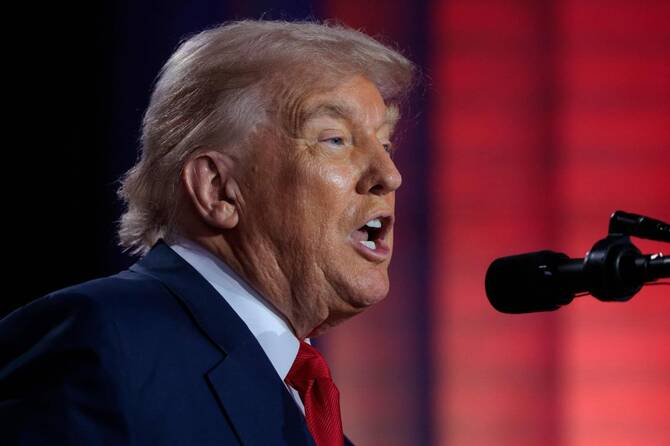
Trump’s trip to Scotland highlights his complex relationship with his mother’s homeland
Short Url
https://arab.news/62tqt
Trump’s trip to Scotland highlights his complex relationship with his mother’s homeland
- He’s likely to get a mixed reception on the trip, which includes visits to his two Scottish golf resorts
- He has faced opposition from environmental campaigners and some neighbors over his Trump International Scotland course in northeast Scotland
Deadly militant offensive sweeps northern and eastern Burkina Faso
- Burkina Faso, ruled by a military junta since September 2022, has faced more than 10 years of raids by groups linked to Al-Qaeda and the Daesh
ABIDJAN: Al-Qaeda-affiliated JNIM has in recent days claimed to have inflicted heavy losses in Burkina Faso as a surge in deadly militant attacks sweeps across the Sahelian state.
Burkina Faso, ruled by a military junta since September 2022, has faced more than 10 years of raids by groups linked to Al-Qaeda and the Daesh, including the Group for the Support of Islam and Muslims (JNIM).
A February UN Security Council report noted that the “pace of JNIM attacks” had slowed in September as fighters were diverted to Mali to back an attempted fuel blockade.
“The group’s efforts in Mali have been the primary focus since early September last year,” said Heni Nsaibia, analyst at conflict monitor ACLED.
But attacks never fully stopped, and JNIM has launched a string of large-scale assaults in northern and eastern Burkina Faso since mid-February, killing dozens, including civilians.
“Since February 14, JNIM has claimed responsibility for 10 attacks across different regions of Burkina Faso,” said Hasret Kargin, an Africa studies researcher at intelligence firm Mintel World.
Deadly assaults
The deadliest incidents targeted Titao’s military base on February 15 in the northwest, where the group says it killed dozens of soldiers.
A separate ambush on the same day left around 50 forestry officers dead in Tandjari in the east.
Around 10 civilians were also killed in Titao, including seven Ghanaian traders.
“This latest round demonstrated a high degree of coordination, given the number of large-scale attacks that occurred between 12 and 22 February,” Nsaibia said.
“Over 130 people” — Burkinabe soldiers, civilian auxiliaries and JNIM fighters — “were killed in this series of battles.”
Kargin noted that JNIM has issued no formal statement explaining the recent uptick after several months of reduced activity.
But militant groups often strike “right before and during” the Muslim holy month of Ramadan, he said, adding current dry-season conditions had helped them on the ground.
‘Smuggling zones’
Recent attacks have gripped the country’s north and east, areas seen as financial hubs for Al-Qaeda’s Sahel branch.
“These are zones with numerous gold sites and key routes that fuel the group’s smuggling activities,” a Burkinabe security analyst said, requesting anonymity.
The north “acts as a bridge” to JNIM’s “main central command” in Mali, Kargin said, while he east — home to a vast nature reserve straddling Niger, Benin and Burkina Faso — allows the group to push into neighboring countries.
The forests, he added, both shield fighters from airstrikes and generate income through illegal timber sales and control of artisanal gold mining.
The Tandjari attack near regional capital Fada N’Gourma highlights JNIM’s growing freedom of movement after having “gained a lot of ground in recent years,” Nsaibia said.
“The question is not the frequency of attacks — they never stopped — but how these groups are able to inflict such heavy losses” when the army claims to be better equipped and better organized, said a Burkinabe political scientist.
The army, which rarely comments on attacks, said in mid-February it now controls 74 percent of national territory, with some “600 villages retaken.”
According to the UN report, JNIM recently appointed a senior leader in eastern Burkina Faso tasked with expanding into Benin, Ivory Coast, Ghana, Niger and Togo.
Burkina Faso, ruled by a military junta since September 2022, has faced more than 10 years of raids by groups linked to Al-Qaeda and the Daesh, including the Group for the Support of Islam and Muslims (JNIM).
A February UN Security Council report noted that the “pace of JNIM attacks” had slowed in September as fighters were diverted to Mali to back an attempted fuel blockade.
“The group’s efforts in Mali have been the primary focus since early September last year,” said Heni Nsaibia, analyst at conflict monitor ACLED.
But attacks never fully stopped, and JNIM has launched a string of large-scale assaults in northern and eastern Burkina Faso since mid-February, killing dozens, including civilians.
“Since February 14, JNIM has claimed responsibility for 10 attacks across different regions of Burkina Faso,” said Hasret Kargin, an Africa studies researcher at intelligence firm Mintel World.
Deadly assaults
The deadliest incidents targeted Titao’s military base on February 15 in the northwest, where the group says it killed dozens of soldiers.
A separate ambush on the same day left around 50 forestry officers dead in Tandjari in the east.
Around 10 civilians were also killed in Titao, including seven Ghanaian traders.
“This latest round demonstrated a high degree of coordination, given the number of large-scale attacks that occurred between 12 and 22 February,” Nsaibia said.
“Over 130 people” — Burkinabe soldiers, civilian auxiliaries and JNIM fighters — “were killed in this series of battles.”
Kargin noted that JNIM has issued no formal statement explaining the recent uptick after several months of reduced activity.
But militant groups often strike “right before and during” the Muslim holy month of Ramadan, he said, adding current dry-season conditions had helped them on the ground.
‘Smuggling zones’
Recent attacks have gripped the country’s north and east, areas seen as financial hubs for Al-Qaeda’s Sahel branch.
“These are zones with numerous gold sites and key routes that fuel the group’s smuggling activities,” a Burkinabe security analyst said, requesting anonymity.
The north “acts as a bridge” to JNIM’s “main central command” in Mali, Kargin said, while he east — home to a vast nature reserve straddling Niger, Benin and Burkina Faso — allows the group to push into neighboring countries.
The forests, he added, both shield fighters from airstrikes and generate income through illegal timber sales and control of artisanal gold mining.
The Tandjari attack near regional capital Fada N’Gourma highlights JNIM’s growing freedom of movement after having “gained a lot of ground in recent years,” Nsaibia said.
“The question is not the frequency of attacks — they never stopped — but how these groups are able to inflict such heavy losses” when the army claims to be better equipped and better organized, said a Burkinabe political scientist.
The army, which rarely comments on attacks, said in mid-February it now controls 74 percent of national territory, with some “600 villages retaken.”
According to the UN report, JNIM recently appointed a senior leader in eastern Burkina Faso tasked with expanding into Benin, Ivory Coast, Ghana, Niger and Togo.
© 2026 SAUDI RESEARCH & PUBLISHING COMPANY, All Rights Reserved And subject to Terms of Use Agreement.


