

Pakistan says nationwide crackdown against sugar hoarders, profiteers underway

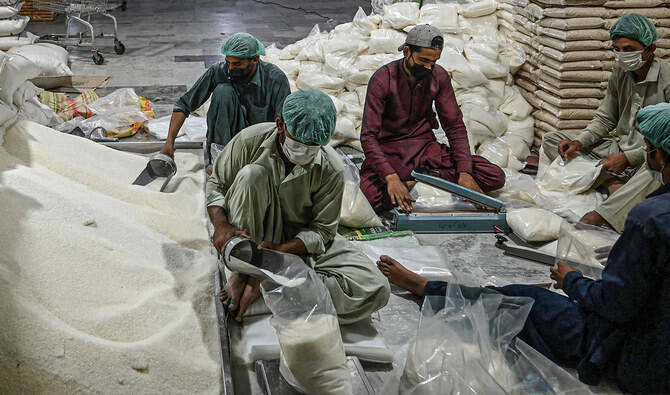
Workers of the Al-Khidmat Foundation, a charity organization, prepare sugar bags to be distributed to people in need, ahead of the Holy month of Ramadan at a warehouse in Islamabad, Pakistan, on April 11, 2021. (AFP/File)
Short Url
Updated 23 July 2025
Follow

Pakistan says nationwide crackdown against sugar hoarders, profiteers underway

  • Pakistan’s food security minister chairs meeting to review sugar market situation, pricing trends
  • Market analysts say retail sugar prices have risen sharply since January, surging to $0.70 per kg

KARACHI: Pakistan’s Food Security Minister Rana Tanveer Hussain announced on Wednesday that a nationwide crackdown against those attempting to disrupt the sugar supply in the country through hoarding and profiteering was underway, amid Islamabad’s attempts to stabilize the commodity’s price. 

Market analysts have said retail sugar prices in several parts of the country have risen sharply since January, surging to Rs200 [$0.70] per kilogram. In Pakistan, high sugar prices have triggered public outcry and become flashpoints for opposition criticism in the past, with allegations of hoarding and cartelization frequently surfacing in election years or periods of economic volatility.

Hussain chaired a meeting with representatives of the Pakistan Sugar Mills Association (PSMA) and other key stakeholders from all provinces on Wednesday, the national food security ministry said in a press release. It said the meeting aimed to review the current sugar market situation, pricing trends, and supply chain dynamics.

“During the meeting, the Federal Minister expressed serious concern over the artificial hike in sugar prices and warned of strict action against all those who are involved in hoarding and market manipulation,” the statement said.

“He announced that a nationwide crackdown is currently underway against those disrupting the sugar supply chain.”

Hussain noted that due to the government’s “decisive actions,” sugar prices have started to decline significantly from Rs200 per kg to Rs. 175–180 [$0.61-0.63] per kg in various markets.

The minister warned sugar mills that were not releasing their existing stocks that the government would not tolerate hoarding, directing all provincial governments to ensure the timely lifting of sugar from mills and facilitate its smooth transportation to markets.

Hussain noted the “exploitative role” of certain middlemen and market intermediaries, saying they were capitalizing on the market’s volatility.

“The federal and provincial authorities are now actively pursuing legal and administrative actions against such elements to curb unjust profiteering,” the ministry said. 

The minister later chaired a high-level meeting of the Steering Committee on Sugar Imports, where all technical, procedural, and operational challenges related to sugar importation were reviewed and resolved, the food security ministry said. 

Earlier this month, Pakistan announced it would import sugar in two phases. In the first phase, a tender for 200,000 metric tons of sugar would be issued, followed by another tender for 150,000 metric tons after one week, the ministry said. 

The ministry also announced it had decided to waive all duties and taxes on sugar imports to ensure the product is available at affordable prices.

Pakistani president arrives in Iraq to deepen trade, energy cooperation

Updated 20 December 2025
Follow

Pakistani president arrives in Iraq to deepen trade, energy cooperation

  • Visit follows recent high-level contacts as Islamabad seeks to expand limited commercial ties with Baghdad
  • Talks are expected to cover investment, manpower and facilitation of Pakistani pilgrims visiting holy sites in Iraq

ISLAMABAD: President Asif Ali Zardari arrived in Iraq on Saturday on an official visit aimed at expanding cooperation in trade, energy and investment, as Pakistan seeks to deepen ties with Baghdad after years of limited engagement.

Pakistan and Iraq established diplomatic relations in 1947 and have traditionally maintained cordial ties, though commercial links remain modest, with officials and business groups identifying scope for cooperation in construction services, pharmaceuticals, manpower and agricultural exports.

“President Asif Ali Zardari arrived in Baghdad on a four-day official visit to Iraq,” his office said in a post on X. “He was received by Culture Minister Dr. Ahmed Fakkak Al-Badrani. During the visit, meetings with senior Iraqi leadership are expected to advance cooperation and further strengthen Pakistan-Iraq relations.”

Zardari’s visit follows a series of recent high-level contacts between the two countries, reflecting efforts to broaden bilateral engagement beyond traditional diplomatic ties and explore collaboration across economic, political and people-to-people domains.

According to Pakistan’s foreign office, the president is expected to hold meetings with Iraq’s senior leadership to discuss cooperation in various areas such as trade and investment, energy, technology, education and manpower.

He is also expected to discuss regional and international issues with Iraqi officials.

Earlier this month, Pakistan’s Interior Minister Mohsin Naqvi met his Iraqi counterpart, Abdul Ameer Al-Shammari, on the sidelines of meetings in Brussels, where both sides agreed to enhance cooperation on security and facilitate travel for Pakistani Shia pilgrims to Najaf and Karbala.

The two officials discussed measures to ensure the smoother movement of these pilgrims and their compliance with visa regulations.