

Italy and Algeria agree to tackle terrorism and migration at summit

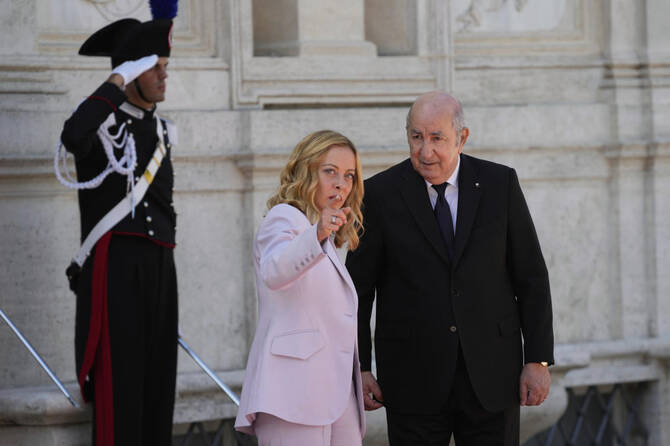
Italian Prime Minister Giorgia Meloni, left, meets with Algeria’s President Abdelmadjid Tebboune at Villa Pamphilj in Rome, July 23, 2025. (AP)
Short Url
Updated 23 July 2025
Follow

Italy and Algeria agree to tackle terrorism and migration at summit

  • A memorandum will be signed between Italy and Algeria on fighting terrorism and its financing
  • The document did not say which threats the countries were focused on

ROME: Italy and Algeria agreed to work together to fight terrorism and control migration during an intergovernmental meeting in Rome on Wednesday, documents showed, while companies signed off on deals on sectors including energy and telecommunications.

Italian Prime Minister Giorgia Meloni met Algerian President Abdelmadjid Tebboune at the 17th-century Villa Doria Pamphili, after a trip to Algiers by Foreign Minister Antonio Tajani in March.

Algeria is Rome’s leading trading partner in Africa, with trade worth almost 14 billion euros ($16.4 billion) while Rome’s investments there amount to 8.5 billion, Italy said.

According to a document seen by Reuters, a memorandum will be signed between Italy and Algeria on fighting terrorism and its financing. The document did not say which threats the countries were focused on.

The two nations will also agree on a plan to coordinate the search and rescue operations for migrants who attempt the dangerous sea crossing from North Africa to Europe. Meloni’s right-wing government was elected in 2022 on a mandate to curb migrant arrivals.

On the business side, Italian energy group Eni this month signed a production sharing contract with oil and gas company Sonatrach worth $1.3 billion to explore and develop hydrocarbons in Algeria.

A document said the two companies will sign an additional agreement on the sidelines of the summit to strengthen their cooperation.

Eni buys gas from Sonatrach under a long-term contract that has made the north African country one of the key fuel suppliers for Italy after Rome severed ties with Russia’s Gazprom following Moscow’s invasion of Ukraine.

A separate deal will involve Submarine cable company Sparkle, a unit of Telecom Italia (TIM), which is set to be sold to a consortium led by Italy’s Treasury later this year.

Sparkle will sign a preliminary agreement with Algerie Telecom for a new subsea cable connecting the two countries.

“Algeria is a strategic partner, and we are working hard to make this partnership ever broader, stronger and more diversified,” Foreign Minister Tajani said during a speech at a business forum with over 400 companies from the two nations.


UN-sanctioned migrant smuggler killed in western Libya

A boat used by migrants is seen near the western town of Sabratha, Libya March 19, 2019. (REUTERS)
Updated 13 December 2025
Follow

UN-sanctioned migrant smuggler killed in western Libya

  • In June 2018, the UN Security Council imposed sanctions on Al-Dabbashi, along with another five Libyan traffickers

CAIRO: A notorious militia leader in Libya, sanctioned by the UN for migrant trafficking across the Mediterranean Sea, was killed on Friday in a raid by security forces in the west of the country, according to Libyan authorities.
Ahmed Oumar Al-Fitouri Al-Dabbashi, nicknamed Ammu, was killed in the western city of Sabratha when security forces raided his hideout. The raid came in response to an attack on a security outpost by Al-Dabbashi’s militia, which left six members of the security forces severely wounded, according to a statement issued by the Security Threat Enforcement Agency, a security entity affiliated with Libya’s western government.
Al-Dabbashi, who was also sanctioned by the US Treasury for trafficking, was the leader of a powerful militia, the “Brigade of the Martyr Anas Al-Dabbashi,” in Sabratha, the biggest launching point in Libya for Europe-bound African migrants.
Al-Dabbashi’s brother Saleh Al-Dabbashi, another alleged trafficker, was arrested in the same raid, added the statement.
In June 2018, the UN Security Council imposed sanctions on Al-Dabbashi, along with another five Libyan traffickers. At the time, the UN report said that there was enough evidence that Al-Dabbashi’s militia controlled departure areas for migrants, camps, safe houses and boats.
Al-Dabbashi himself exposed migrants, including children, to “fatal circumstances” on land and at sea, and of threatening peace and stability in Libya and neighboring countries, according to the same report.
Al-Dabbashi was also sanctioned by the US Treasury for the same reason.
Libya has been a main transit point for migrants fleeing war and poverty in Africa and the Middle East. The country was plunged into chaos following a NATO-backed uprising that toppled and killed longtime autocrat Muammar Qaddafi in 2011.
The country has been fragmented for years between rival administrations based in the east and the west of Libya, each backed by various armed militias and foreign governments.