

First climate migrants arrive in Australia from sinking Tuvalu in South Pacific

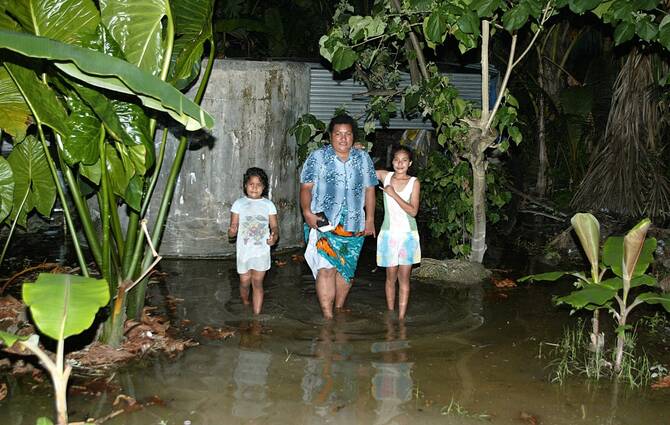
A photo dated 2004 shows a family returning to their flooded property in Funafuti, Tuvalu. (AFP)
Short Url
Updated 11 December 2025
Follow

First climate migrants arrive in Australia from sinking Tuvalu in South Pacific

  • The intake is capped at 280 visas annually to prevent a brain drain in the small island nation

SYDNEY: The first climate migrants to leave the remote Pacific island nation of Tuvalu have arrived in Australia, hoping to preserve links to their sinking island home, foreign affairs officials said on Thursday.
More than one-third of Tuvalu’s 11,000 population applied for a climate visa to migrate to Australia, under a deal struck between the two countries two years ago.
The intake is capped at 280 visas annually to prevent a brain drain in the small island nation.
Among the islanders selected in the initial intake of climate migrants is Tuvalu’s first female forklift driver, a dentist, and a pastor focused on preserving their spiritual life thousands of kilometers (miles) from home, Australian government officials said.
Tuvalu, one of the countries at greatest risk from climate change because of rising sea levels, is a group of low-lying atolls scattered across the Pacific between Australia and Hawaii.
Manipua Puafolau, from Tuvalu’s main island of Funafuti, arrived in Australia a fortnight ago. A trainee pastor with the most prominent church in Tuvalu, he plans to live in the small town of Naracoorte in the state of South Australia, where several hundred Pacific Islanders work in seasonal agriculture and meat processing jobs.
“For the people moving to Australia, it is not only for their physical and economic well-being, but also calls for spiritual guidance,” he said in a video released by Australia’s foreign affairs department.
Tuvalu Prime Minister Feleti Teo visited the Tuvaluan community in Melton, Melbourne, last month to emphasize the importance of maintaining strong ties and cultural bonds across borders as citizens migrate, Tuvalu officials said.
On Tuvalu’s main atoll of Funafuti, the land is barely wider than the road in many stretches. Families live under thatched roofs, and children play football on the airport runway due to space constraints.
By 2050, NASA scientists project daily tides will submerge half of Funafuti atoll, home to 60 percent of Tuvalu’s residents, where villagers cling to a strip of land as narrow as 20 meters (65 feet). The forecast assumes a one-meter rise in sea levels, while the worst case, double that, would put 90 percent of the country’s main atoll under water.

CLIMATE VISAS OFFER ‘MOBILITY WITH DIGNITY’
Australia’s Foreign Minister Penny Wong said the climate migrants would contribute to Australian society.
The visa offered “mobility with dignity, by providing Tuvaluans the opportunity to live, study and work in Australia as climate impacts worsen,” Wong said in a statement to Reuters.
Support services are being established by Australia to help Tuvaluan families set up in the east coast city of Melbourne, Adelaide in South Australia and in the northern state of Queensland.
Kitai Haulapi, the first female forklift driver in Tuvalu, recently married and will relocate to Melbourne, population five million. In a video released by Australia’s foreign affairs department she says that she hopes to find a job in Australia and continue to contribute to Tuvalu by sending money back to her family.
Dentist Masina Matolu, who has three school-aged children and a seafarer husband, will move with her family to the northern Australian city of Darwin. She plans to work with indigenous communities.
“I can always bring whatever I learn new from Australia back to my home culture, just to help,” she said in a video statement.


India, Arab League target $500bn in trade by 2030

Updated 01 February 2026
Follow

India, Arab League target $500bn in trade by 2030

  • It was the first such gathering of India–Arab FMs since the forum’s inauguration in 2016
  • India and Arab states agree to link their startup ecosystems, cooperate in the space sector

NEW DELHI: India and the Arab League have committed to doubling bilateral trade to $500 billion by 2030, as their top diplomats met in New Delhi for the India–Arab Foreign Ministers’ Meeting. 

The foreign ministers’ forum is the highest mechanism guiding India’s partnership with the Arab world. It was established in March 2002, with an agreement to institutionalize dialogue between India and the League of Arab States, a regional bloc of 22 Arab countries from the Middle East and North Africa.

The New Delhi meeting on Saturday was the first gathering in a decade, following the inaugural forum in Bahrain in 2016.

India’s Foreign Minister S. Jaishankar said in his opening remarks that the forum was taking place amid a transformation in the global order.

“Nowhere is this more apparent than in West Asia or the Middle East, where the landscape itself has undergone a dramatic change in the last year,” he said. “This obviously impacts all of us, and India as a proximate region. To a considerable degree, its implications are relevant for India’s relationship with Arab nations as well.”

Jaishankar and his UAE counterpart co-chaired the talks, which aimed at producing a cooperation agenda for 2026-28.

“It currently covers energy, environment, agriculture, tourism, human resource development, culture and education, amongst others,” Jaishankar said.

“India looks forward to more contemporary dimensions of cooperation being included, such as digital, space, start-ups, innovation, etc.”

According to the “executive program” released by India’s Ministry of External Affairs, the roadmap agreed by India and the League outlined their planned collaboration, which included the target “to double trade between India and LAS to US$500 billion by 2030, from the current trade of US$240 billion.”

Under the roadmap, they also agreed to link their startup ecosystems by facilitating market access, joint projects, and investment opportunities — especially health tech, fintech, agritech, and green technologies — and strengthen cooperation in space with the establishment of an India–Arab Space Cooperation Working Group, of which the first meeting is scheduled for next year.

Over the past few years, there has been a growing momentum in Indo-Arab relations focused on economic, business, trade and investment ties between the regions that have some of the world’s youngest demographics, resulting in a “commonality of circumstances, visions and goals,” according to Muddassir Quamar, associate professor at the School of International Studies, Jawaharlal Nehru University.

“The focus of the summit meeting was on capitalizing on the economic opportunities … including in the field of energy security, sustainability, renewables, food and water security, environmental security, trade, investments, entrepreneurship, start-ups, technological innovations, educational cooperation, cultural cooperation, youth engagement, etc.,” Quamar told Arab News.

“A number of critical decisions have been taken for furthering future cooperation in this regard. In terms of opportunities, there is immense potential.”