

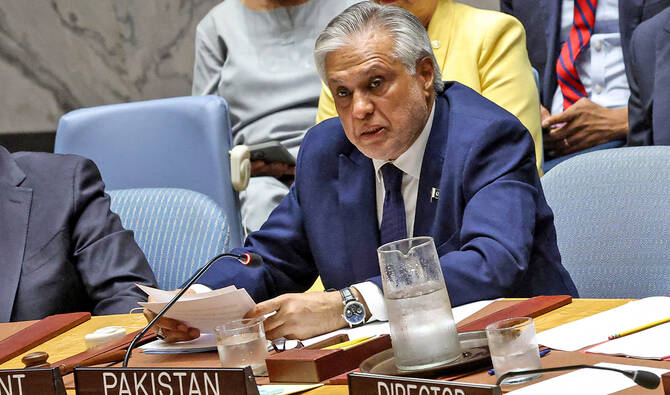
Pakistan seeks UN Human Rights Council seat, pledges consensus-based engagement

akistan's Foreign Minister Ishaq Dar, who is acting as president of the U.N. Security Council, addresses a meeting of the United Nations Security Council on international peace and security through multilateralism, at U.N. headquarters in New York City, US, on July 22, 2025. (REUTERS)
Short Url
Updated 23 July 2025
Follow

Pakistan seeks UN Human Rights Council seat, pledges consensus-based engagement

  • Pakistan has previously served multiple terms on the Geneva-based Human Rights Council
  • Dar reaffirms support for UN reforms, multilateral diplomacy during Security Council presidency

ISLAMABAD: Pakistan has this week formally announced its candidacy for a seat on the United Nations Human Rights Council for the 2026–2028 term, vowing to pursue a platform based on tolerance, universality and consensus-building.

The announcement was made by Deputy Prime Minister and Foreign Minister Ishaq Dar on Wednesday during a reception hosted by Pakistan’s Mission in New York as the country assumed the rotating presidency of the UN Security Council for the month of July.

Pakistan has previously served multiple terms on the Geneva-based Human Rights Council, which is composed of 47 member states elected for staggered three-year terms by the UN General Assembly. The next round of elections is scheduled for late 2025.

“Pakistan has also presented its candidature for election to the Human Rights Council for the term 2026–2028. Our engagement with the Human Rights Council is guided by the idea of truth, tolerance, respect, universality, consensus-building and engagement,” Dar said at the dinner.

“Pakistan’s candidature is endorsed by the Asia-Pacific Group, and we hope to count on your valuable support.”

The announcement coincides with Pakistan’s broader push for UN reform, its active participation in Security Council deliberations this month and its ongoing diplomatic efforts to strengthen the UN system’s focus on peace, development, and rights.

Dar also used the reception to reaffirm Pakistan’s commitment to multilateral diplomacy and UN Charter principles, especially the peaceful resolution of disputes and the non-use of force. 

As part of its Security Council presidency, Pakistan has prioritized three areas: the peaceful settlement of disputes, multilateralism and enhanced cooperation between the UN and regional bodies such as the Organization of Islamic Cooperation (OIC), Dar explained. 

“These same guiding principles continue to shape our contributions to the Council’s work, including in our presidency this month, both in deliberations and in action,” the deputy prime minister said, noting that Pakistan continues to support “reform of the United Nations to make this organization stronger, more effective, and more responsive to the interest and priorities of the general membership.”

Pakistan, he added, has “championed strengthening of the three pillars of the United Nations — peace and security, development and human rights,” including across the General Assembly, ECOSOC, and other multilateral platforms.

On Tuesday, under Pakistan’s presidency, the UNSC unanimously adopted a resolution calling on member states to use peaceful means to resolve disputes.

The resolution encourages states to make full use of existing mechanisms such as “negotiation, mediation, arbitration, judicial settlement or other peaceful means,” in accordance with the UN Charter.


Pakistan offers Kyrgyzstan Arabian Sea access as two states sign 15 cooperation accords

Updated 5 sec ago
Follow

Pakistan offers Kyrgyzstan Arabian Sea access as two states sign 15 cooperation accords

  • Pakistan and Kyrgyzstan sign MOUs spanning trade, energy, agriculture, ports, education, security cooperation
  • Kyrgyz president is on first visit to Pakistan in 20 years as both sides push connectivity and CASA-1000 power links

ISLAMABAD: Pakistan on Thursday offered Kyrgyzstan the shortest and most economical route to the Arabian Sea as the two countries signed 15 agreements and memoranda of understanding aimed at boosting cooperation across trade, energy, agriculture, education, customs data-sharing and port logistics.

The accords were signed during a visit to Islamabad by President Sadyr Zhaparov, the first by a Kyrgyz head of state to Pakistan in two decades, and part of Islamabad’s renewed push to link South Asia with landlocked Central Asian economies through ports, power corridors and transport routes.

For Pakistan, Kyrgyzstan offers access to hydropower through CASA-1000, a $1.2 billion regional electricity transmission project designed to carry surplus summer electricity from Kyrgyzstan and Tajikistan through Afghanistan into Pakistan. For Bishkek, Pakistan provides overland access to warm-water ports on the Arabian Sea, creating a shorter commercial route to global markets.

“President Asif Ali Zardari has reiterated Pakistan’s readiness to offer Kyrgyzstan the shortest and most economical route to the Arabian Sea,” Radio Pakistan reported after Zhaparov met the Pakistani president. 

The two leaders also discussed expanding direct flights to deepen business, tourism and people-to-people ties.

Zardari welcomed Kyrgyzstan’s completion of its segment of the CASA-1000 project and “reaffirmed Pakistan’s commitment to completing its part of the project, which is now at an advanced stage,” the state broadcaster said. 

Zhaparov thanked Islamabad for supporting Bishkek’s candidacy for a non-permanent UN Security Council seat and invited Zardari to visit Kyrgyzstan at a time of his convenience. Both sides expressed satisfaction with progress under the Quadrilateral Traffic in Transit Agreement, designed to facilitate road movement between Pakistan, Kyrgyzstan, Kazakhstan and China.

Earlier, both governments exchanged 15 sectoral cooperation documents covering commerce, mining, geosciences, power, agriculture, youth programs, the exchange of convicted persons, customs electronic data systems and a sister-city linkage between Islamabad and Bishkek.

According to APP, the MOUs were signed by ministers representing foreign affairs, commerce, economy, energy, power, railways, interior, culture, health and tourism. Agreements also covered cooperation between Pakistan’s Foreign Service Academy and the Diplomatic Academy of Kyrgyzstan, as well as collaboration between universities, youth ministries and cultural institutions.

“Our present mutual trade, comprising of about $15–16 million will be enhanced to $200 million in the next two years,” Prime Minister Shehbaz Sharif said after the agreements were signed, calling them “a framework for structured, result-oriented engagement and closer institutional linkages.”

Sharif said Pakistan was ready to serve as a maritime outlet for the landlocked Central Asian republic, offering access to Karachi, Port Qasim and Gwadar to help Kyrgyz goods reach regional and global markets.