

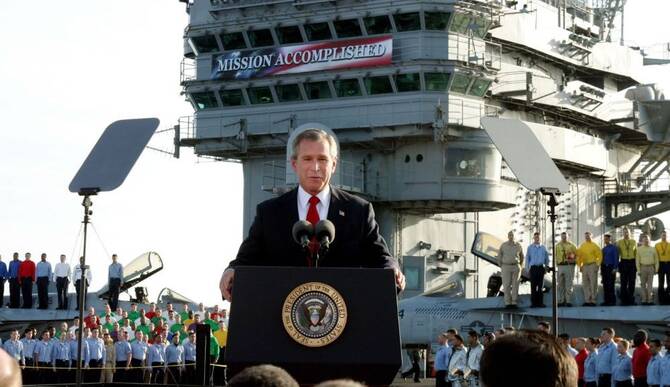

LONDON: A series of released records in the UK have revealed that President George W. Bush viewed the Iraq war as a “crusade.”
Cabinet Office papers made public on Tuesday show Bush considered the US “God’s chosen nation” tasked with ridding the world of “evil-doers,” including Saddam Hussein.
Sir Christopher Meyer, the UK’s ambassador to Washington, wrote in December 2002 in a diplomatic cable to Whitehall: “More than anything else, he (Bush) fears another catastrophic terrorist attack on the homeland, especially one with an Iraqi connection.”
He added: “His view of the world is Manichean. He sees his mission as ridding it of evil-doers. He believes American values should be universal values. He finds the Europeans’ differentiation between Osama bin Laden and Saddam Hussein self-serving.
“He is strongly allergic to Europeans collectively. Anyone who has sat round a dinner table with low-church Southerners will find these sentiments instantly recognisable.”
In January 2023, Sir Tony Blair met with Bush in the US to urge him to use diplomacy, but Sir Christopher wrote Jan. 29: “It is politically impossible for Bush to back down from going to war in Iraq this spring, absent Saddam’s surrender or disappearance from the scene.”
On Jan. 30, Sir David Manning, a UK foreign policy adviser, told Sir Tony to warn Bush that a UN resolution was “politically essential for the UK, and almost certainly legally essential as well.”
Sir David told Condoleezza Rice, Bush’s secretary of state, that an invasion of Iraq without one could bring down the Labour government, and that “the US must not promote regime change in Baghdad at the price of regime change in London.”
He added in a message to Sir Tony: “I said that Bush could afford to gamble. He wanted a second resolution but it was not crucial to him. He already had congressional authority to act unilaterally. This was quite different from the situation you were facing.
“Condi acknowledged this but said that there came a point in any poker game when you had to show your cards. I said this was fine for Bush. He would still be at the table if he showed his cards and lost. You would not.”
The cables also reveal other aspects of Sir Tony’s time in office, including a birthday message from Russian President Vladimir Putin in 2001.
“Dear Tony,” the message read, “accept my sincere congratulations on your birthday and heartfelt wishes of good health, happiness, success and well being to you and your family.
“With great warmth I recollect our last meeting in Stockholm, I am convinced that regular contacts between us will further facilitate the development of Russian-British relations, strengthening international security and stability.”
Other revelations include a thorny diplomatic incident, when former French President Jacques Chirac had spoken in private to Sir Tony about Clare Short, the international development secretary, to complain she was “viscerally anti-French and insupportable.”
In an effort to improve relations with Chirac, UK officials also considered purchasing a map of Afghanistan for Chirac denoting British military failures in the country for “a laugh” for his birthday in November 2001.


