

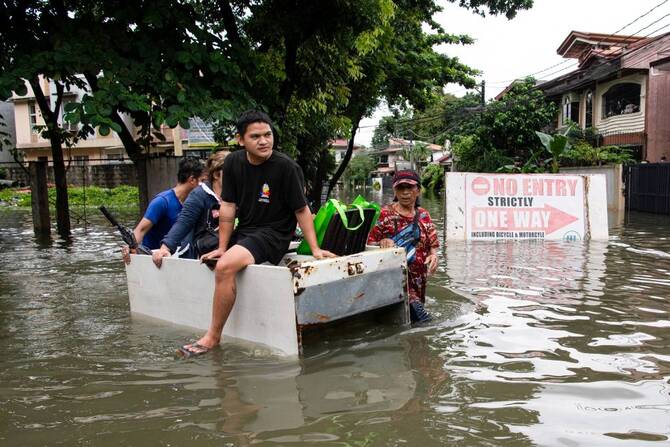

MANILA: Torrential rains brought the Philippine capital Manila to a standstill on Tuesday, as heavy flooding displaced tens of thousands of people across the country.
Monsoon downpours that began last week and intensified due to Typhoon Wipha have killed at least six people, displaced over 82,000, and affected more than 1.2 million others.
Government offices and schools are suspended until at least Wednesday, as the heavy rain submerged around 500 areas in the Philippine capital region alone.
“The flooding varies in depth — from gutter-level to much deeper waters,” Don Artes, chairman of Metro Manila Development Authority, said at a briefing on Tuesday.
The severe floods in Manila were partly triggered by the city’s old drainage system.
“Our drainage system is also outdated — more than 50 years old — and too small for today’s rainfall volume,” Artes said.
Around 17,000 people remain in evacuation centers, as President Ferdinand Marcos Jr. ordered state agencies to focus on disaster relief operations.
“The OCD (Office of Civil Defense) is now on red alert … The most heavily affected areas are Metro Manila, as well as the provinces of Bulacan, Pampanga, Cavite, Batangas, and Rizal,” OCD Assistant Secretary Raffy Alejandro IV said.
Philippine authorities are bracing for more heavy rain, with the southwest monsoon expected to “bring moderate to intense rains of up to 200mm within the next few days,” the Interior Ministry said in a statement, adding that preemptive evacuation has started in some areas.
The national weather bureau, PAGASA, said it expects “widespread incidents of severe flooding” with landslides until at least Wednesday in the Manila capital region, as well as the provinces of Zambales, Bataan, Cavite and Batangas.
The Philippines is one of the most vulnerable countries to extreme weather events, with an average of 20 tropical storms passing through the country every year.
“Flooding, especially during the southwest monsoon season, is getting frustrating and tiring,” Ryan Reyes Soriano, a 47-year-old resident of Malabon city, told Arab News.
“Formerly floods during the 80s up to the 90s were a cause for concern if they go up waist level. Now floods often go as high as a story if storms are bad, and that is a difference of 10 to 15 feet (3 to 4.5 meters).”
Malabon, a coastal city located north of Manila, was one of the most severely affected areas in the capital region. Almost all of its 21 districts were submerged in floods, with some regions still inundated as of Tuesday afternoon.
“In some cases it’s deep enough for a person to drown. Lucky if it’s only knee-deep,” Soriano said. “I went outside earlier, the water is still above my waist.”


