

Pakistan warns of fresh floods this week as monsoon-related deaths rise to 221

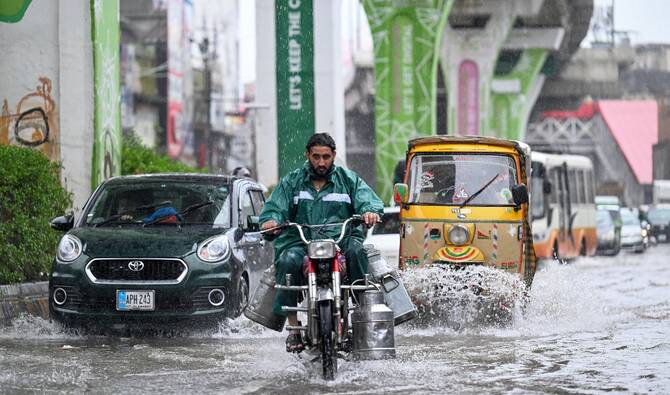
Commuters make their way through a flooded street during heavy monsoon rains in Rawalpindi on July 17, 2025. (AFP/ file)
Short Url
Updated 21 July 2025
Follow

Pakistan warns of fresh floods this week as monsoon-related deaths rise to 221

  • Punjab reports highest number of deaths at 135, followed by 46 in Khyber Pakhtunkhwa
  • Landslides may block roads in Galliyat, Kashmir and Gilgit-Baltistan during forecast period

ISLAMABAD: Pakistan is likely to witness more floods as a fresh rainy spell is likely to continue till July 25, the Pakistan Meteorological Department (PMD) on Monday, with the number of monsoon-related deaths rising to 221 since late June.

Pakistan’s most populous Punjab province has reported the highest number of deaths at 135, followed by 46 in Khyber Pakhtunkhwa, 22 in Sindh, 16 in Balochistan, and one each in the federal capital of Islamabad and Azad Kashmir.

The deceased included 104 children, 77 men and 40 women, according to a latest situation report shared by the National Disaster Management Authority (NDMA).

“Heavy rains may generate flash floods in local streams of Chitral, Dir, Swat, Shangla, Mansehra, Kohistan, Abbottabad, Buner, Charsadda, Nowshera, Swabi, Mardan, Murree, Galliyat, Islamabad/Rawalpindi, Hill torrents of DG Khan, Northeast Punjab and Kashmir from July 21-25,” the PMD said on Monday.

“Heavy Downpour may cause urban floods in low-lying areas of Islamabad/Rawalpindi, Gujranwala, Lahore, Sialkot, Sargodha, Faisalabad, Okara, Nowshera and Peshawar.”

During this period, landslides and mudslides may block roads in vulnerable areas of Murree, Galliyat, Kashmir and Gilgit-Baltistan, according to the PMD. Heavy rains, windstorms and lightning could also damage weak structures, electric poles, billboards, vehicles and solar panels.

Monsoon season brings South Asia 70 to 80 percent of its annual rainfall, arriving in early June in India and late June in Pakistan, and lasting through until September.

The annual rains are vital for agriculture and food security, and the livelihoods of millions of farmers. But increasingly erratic and extreme weather patterns are turning the rains into a destructive force.

In 2022, record-breaking monsoon rains combined with glacial melt submerged nearly a third of Pakistan, killing more than 1,700 people and displacing over 8 million. In May, at least 32 people were killed in severe storms, including strong hailstorms.


Pakistan telecom regulator urges restraint on social media amid regional tensions

Updated 28 February 2026
Follow

Pakistan telecom regulator urges restraint on social media amid regional tensions

  • PTA warns against sharing unverified content, says legal action may follow ‘fake news’
  • Advisory comes as Pakistan strikes targets in Afghanistan and Iran faces US, Israeli attacks

ISLAMABAD: Pakistan’s telecom regulator on Saturday urged citizens to avoid sharing “unverified or inflammatory” content online, warning that legal action could be taken against those spreading misinformation amid what it described as a “sensitive national situation.”

The advisory from the Pakistan Telecommunication Authority (PTA) comes as Islamabad says it is targeting militant positions inside Afghanistan following a recent flareup between the two neighbors, while Iran is under attack by the United States and Israel in an escalating regional conflict that has heightened security concerns across South and West Asia.

“In view of the prevailing sensitive national situation, Pakistan Telecommunication Authority (PTA) urges all citizens to be responsible while using social media and digital platforms,” the regulator said in a statement posted on X.

The PTA advised citizens “not to share, disseminate, forward, or upload any unverified, inflammatory, or misleading information/content that may directly or indirectly harm the national interest, public order, or state institutions.”

It said people should instead rely on authentic information based on official sources and refrain from spreading rumors and “fake news.”

“Sharing any fake news/information is liable to legal action in accordance with applicable laws,” the authority said, calling on citizens to act with “caution, maturity, and a strong sense of national responsibility” to help maintain stability and public confidence.

Pakistan in recent years has witnessed increasingly stringent implementation of the Prevention of Electronic Crimes Act (PECA), a cybercrime law that has drawn criticism from rights groups, with journalists and activists arrested and prosecuted under its provisions.