

India court acquits 12 in deadly 2006 train blasts case

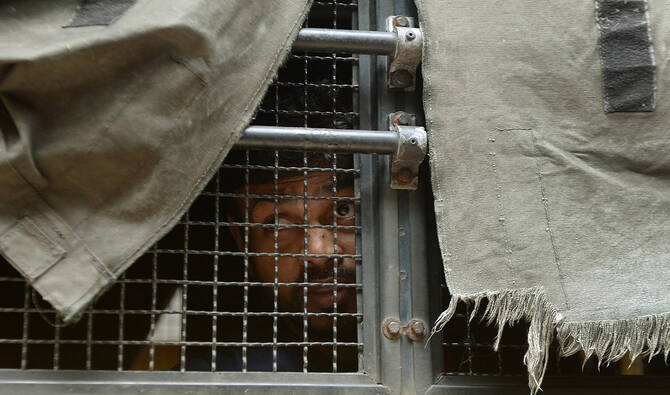
An Indian prisoner, convicted of involvement in the 2006 Mumbai train blasts, looks out from a police van on his way to a special court in Mumbai on September 16, 2015. (AFP/File)
Short Url
Updated 21 July 2025
Follow

India court acquits 12 in deadly 2006 train blasts case

  • Men were convicted in 2015 of murder, conspiracy, waging war against country over attacks that killed 187
  • Indian prosecutors accused Pakistan-based militant group Lashkar-e-Taiba of being behind the train blasts

MUMBAI, India: An Indian court acquitted on Monday 12 men previously convicted for a series of bomb blasts that ripped through packed commuter trains in Mumbai in 2006 that killed 187 people.

The men were convicted in 2015 of murder, conspiracy, and waging war against the country over the attacks during the evening rush hour of July 11, 2006 that also injured more than 800 people.

Five were sentenced to death, while the other seven were given life imprisonment.

But, 10 years later, the Bombay High Court set aside a lower court’s verdict and acquitted the 12 men.

Justices Anil Kilor and Shyam Chandak said in their judgment, the prosecution had “utterly failed to establish the offense beyond the reasonable doubt against the accused on each count.”

The men were ordered to be released from jail “if they are not required to be detained in any other case.”

The prosecution can appeal against the order in the Supreme Court.

A total of seven blasts ripped through the trains after the bombs, packed into pressure cookers, were placed in bags and hidden under newspapers and umbrellas.

Prosecutors said the devices were assembled in Mumbai and deliberately placed in first-class coaches to target the city’s wealthy Gujarati community.

They said the bombings were intended as revenge for the riots in the western state of Gujarat in 2002, which left some 2,000 people dead, most of them Muslims.

Prosecutors accused Pakistan-based militant group Lashkar-e-Taiba of being behind the attacks, although a little-known outfit called the Lashkar-e-Qahhar later claimed responsibility.

Pakistan denied the allegations.


Explosions and sounds of aircraft heard in Kabul, hours after Afghanistan attacks Pakistan

Updated 4 sec ago
Follow

Explosions and sounds of aircraft heard in Kabul, hours after Afghanistan attacks Pakistan

KABUL, Afghanistan: At least three explosions and the sound of aircraft reverberated in Kabul early Friday, hours after Afghanistan launched a cross-border attack on Pakistan in the latest escalation of violence between the volatile neighbors.
There was no immediate information on the exact location of the explosions in the Afghan capital, or of any potential casualties.
Afghanistan said its military launched its attack across the border into Pakistan late Thursday to retaliate for Pakistani airstrikes on Afghan border areas Sunday, and claimed to have captured more than a dozen Pakistani army posts.
Pakistan’s government, which had described last Sunday’s airstrikes as an attack on militants harbored in the area, confirmed clashes were taking place Thursday along the border but dismissed claims that army posts had been captured. It called Afghanistan’s attack unprovoked.
“In response to the repeated rebellions and insurrections of the Pakistani military, large-scale offensive operations were launched against Pakistani military bases and military installations along the Durand Line,” Afghan government spokesman Zabihullah Mujahid said in a post on X Thursday night. Afghanistan’s Defense Ministry said the retaliatory attacks were occurring along the border in five provinces.
The two countries’ 2,611-kilometer  long border is known as the Durand Line, which Afghanistan has not formally recognized.
The two sides reported widely differing casualty figures.
Afghanistan’s deputy government spokesman Hamdullah Fitrat posted on X that “up to 55” Pakistani soldiers had been killed, with the bodies of 23 taken into Afghanistan, while an undisclosed number of soldiers had been captured.
Pakistan’s Information Minister Attaullah Tarar disputed the claim, saying two Pakistani soldiers had been killed and three others wounded. He said 36 Afghan fighters had been reported killed. In a post on X, he said Pakistan was giving a “strong and effective response” to what he called unprovoked firing from Afghanistan, and would continue to do so.
Mosharraf Ali Zaidi, spokesman for Pakistan’s Prime Minister Shehbaz Sharif, denied that any Pakistani soldiers had been captured.
Fighting also broke out in a separate part of the border, with both sides reporting exchanges of fire in the Torkham border area.
Afghan authorities were evacuating a refugee camp near the Torkham border crossing after several refugees were wounded, said Qureshi Badlon, head of Torkham’s Information and Public Awareness Board. On the Pakistani side of the border, local police said residents were also evacuating to safer areas, while some Afghan refugees who had been waiting to cross back into Afghanistan were also moved to secure locations. Pakistan launched a sweeping crackdown on migrants in Oct. 2023 and has expelled hundreds of thousands of people.
Pakistani police said mortars fired from Afghanistan had landed in nearby villages, but there were no reports of civilian casualties.
“Pakistan will take all necessary measures to ensure its territorial integrity and the safety and security of its citizens,” Pakistan’s Information Ministry said in a post on X.
Afghanistan’s military released video footage of military vehicles moving at night, and the sound of heavy gunfire. The video could not be independently verified.
Tension has been high between the two neighbors for months, with deadly border clashes in October killing dozens of soldiers, civilians and suspected militants. The violence followed explosions in Kabul that Afghan officials blamed on Pakistan. Islamabad, at the time, conducted strikes deep inside Afghanistan to target militant hideouts.
A Qatari-mediated ceasefire between the two countries has largely held, but the two sides have still occasionally traded fire across the border. Several rounds of peace talks in November failed to produce a formal agreement.
On Sunday, Pakistan’s military carried out strikes along the border with Afghanistan, saying it had killed at least 70 militants.
Afghanistan rejected the claim, saying dozens of civilians had been killed, including women and children. The Defense Ministry said “various civilian areas” in eastern Afghanistan had been hit, including a religious madrassa and several homes. The ministry said the strikes were a violation of Afghanistan’s airspace and sovereignty.
Militant violence has surged in Pakistan in recent years, much of which Pakistan blames on the Pakistani Taliban, or TTP, and outlawed Baloch separatist groups. The TTP is separate from but closely allied with Afghanistan’s Taliban. Islamabad accuses the TTP of operating from inside Afghanistan, a charge both the group and Kabul deny.