

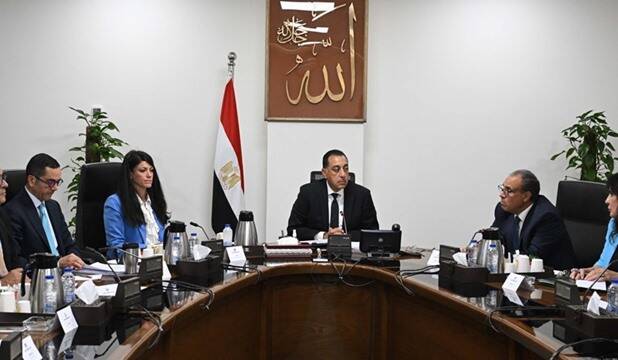

RIYADH: Egypt’s prime minister has instructed his government to prepare a package of investment opportunities for US firms, aiming to strengthen bilateral relations.
In a meeting with his Cabinet ministers, Mostafa Madbouly stated that several opportunities are available, particularly given the significant advantages offered by the country’s government to foreign investors, according to Egypt’s State Information Service.
Egypt is intensifying efforts to attract foreign direct investment as part of its broader economic reform agenda and Vision 2030 strategy for sustainable development.
Amid global headwinds and domestic economic challenges, the Egyptian government has launched several initiatives to deepen economic partnerships with major international players, notably the US.
One key milestone in this effort was the US–Egypt Policy Leaders Forum 2025, held in May, at which Madbouly announced that over 1,800 US companies are currently operating in the country, generating $47 billion in investments over the past two decades.
Discussing the latest Cabinet meeting, the Egyptian State Information Service reported that Madbouly “highlighted the government’s interest in supporting Egyptian-US relations in light of the strategic and historical ties between the two sides, noting the many opportunities for cooperation that could be exploited to support joint collaboration.”
The Egyptian prime minister added that his government is keen to remove all obstacles to joint cooperation, as well as to propose specific projects that will be discussed for collaboration in the upcoming period.
During the gathering, Egypt’s Minister of Industry and Transport, Kamel Al-Wazir, reviewed investment opportunities presented to US companies in sectors such as ports, maritime transport, and industrial zones.
Minister of Planning, Economic Development, and International Cooperation Rania El-Mashat outlined Egypt’s development cooperation efforts with the US, highlighting successful collaborative programs that contribute to the country’s development and further strengthen relations between the two sides.
At the conclusion of the meeting, Madbouly instructed all relevant authorities to coordinate on preparing a set of promising investment opportunities and to ensure they are presented to US companies, to boost foreign direct investment in Egypt.
Egypt, Germany in talks for €100m debt swap deal

International Cooperation Minister Rania Al-Mashat spoke at a joint press conference in Cairo with Foreign Minister Badr Abdelatty and Germany’s Minister for Economic Cooperation and Development Reem Alabali-Radovan. State Information Service
In another major development, Al-Mashat announced that the country is in talks with Germany over a new debt swap agreement worth €100 million ($116.48 million), to be disbursed in two tranches.
The first tranche is expected in December 2025 and the second in June 2026, according to the north African country’s State Information Service.
“These negotiations reflect the strength of Egyptian-German development cooperation and shared priorities in supporting sustainable development projects,” said Al-Mashat.
According to Egypt’s Ministry of International Cooperation, the total value of debt swaps between Egypt and Germany would reach €340 million with this new agreement.


